Showing posts with label Victor Mature. Show all posts

Sunday, May 31, 2026

Marilyn Monroe at the 1956 Royal Film Performance

The Daily Telegraph 10/30/56

In 1956, two of the most famous women in the world met. Both women were the same age - 30, but their lives could not have been more different. The occasion? The Royal Film Performance. The women? Her Majesty Queen Elizabeth the Second and Marilyn Monroe. The result? An iconic moment in time.

How did this meeting come about?

Marilyn's arrival in London

In July 1956 Marilyn and her new husband, Arthur Miller, arrived in London, where Marilyn was set to start work on her latest film, The Sleeping Prince (later renamed The Prince and the Showgirl) with Laurence Olivier. She made it known that she hoped to meet the Queen while there and was thrilled when she was issued an invitation to the Royal Film Performance, which was held every year in aid of the Cinematograph Trade Benevolent Fund. It would take place at the Empire Theatre on Monday, October 29th. 

Here is footage of Marilyn arriving, as well as footage of the Queen going down 
the line meeting the stars (with audio from a 1960 interview in the background).

A crowd of around 2000 waited outside the theatre to catch a glimpse of the stars. Marilyn was one of the last to arrive at "The Queen's Show," as she had nicknamed the event. She stood outside and waved to the crowd for two minutes, while they chanted her name, before making her way inside.


Her dress, designed by Madame de Rachelle with Marilyn's input, caused quite a stir once she removed her cape. It was described by the Daily Telegraph as "gold tissue with topaz shoulder straps" and by the Daily Record as a strait-jacket, due to its tightness. 


The safety-pin incident actually happened at a press conference.

The Queen, however, didn't bat an eye at Marilyn's revealing dress. Rather, she remarked on the fact that they were "neighbors." With Princess Margaret, who was also in attendance, they talked about biking (Marilyn was gifted a bicycle on her arrival by the Daily Sketch). 


When asked about what she thought of the Queen afterwards, Marilyn replied that she was "very warm-hearted. She radiates sweetness." She also demonstrated her curtsy to the press. 

Marilyn apparently made a big impression on the Queen too, as she was later reported to have watched all of Marilyn's films. The source also quoted the Queen as saying, "I thought Miss Monroe was a very sweet person. But I felt sorry for her, because she was so nervous that she had licked all her lipstick off" (People, 1961). 

Whether this is true or not, I believe the Queen probably saw at least some of Marilyn's films. 

I'll leave you with this article from the Evening Standard with its' extensive write-up about Marilyn.

Mr. Miller Was Marilyn's LIFEBELT


This post is part of the Marilyn Monroe - 100th Birthday Anniversary Blogathon hosted by Hoofers and Honeys. Be sure to visit her site and read the rest of the entries celebrating the centennial of this iconic woman!


Sources
Morgan, Michelle. When Marilyn Met the Queen: Marilyn Monroe's Life in England. Pegasus Books, 2022. 
British and Australia Newspaper Archives

Monday, May 16, 2022

National Classic Movie Day: Four Favorite Noirs Blogathon

UPDATE: This was my 500th blog post!

The National Classic Movie Day Blogathon hosted by the Classic Film & TV Cafe every year is one of the highlights of every blogger's calendar. This year the topic is Four Favorite Film Noirs

Not long after the very first National Classic Movie Day Blogathon, I wrote a post on my top 5 Film Noirs. A month later I lengthened it to ten (#6 and 8 would no longer have any chance of being on that list). However, at the time, I had hardly seen any, as it wasn't particularly my favorite genre - some of them were a little too violent or dark for my taste. As I got older though I discovered that they were actually really good. Like, REALLY GOOD. Becoming a Robert Ryan fan also helped ;) Anyway, without further ado, here are four of my favorite Noirs.

(1948)

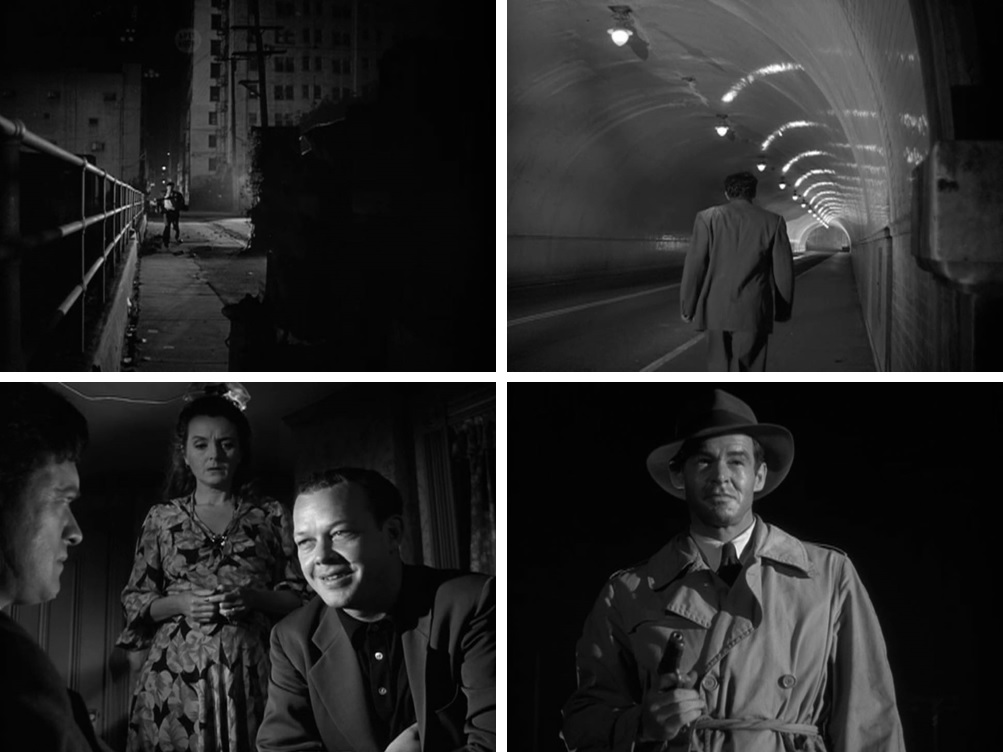
I loved Act of Violence (1948) so much I rewatched it again a month later and took over 300 screenshots (you can see them here on my blog Facebook page - don't go all the way to the end if you haven't seen the movie). On the surface, war hero Frank Enley (Van Heflin) has a great life. He has a beautiful young wife (Janet Leigh) an adorable baby, and is well respected by his community. But when a mysterious man with a limp begins to stalk him, Enley's life quickly unravels and his dark secret is exposed. He confesses to his wife that during his time in a POW camp he became an informer in exchange for food. The man who is following him (Robert Ryan), was his friend Joe, who suffered torture because of Heflin's actions. Joe is out for revenge, intent on killing Enley and punishing him for his actions. Enley tries to run from Joe and even hires a hit man, with the help of a woman he meets in a bar (Mary Astor). Of course, being a Noir, the viewer already knows that Enley is doomed to his fate.

The deft cinematography of David Surtees is a visual depiction of Enley's worsening nightmare. It "shimmers with sunlight" at the beginning of the film and gradual descends into something "straight out of a Freudian nightmare"(Film Noir FAQ, David J. Hogan, p. 343). This is also aided by on-location shooting. The director, Fred Zinnemann, had "learned the value of authentic locations, and this new picture gave him and Surtees a chance to photograph the real LA, where Enley flees and descends into the criminal underworld." This "sense of realism extended to the actors as well. 'No makeup of any kind was used on any member of the cast,' wrote Surtees. 'We tried to maintain on the screen a high standard of skin texture.' This technique heightened the hard set of Ryan's face, with its lined brow and sneering mouth" (The Lives of Robert Ryan, J.R. Jones, p.84-85).

(1956)

Nightfall (1956) is what I call a "snowy noir." There's something about black and white cinematography and snow that I just love. Also, this film stars Aldo Ray (anybody else think he has a sexy voice? lol). Vanning (Ray) is a commercial artist who has been wrongly accused of murdering his friend while on a hunting trip in Wyoming. Not only that, but he's also accused of robbing a bank. Following from town to town is an insurance investigator for the bank and the two real bad guys, the pistol whipping, trigger happy Red and John (Brian Keith), the brains of the outfit. Vanning meets a model, Marie Gardner (Anne Bancroft), at the bar one night and let's his guard down a little. As they exit he is intercepted by John and Red, who intimate that Marie was helping them. He manages to  escape and heads to Marie's apartment to confront her but she assures him of her innocence. He tells her his story and then the two of them take the bus to Wyoming to try and find the money that can clear his name. The movie climaxes with an epic shootout/fight involving a snowplow. You can watch it on YouTube. It was directed by Jacques Tourneur(who directed another favorite of mine, Cat People) with cinematography by Burnett Guffey. 

Love this shot of Brian Keith.

(1944)

In Phantom Lady (1944), a man is accused of murdering his wife. The only person who could provide him with an alibi is a "phantom lady" with an unusual hat. His secretary, Kansas (Ella Raines), sets out to clear his name. I was blown away when I first saw this movie and Raines became an instant favorite. Rather than me try and describe it, please just do yourself a favor and watch it. 

My favorite shot from the film.

Elwood Bredell was selected as cinematographer. He was advised by director Robert Siodmak to "study Rembrandt's paintings as an example of how dark shadows could attract the eye of the viewer toward a certain portion of the composition." There is a "contrast between the bright, well-organized business world inhabited by Carol and her boss and the city's distorted, menacing underworld, as Carol slides even further down the rabbit hole," and a "nightmarish atmosphere through highly stylized moments, rich textures, and claustrophobic settings... Siodmak favored low-key lighting, which would lend itself to sharply contrasting shadows and large areas of black" (Phantom Lady: Hollywood Producer Joan Harrison, The Forgotten Woman Behind Hitchcock, Christina Lane, p. 147-148). 

(1946)

Nobody Lives Forever (1946) stars one of my favorite actors, the ever-troubled John Garfield. It is unusual in that much of the film takes place in the sunlight instead of the typical Noir darkness and on the beach instead of the city streets. Even then, the dark scenes are shrouded in mist instead of bathed in garish neon lights.

I'm going to cheat a little here and link up a post I wrote on the film several years ago. There are lots of great screenshots on the post.

Monday, March 21, 2016

Netflix Monthly Movie: The Robe (1953)

 
The First Picture on the New Miracle Curved Screen !
 
The Greatest Story of Love, Faith, and Overwhelming Spectacle!


This months Netflix movie is The Robe (1953) starring Richard Burton, Victor Mature, and Jean Simmons. It tell the story of a Roman soldier Marcellus (Burton), whose job it was to crucify Jesus. He wins the robe worn by Christ by casting lots. But when he wears it, it puts a curse on him, or so he thinks. After the crucifixion, he is sent back to Rome, but he is haunted by what he has done. He goes back to Judea to find the Robe and destroy it, so as to destroy its hold on him. During his journey, he meets believers and followers of the dead Christ, Christians. One of these is his former Greek slave, Demetrious (Mature), who is now  follower of Peter. It is he who carries the robe of Christ.

You're afraid, but you really don't know the reason why. You think it's his robe that made you ill. But it's your own conscience, your own decent shame. Even when you crucified him you felt it.

Marcellus too becomes a Christian. Upon returning to Rome, Marcellus must now face Emperor Caligula.

Directed by Henry Koster (It Started with Eve, The Bishop's Wife, Harvey, The Singing Nun), this was the first movie filmed in Cinemascope and it is truly a spectacle. Complemented by glorious Technicolor and lavish sets of the powerful Roman Empire, it is a film well worth seeing. It is a long film - it runs 135 minutes - but it does not feel long. The sweeping and intense musical score by Alfred Newman complements the picture perfectly. This is a great film for the whole family to watch during this Holy Week.


Simon Peter (Michael Rennie) & Marcellus (Burton)

Trivia:

So sure was the studio of the films success, a sequel titled Demetrius and the Gladiators (1954) was immediately put into action. Victor Mature reprised his role as the Greek slave and follower of Simon Peter. The film takes place right at the end of The Robe, in the year 53 AD. A third film was made about Simon Peter, The Big Fisherman (1959), with Howard Keel in the title role.

Burton & Mature

It is the first motion picture in Cinemascope to be nominated for the Best Picture Academy Award.

Diagram of the curved screen.

The second movie to begin shooting in Cinemascope, but the first to be released (Sept. 16, 1953). The first film to go before Cinemascope lens-equipped cameras was How to Marry a Millionaire (1953) and was released Nov. 4, 1953.

Opening at Grauman's Chinese Theatre, September 24, 1953.

Acclaimed by many film historians as a triumph in the art of motion-picture music, Alfred Newman's reverent, intense film score failed to garner an Academy Award nomination for Best Score for a Dramatic Motion Picture (though Newman still took home an Oscar that night - for his adaptation of music for the Irving Berlin-Ethel Merman frolic, Call Me Madam (1953). Angered by the Academy voters' snub of Newman, distinguished film composer Franz Waxman, an Oscar winner for Sunset Blvd. (1950) and A Place in the Sun (1951), resigned from the Academy of Motion Picture Arts and Sciences.

The film won Oscars for Best Art Direction - Set Decoration in the color category and Best Costumes, also in the color category. In addition to Best Picture, it was also nominated for Best Actor (Burton) and Best Color Cinematography. It also won a Golden Globe for Best Picture - Drama.

At one point the producers considered making Marcellus older and casting Laurence Olivier.

Darryl F. Zanuck originally offered the role of Marcellus to Tyrone Power in a bid to get him to renew his contract with Fox. Power instead opted to star in the play "John Brown's Body" on Broadway.

Burt Lancaster was originally cast in the role played by Victor Mature.

Janet Leigh was considered for the role of Diana (Simmons).


Director Henry Koster chose Donald C. Klune - his 2nd assistant director - to play the role of Jesus in the film (his face is never seen). Klune would thus sign all the extras' vouchers and finish the paperwork while still in costume. He also had to eat lunch in his dressing room, as the studio thought it would be inappropriate for "Jesus" to eat in the commissary at Fox.

The opening shot after the title credits (and the background "red robe" curtain parts) is actually a scene lifted from this film's sequel, Demetrius and the Gladiators (1954).

The set of Cana, the village of Galilea where Marcellus Gallio meets Peter, was a redress of sets originally built for Algiers (1936), that had stood on the studio backlot for seventeen years. The sets were later used in Demetrius and the Gladiators (1954) - this film's sequel - as the Christian neighborhood in Rome where Demetrius lives in the beginning of the movie. The well with the old broken columns can be easily recognized.

Based on the book of the same title by Lloyd C. Douglas