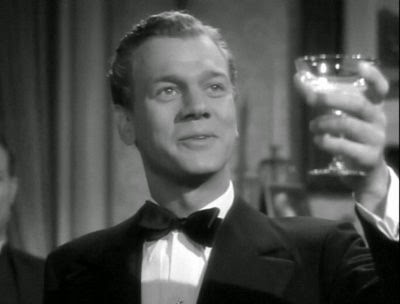
Today is the 110th birthday of Joseph Cotten.
The following is from
IMDb (I didn't know it was his birthday till late, otherwise I would have written up my own bio):
Joseph Cheshire Cotten, Jr. was born in Petersburg, Virginia, into a well-to-do Southern family. He was the eldest of three sons born to Sally Whitworth (Willson) and Joseph Cheshire Cotten, Sr., an assistant postmaster.
1908, with his father and grandfather
Jo (as he was known) and his brothers Whit and Sam spent their summers at their aunt and uncle's home at Virginia Beach. And there and at an early age he discovered a passion for story-telling, reciting, and performing acts for his family. Cotten studied acting at the Hickman School of Expression in Washington, D.C. and worked as an advertising agent afterward. But by 1924 tried to enter acting in New York. His money opportunities were limited to shipping clerk, and after a year of attempting stage work, he left with friends, heading for Miami. There he found a variety of jobs: lifeguard, salesman, a stint as entrepreneur -- making and selling 'Tip Top Potato Salad' - but more significantly, drama critic for the Miami Herald. That evidently led to appearance in plays at the Miami Civic Theater. Through a connection at the Miami Herald he managed to land an assistant stage manager job in New York. In 1929 he was engaged for a season at the Copley Theatre in Boston, and there he was able to expand his acting experience, appearing in 30 plays in a wide variety of parts. By 1930 he made his Broadway debut. In 1931 Cotten married Lenore La Mont (usually known as Kipp), a pianist, divorced with a two-year-old daughter.

1928
To augment his income as an actor in the mid-30s, Cotten took on radio shows in addition to his theatre work. At one audition he met an ambitious, budding actor/writer/director/producer with a mission to make his name-Orson Welles. Cotten was 10 years his senior, but the two found a kindred spirit in one another. For Cotten, Welles association would completely redirect his serious acting life. Their early co-acting attempts boded ill for employment in formal acting vehicles. At a rehearsal for CBS radio the two destroyed a scene taking place on a rubber tree plantation. One or the other was supposed to say the line: "Barrels and barrels of pith...." They could not overcome uncontrolled laughter at each attempt. The director berated them as acting like 'school-children' and 'unprofessional', and thereafter both were considered unreliable. Welles's ambition put that quickly behind them when he formed The Mercury Theatre Players. In 1937, Cotten starred in Welles's Mercury productions of "Julius Caesar" and "Shoemaker's Holiday". And he made his film debut in the Welles-directed short
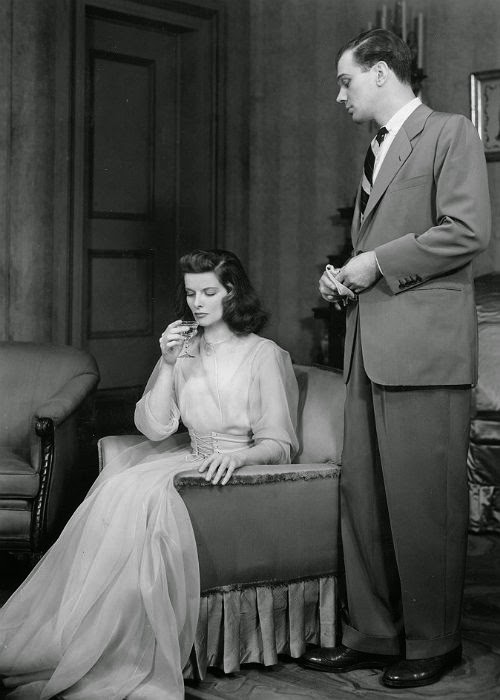
Too Much Johnson (1938), a comedy based on William Gillette's 1890 play. The short was occasionally screened before or after Mercury productions, but never received an official release. Cotten returned to Broadway in 1939, starring as C.K. Dexter Haven in the original production of Philip Barry's "The Philadelphia Story".
With Katharine Hepburn in the theatrical version of The Philadelphia Story
The uproar over Welles's "War of the Worlds" radio broadcast, was rewarded with an impressive contract from RKO Pictures. The two-picture deal promised full creative control for the young director, and Welles brought his Mercury players on-board in feature roles in what he chose to bring to the screen. But after a year, nothing had germinated until Welles met with writer Herman J. Mankiewicz, resulting in the
Citizen Kane (1941) idea - early 1940. The story of a slightly veiled William Randolph Hearst with Welles as Kane and Cotten, in his Hollywood debut, as his college friend turned confidant and theater critic, Jed Leland, would become film history, but at the time it caused little more than a ripple. Hearst owned the majority of the country's press outlets and so forbade advertisements for the film. The film was nominated for nine Academy Awards in 1942 but was largely ignored by the Academy, only winning for Best Screenplay for Welles and Mankiewicz.
With Orson Welles in Citizen Kane
Thereafter he appeared with some of the most leading of Hollywood leading ladies - a favorite being Jennifer Jones, Selznick's wife with the two of them being his most intimate friends. Cotten got the opportunity to play a good range of roles through the 1940s - the darkest being the blue beard-like killer in Alfred Hitchcock thriller Shadow of a Doubt (1943) with Teresa Wright. He starred later in the critically acclaimed
Portrait of Jennie (1948), from the haunting Robert Nathan book. Cotten is thoroughly convincing as a second-rate, unmotivated artist who finds inspiration from a chance acquaintance budding into love with an incarnation of a girl who died years before.
Shadow of a Doubt
With the passing of his first wife in 1960 Cotten met and married British actress Patricia Medina. The 1960s found him equally busy in TV and film.
With wife, Patricia
Cotten was not ready to turn his back on Hollywood until the beginning of the 1980s. After a
Love Boat episode (1981), Cotten joined his wife and his love of gardening and entertaining friends in retirement. He also had the time to write an engaging autobiography
Vanity Will Get You Somewhere (1987). Cotten's somewhat matter-of-fact and seemingly gruff acting voice served him well. Certainly his command of varied roles deserved more than the snub of never being nominated for an Academy Award. He was not the only actor to suffer being underrated, but that is largely forgotten in those memorable roles that speak for him. And for what it is worth, the Europeans had the very good sense to award him the Venice Film Festival Award for Best Actor for
Portrait of Jennie, one of his favorite roles.
He died of pneumonia February 6, 1994 in Los Angeles, CA.
Movies to Watch
Shadow of a Doubt (1943) dir. by Alfred Hitchcock. Also starring Teresa Wright.
Gaslight (1944) starring Ingrid Bergman and Charles Boyer.
On the set of Gaslight with Bergman. Wonder what they're eating?
Since You Went Away (1944) starring Claudette Colbert, Jennifer Jones, Shirley Temple, and several other well known actors. I know I watched this but it was quite some time ago and I don't remember much.
Jennifer Jones, Joseph Cotten, Robert Walker, and Claudette Colbert
I'll Be Seeing You (1944) starring Ginger Rogers and Shirley Temple. You can watch it
here.
Portrait of Jennie (1948) starring Jennifer Jones, which I wrote about
here.
Quotes
I didn't care about the movies really. I was tall. I could talk. It was easy to do.
My wife told me one of the sweetest things one could hear: "I am not jealous. But I am truly sad for all the actresses who embrace you and kiss you while acting, for with them, you are only pretending."
All images found via Pinterest