1939 has always been remembered as a big year for movies. Everyone has at least heard of the classics
Gone With the Wind and
The Wizard of Oz and if you are a classic movie fan you've probably also heard of
Stagecoach and
Mr. Smith Goes to Washington. Yes, 1939 certainly was a great year. The only problem was there wasn't enough awards to go around. All of them could not win Best Picture.
Gone With the Wind swept the awards like the fire swept Atlanta, setting a new record with 8 awards plus the Irving Thalberg award for producer David O. Selznick. It won Best Picture, Best Actress (Vivien Leigh), Best Supporting Actress (Hattie McDaniel), Best Director (Victor Fleming), Film Editing, Art Direction, Screenplay (the writer, Sidney Howard, had died during production and therefore became the first posthumous winner), and Color Cinematography (new classification). It was also nominated for Best Actor (Clark Gable), Best Supporting Actress (Olivia de Havilland), Sound Recording, and Special Effects.
The Wizard of Oz won Best Song (
Over the Rainbow), Best Original Score, and a Juvenile Award for Judy Garland. It had a total of 5 nominations (including Best Picture, Art Direction, and Special Effects).
You can never listen to this song too many times
Stagecoach, best known as being John Wayne's breakout role, was nominated for Best Picture, Best Director (John Ford), Film Editing, Art Direction, and B&W Cinematography. It won for Best Supporting Actor (Thomas Mitchell) and Music-Scoring. Unfortunately Wayne was not nominated for his role as the Ringo Kid.
Mr. Smith Goes to Washington was nominated in nine categories for Best Picture, Best Actor (James Stewart), Best Supporting Actor (Harry Carey), Best Director (Frank Capra), Film Editing, Art Direction, Music-Scoring, Sound Recording, and Writing-Best Screenplay. It only won one of it's nominations: Writing-Best Original Story.
Other Best Picture nominees were
Dark Victory starring Bette Davis,
Goodbye Mr. Chips starring Robert Donat and Greer Garson (6 nominations, 1 award),
Love Affair starring Irene Dunne (and Charles Boyer),
Ninotchka starring Greta Garbo,
Of Mice and Men (Lon Chaney Jr. and Burgess Meredith), and
Wuthering Heights (starring Laurence Olivier and Merle Oberon - 7 nominations, 1 award) - names not in parenthesis also nominated for Best Actor or Actress.
><><><><><><><><><><><><><><><><><><
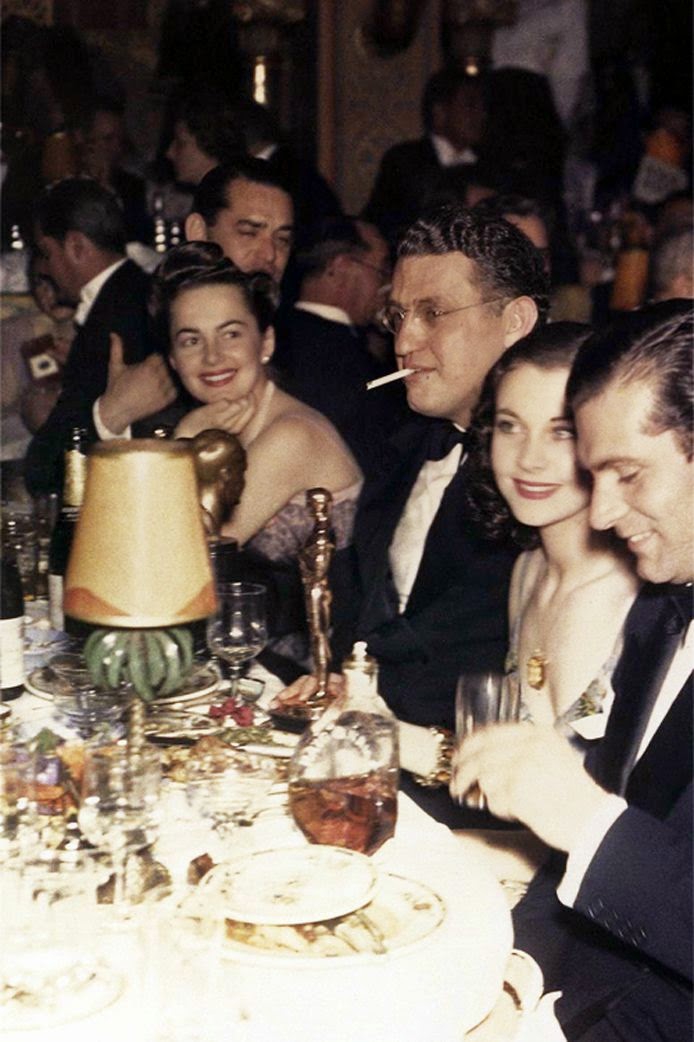
The ceremony was held on Feb. 29, 1940 at the now famous Cocoanut Grove of the Los Angeles Ambassador Hotel. Bob Hope was the Master of Ceremonies, his first of 19 times. The winners names were accidently printed in the 8:45pm edition of the Los Angeles Times, meaning there were no surprises. After this incident, the envelope reveal as we know it was instituted.
Here we see the stars arriving:
Best Picture:
Gone With the Wind
Olivia de Havilland, David O. Selanick, Vivian Leigh, and Laurence Olivier
Best Actor: Robert Donat in
Goodbye Mr. Chips (Mickey Rooney was nominated for his first 'real' Oscar for his performance in
Babes in Arms)
Spencer Tracy accepted for the absent Donat
Donat
Best Actress: Vivien Leigh in
Gone With the Wind
Best Supporting Actor: Thomas Mitchell in
Stagecoach (he was also in
Gone With the Wind and
Mr. Smith Goes to Washington as well as several other films that year - a very busy guy)
Best Supporting Actress: Hattie McDaniel in
Gone With the Wind - here is a great article about McDaniel's career and win.
Being presented with her award by Fay Bainter
Best Director: Victor Fleming for
Gone With the Wind
Special Awards:
To Douglas Fairbanks, "recognizing the unique and outstanding contribution of Douglas Fairbanks, first president of the Academy, to the international development of the motion picture." Fairbanks had died two months before. His son, Douglas Fairbanks Jr., accepted the award on his behalf.
To Judy Garland for her "outstanding performance as a screen juvenile during the past year."
To Technicolor Company for its "contributions in successfully bringing three-color feature production to the screen." (There is a dvd special feature on the three-strip Technicolor process on
The Adventures of Robin Hood - 1938.)
Other notable films of 1939:
The Women,
Gunga Din,
The Private Lives of Elizabeth and Essex,
The Hunchback of Notre Dame,
Bachelor Mother,
Golden Boy (William Holden's breakout role),
Intermezzo (Ingrid Bergman's American film debut),
Beau Geste.
Take a look at this very complete
timeline of movie history in 1939 for more movies from this year.
Watch this fantastic 17 minute presentation,
Cavalcade of the Academy Awards.
It shows the stars arriving and accepting their awards. I love how Bob Hope is sitting in the background in between presentations.


movie_.jpg)