Lucille Ball and Desi Arnaz were the ultimate Dynamic Duo. Married in real life, they perfectly complemented each other. Not only were they paired in the classic and groundbreaking TV show I Love Lucy, they also shared the screen in two movies (they met on the set of Too Many Girls in 1940 but don't share the screen much). And in both of those films, The Long, Long Trailer (1953) and Forever, Darling (1956), their characters were married.
Searching for wedding pictures of Lucy and Desi on the internet is not an easy task as every on-screen wedding can be, and usually is, labeled as their REAL wedding. The couple actually eloped on November 30th, 1940, just six months after they met. In 1949 they renewed their vows, which we have photos of.
For the Catholic Church service, Lucy wore a blue satin dress with a full skirt and portrait neckline, which she paired with a chic white flowered hat, ruffled gloves, and strappy peep-toed heels. Desi looked sharp in a white suit.
In season 1 of I Love Lucy, Lucy and Desi had their first on-screen wedding. In "The Marriage License," which aired on April 7, 1952, Lucy finds a misspelling on her marriage license and believes her marriage to Ricky (Arnaz) isn't legal. Lucy makes Ricky recreate his proposal and the two get married at their hotel (which incidentally was the Byram River Beagle Club in Greenwich, Connecticut where Lucy and Desi had been married in 1940). You can watch the full episode here.
Lucy wore a full skirted dress with spaghetti straps, a lovely tulle veil attatched to a floral headpiece, multi-strand pearl choker, and satin peep-toe heels with an ankle strap.
For The Long, Long Trailer (1953) Lucy wore an exquisite lace gown designed by Helen Rose. It had a strapless bodice with a lace overlay featuring a high stand-up collar and long sleeves. A lace apron-like skirt fell over a full skirt. A flowered headpiece worn on the back of the head held the long tulle veil.
In Forever, Darling (1956) Lucy wore a similar dress with a more elaborate veil, this one designed by Eloise Jenssen. The headpiece has lace and flowers that frame the face closely and the dress has a dramatic pleated skirt.
The sketch by Jenssen shows a different veil. To see more photos check out my more in-depth post.
Lastly, here are some wedding anniversary photos that could be mistaken for wedding photos.
I didn't watch a ton of movies this month (I've been watching Cheers) but the ones I did watch were pretty much all winners.
* means a rewatch
The Telegraph Trail (1933) - John Wayne & Marceline Day, Frank McHugh
Back in Circulation (1937) - Pat O'Brien & Joan Blondell
*The Adventures of Robin Hood (1938) - Errol Flynn & Olivia de Havilland, Alan Hale, Claude Rains, Basil Rathbone
The Girl of the Golden West (1938) - Jeanette MacDonald & Nelson Eddy, Walter Pidgeon, Buddy Ebson
There Goes My Heart (1938) - Fredric March & Virginia Bruce, Patsy Kelly
Wonder Man (1945) - Danny Kaye & Vera-Ellen, Virginia Mayo, S.Z. Sakall
Till the End of Time (1946) - Dorothy McGuire, Robert Mitchum, Guy Madison
Rachel and the Stranger (1948) - Loretta Young, William Holden, Robert Mitchum
Take Me Out to the Ball Game (1949) - Gene Kelly, Frank Sinatra, Esther Williams
Force of Arms (1951) - William Holden & Nancy Olsen
The Smallest Show on Earth (1957) - Peter Sellers, Margaret Rutherford
The Girl Most Likely (1958) - Jane Powell, Cliff Robertson
*Period of Adjustment (1962) - Jane Fonda & Jim Hutton, Anthony Franciosa (rewatched it with my brothers)
Hour of the Gun (1967) - James Garner, Jason Robards, Robert Ryan
*Ghost (1990) - Patrick Swayze & Demi Moore, Whoopi Goldberg, Tony Goldwyn
*The Count of Monte Cristo (2002) - Jim Caviezel, Guy Pierce, Dagmara Dominczyk, Ricahrd Harris, Luis Guzman, Henry Cavill ♥
Least Favorite Movie: None.
Favorite Movie: Hands down The Smallest Show on Earth. If you've never seen it drop everything and get your hands on a copy!! I also really enjoyed the three new-to-me Holden movies I watched as well as There Goes My Heart and Back in Circulation. So basically I loved almost all the movies I watched this month ;)
It's that time of year again when TCM announces it's next free online class. We've had Film Noir, we've had Slapstick, we've had Hitchcock, and now we're getting Musicals! (still waiting for one on Screwball...)
Offered in collaboration with Ball State University and offered on the online platform Canvas, these classes give everyone a chance to major in MOVIE! And the great thing is it's free! And, you only have to spend as much time on it as you have available. The readings and lectures are easy to keep up with and the quizzes are just right - not to hard, not to easy. You can get as involved as you want: message boards, movies, and games all make for a fun learning experience. I know, I've taken them all :)
This years class is going to be a little different in that it is being taught by Vanessa Theme Ament instead of our beloved Richard Edwards. I'm sure she will do a fantastic job though :)
The class runs from June 3rd through July 1st and covers musicals from the 30s to the 70s. You do not need TCM for the course. Many musicals are readily available on dvd and at your local library!
WEEK 1: Introduction / Musicals of the 1920s & 1930s
The beginnings of sound technology and the first film musicals in the 1920s and 1930s: The Great Ziegfeld, Top Hat, Broadway Melody, and other films
Important musicals that set the standard for the decade: The Great Depression
The transition from Broadway to Hollywood
New stars in musicals, directors, editors, and other creatives that influenced the decade: Ernst Lubitsch, Fred Astaire and Ginger Rogers, and others
Key song numbers that typify the movie musical in the 1930s
WEEK 2: Musicals of the 1940s
The changing terrain of the 1940s movie musical surrounding WWII: Yankee Doodle Dandy, On the Town, Meet Me in St. Louis, and other films
Performers who developed during the 1940s, choreographers who direct and musicians who produce: Busby Berkeley, Ester Williams, Red Skelton, Judy Garland and others
Studios, stars, and stories for wartime America: the transition to nationalism
Pre-recording, post-sound, and location scenes
The emerging films of diversity: Cabin in the Sky, Showboat, and other films
WEEK 3: Musicals of the 1950s
The high times of the 1950s and the Blacklist: The Bandwagon, An American in Paris, High Society, and other films
The development of camera, sound, and exhibition
Glamour and the expanded role of design
The broadening of the composer, producer, and editor
Key figures who expand their scope: Gene Kelly, Vincente Minnelli, Elvis Presley, and others
WEEK 4: Conclusion / Musicals of the 1960s and 1970s
The disruption of the studios: independent film influences
Turbulence in the country and cultural challenges: Tommy, Cabaret and other films
Changing musical tastes, youth, and historical films: Funny Girl, 1776, My Fair Lady, and other films
The British Invasion: The Beatles and A Hard Day’s Night
Directors, stars, and producers who transitioned into the 1960s
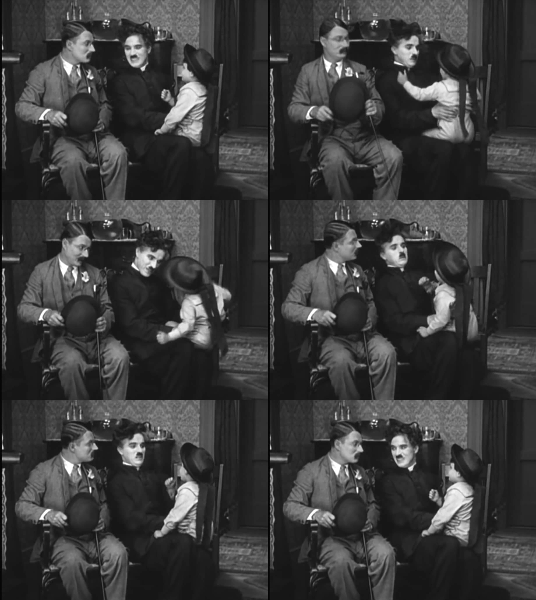
The Pilgrim (1923) - written, directed, and produced by Charlie Chaplin - was Chaplin's last "short" before going into feature length films. In it, Chaplin plays an escaped convict who disguises himself as a minister and is mistaken for the new parson in a small Texas town. He is brought to the church where, in my favorite scene, he acts out the story of David and Goliath. You can watch it below:
After that he is brought to the house where he will stay. On his way there he is recognized by his cell mate who follows him and invites himself to tea. While there, the landlady tries to pay her next mortgage bill to the deacon, who refuses to accept the payment on the Sabbath. Chaplin's friend proceeds to steal the money and Chaplin chases after him, recovering the money and returning it to the landlady's pretty daughter. He is then recognized as a convict and arrested. On his way back to jail the sheriff lets Chaplin escape into Mexico, where he has no jurisdiction.
An interesting note from an article on TCM: "Also notable in the cast is Chaplin's brother Sydney who appears in three roles as the eloping man, the train conductor and the father of the "slapping boy." The "slapping boy" is played by three-and-a-half-year old Dean Reisner and son of ThePilgrim's assistant director Charles Reisner (who also plays the pickpocket). Dean would grow up to become a leading screenwriter in Hollywood, penning the "do you feel lucky, punk" scene for Dirty Harry (1971)."
This little film was great fun to watch. Being so short it's hard to write about, so I hope this short post will encourage you to watch the film for yourself, which is linked for you below:
"Criminal pathologists try to crack a case with nothing but the victim's bones to go on."
This was the brief synopsis on TCM for the 1950 film Mystery Street. It sounded interesting so I added it to my list. I was also intrigued because the lead was played by Mexican actor Ricardo Montalban, who I've watched recently in a couple Esther Williams films as well as the WWII film Battleground (1949) - in which he gave a wonderful performance.
As soon as I watched it, I knew I had to write about it. Showing the procedural side of police work, the film was groundbreaking in showing how policemen use the science of forensics to solve crimes, in this case a murder in which all that is left to go on is some bones buried in the sand on the beach.
The audience already know who the bones belong to and who committed the crime, so there is no mystery involved. The excitement comes from seeing the way in which the clues are gathered and how the murderer and his victim are identified by the police. There is of course some suspense/action near the end with the death of the victims' landlady who tried to use her knowledge for monetary gain.
Trailer
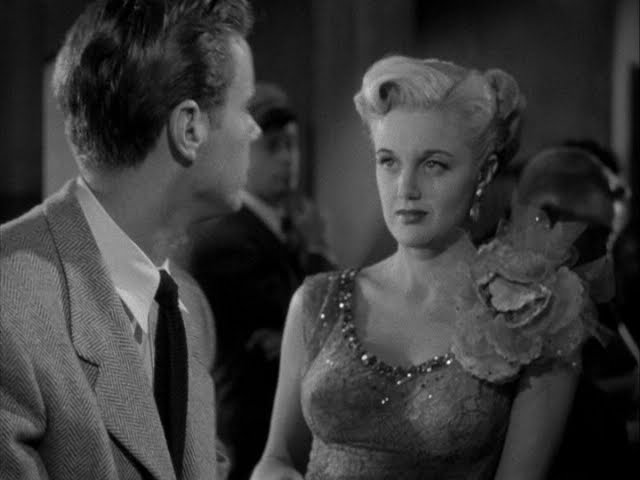
The film opens with the victim, Vivian Heldon (Jan Sterling) making a phone call to the married man she is having an affair with. She demands he meet her at the Grass Skirt cafe, her place of employment in Boston. While there she meets a young man, Henry Shanway (Marshall Thompson), who's wife has just lost their baby in childbirth. Vivian offers to take the inebriated Shanway home but instead takes over his car to meet her lover Hartley on Cape Cod. When he protested to ditches him on the side of the road a few miles from a diner. At the beach, Vivian demands Hartley give her money. Instead, he shoots her while she's still on the car, then buries her body among the sand dunes.
Three months later, her bones are discovered. They are all that remain of Vivian. The car belonging to Shanway, which was sunk by Hartley in a nearby pond, is also found. Police Lieutenant Peter Moralas (Montalban) is put on the case. They take the bones to Dr. McAdoo (Bruce Bennett), the forensics expert at the Department of Legal Medicine at Harvard University. McAdoo explains the process of gaining clues from bones. Once the skeleton is assembled, he is able to tell the sex, age, height, and build of the victim and when she died. The bones also reveal that she was pregnant. With that information, the police are then able to look through their missing persons file and narrow down the results. The most fascinating part (which you can watch here) is when they take photos of the possible candidates and match them with the skull (these scenes reminded me of the popular show Bones, which ended it's 12 season run last year).
Once they've ided the victim, Moralas sets out to figure out who murdered her. He visits her boarding house, run by Mrs. Smerrling (Elsa Lanchester) and is shown the victims belongings that were left behind and packed away by Mrs. Smerrling. When questioned by Moralas, she does not reveal all she knows. Calling a number that Vivian had scrawled on the wall next to the telephone, she tracks down the killer and pays him a visit in order to blackmail him. While he doesn't give her any money, she steals his gun - the murder weapon - from his desk and slips it in her purse.
Moralas meanwhile, also visits the Grass Skirt and learns that Vivien left with a young man. They track him down and are able to confirm that the car they found in the pond was his, which he had reported was stolen from in front of the hospital. Caught in his lie, he becomes their prime suspect and is arrested. However, the discovery of the bullet that killed Vivian lodged under the car raises doubts in Moralas' mind. He continues searching and is lead to Hartley by checking Vivien's phone bill. Hartley denies knowing Vivien and watches nervously as Moralas searches his office. When the gun is not discovered, Hartley pays a visit to Mrs. Smerrling, who again tries to blackmail him. She has hidden the gun at the baggage claim at the train station and put the claim ticked in a bird cage. Hartley, getting desperate, forces her to reveal the hiding place then, when there's a knock on the door, hits her on the head with a candlestick, killing her.
The visitor is Shanway's wife, trying to prove her husband's innocence. Moralas shows up a few minutes later - he was going to question Mrs. Smerring again - discovers the baggage claim ticket, and hurries to the train station. He arrives just moments after Hartley convinced the baggage claim attendant to give him the bag containing the gun despite not having a ticket. He and his partner chase Hartley down and arrest him for the murder of Vivian Heldon, clearing Shanway in the process.
The film, directed by John Sturges, was filmed in Boston and had a special thanks to Harvard in the credits. The screenplay was nominated for an Academy Award. Mystery Street is the Noir Alley pick for April 14/15 on TCM. Don't miss it!
This month I checked off a couple of must-see Classics, revisited some favorites, and watched a few more Robert Ryan movies ;)
Speaking of Ryan, I'd like to apologize to the people waiting for Part 2 of my Robert Ryan post. It will be coming shortly. I've decided to also do a Part 3 AFTER I've seen some of his post-1958 films, since as of now I've only seen him in The Longest Day and don't even remember his part in that.
* means a rewatch
The Pilgrim (1923) - Charlie Chaplin
This Modern Age (1931) - Joan Crawford
Daughter of the Dragon (1931) - Anna May Wong
Haunted Gold (1932) - John Wayne
Zou Zou (1934 - French) - Josephine Baker, Jean Gabin
The Count of Monte Cristo (1934) - Robert Donat
Naughty Marietta (1935) - Jeanette MacDonald & Nelson Eddy, Frank Morgan, Elsa Lanchester
I Live My Life (1935) - Joan Crawford & Brian Aherne, Frank Morgan
Shall We Dance (1937) - Fred Astaire & Ginger Rogers, Edward Everett Horton
Stablemates (1938) - Mickey Rooney, Wallace Beery, Margaret Hamilton
Goodbye, Mr. Chips (1939) - Robert Donat & Greer Garson
On Your Toes (1939) - Eddie Albert, Zorina, Alan Hale
Seven Sinners (1940) - Marlene Dietrich & John Wayne
The Fighting 69th (1940) - James Cagney, Pat O’Brien, George Brent, Alan Hale, Frank McHugh, Dennis Morgan
Unexpected Uncle (1941) - Charles Coburn, Anne Shirley & James Craig
Trail Street (1947) - Randolph Scott, Robert Ryan, Anne Jeffreys, George 'Gabby' Hayes, Madge Meredith
Return of the Bad Men (1948) - Randolph Scott, Robert Ryan, Anne Jeffreys, George 'Gabby' Hayes, Jacqueline White
Winter Meeting (1948) - Bette Davis
Caught (1949) - Robert Ryan, Barbara Bel Geddes, James Mason
The Set-Up (1949) - Robert Ryan & Audrey Totter
The Crooked Way (1949) - John Payne & Ellen Drew
Conspirator (1949) - Robert Taylor & Elizabeth Taylor
The Secret Garden (1949) - Margaret O’Brien, Herbert Marshall, Dean Stockwell
The Sword and the Rose (1953-Disney) - Richard Todd & Glynis Johns
From Here to Eternity (1953) - Montgomery Clift & Donna Reed, Burt Lancaster & Deborah Kerr, Frank Sinatra
The Girl Who Had Everything (1953) - Elizabeth Taylor & Fernando Lamas, William Powell, Gig Young
Bad Day at Black Rock (1955) - Spencer Tracy, Robert Ryan, Walter Brennan, Ernest Borgnine, Lee Marvin
*Tammy and the Bachelor (1957) - Debbie Reynolds & Leslie Nielsen, Walter Brennan, Mildred Natwick, Fay Wray
*Gidget (1959) - Sandra Dee & James Darren, Cliff Robertson
The Sundowners (1960) - Robert Mitchum & Deborah Kerr, Peter Ustinov, Glynis Johns
In the Line of Fire (1993) - Clint Eastwood, John Malkovich
*Apollo 13 (1995) - Tom Hanks, Bill Paxton, Kevin Bacon, Ed Harris, Gary Sinise, Kathleen Quinlan
Life (1999) - Eddie Murphy & Martin Lawrence (brother’s choice)
Least Favorite: Haunted Gold was sometimes laughingly bad, sometimes cringe-worthy (why are African American's always depicted as superstitious and terrified of ghosts? Sometimes it's funny - Willie Best comes to mind - but this was ridiculously overdone). It was only 59 minutes though. If The Girl Who Had Everything hadn't of had William Powell in it, I wouldn't have watched it. I've been waiting for TCM to show it again for four years though so I can finally check it off my list of Powell movies watched!
Favorite Movies: Goodbye, Mr. Chips gave me a serious lump in my throat for most of the second half. Such a sweet movie. I also really enjoyed I Live My Life and The Count of Monte Cristo (the 2002 version is one of my favorite movies)
Last month I watched Wuthering Heights (1939) for the first time (it was a tragic gothic romance kind of day) and was delighted to find that there was a wedding gown involved. Merle Oberon, who plays Cathy in the film, is getting married to Edgar Linton, played by David Niven. It's a doomed marriage as she really loves the penniless Heathcliff, played by the brooding Laurence Olivier. If it's one thing I've learned from the movies, it's to never marry for money if you love someone else. It usually ends in death.
Cathy's wedding dress has a full gathered skirt made of heavy satin. The short sleeve bodice has a soft v-neckline with a short attached shawl of lace, creating butterfly sleeves. A large bow adorns the front of the neckline.
A tulle veil is attached to a circlet of baby's breath. Short gloves and a small cross necklace complete the look.
In the promo shot on the right, Oberon is holding Calla lilies instead of the small bouquet shown in the film.