Showing posts with label Drama. Show all posts

Tuesday, April 3, 2018

Mystery Street (1950)


"Criminal pathologists try to crack a case with nothing but the victim's bones to go on."

This was the brief synopsis on TCM for the 1950 film Mystery Street. It sounded interesting so I added it to my list. I was also intrigued because the lead was played by Mexican actor Ricardo Montalban, who I've watched recently in a couple Esther Williams films as well as the WWII film Battleground (1949) - in which he gave a wonderful performance.


As soon as I watched it, I knew I had to write about it. Showing the procedural side of police work, the film was groundbreaking in showing how policemen use the science of forensics to solve crimes, in this case a murder in which all that is left to go on is some bones buried in the sand on the beach.

The audience already know who the bones belong to and who committed the crime, so there is no mystery involved. The excitement comes from seeing the way in which the clues are gathered and how the murderer and his victim are identified by the police. There is of course some suspense/action near the end with the death of the victims' landlady who tried to use her knowledge for monetary gain.

Trailer

The film opens with the victim, Vivian Heldon (Jan Sterling) making a phone call to the married man she is having an affair with. She demands he meet her at the Grass Skirt cafe, her place of employment in Boston. While there she meets a young man, Henry Shanway (Marshall Thompson), who's wife has just lost their baby in childbirth. Vivian offers to take the inebriated Shanway home but instead takes over his car to meet her lover Hartley on Cape Cod. When he protested to ditches him on the side of the road a few miles from a diner. At the beach, Vivian demands Hartley give her money. Instead, he shoots her while she's still on the car, then buries her body among the sand dunes.

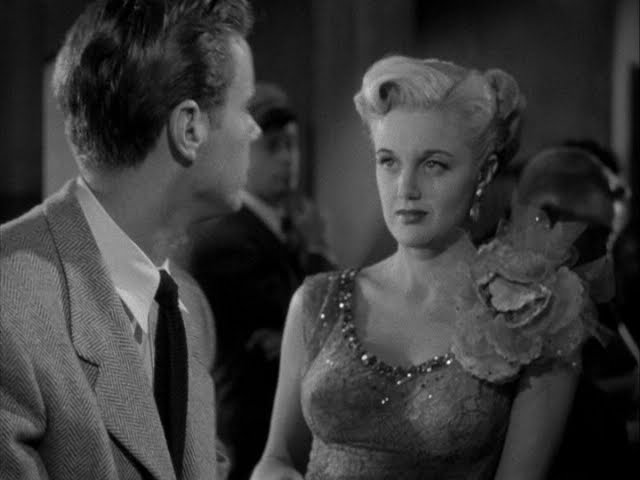
 
Three months later, her bones are discovered. They are all that remain of Vivian. The car belonging to Shanway, which was sunk by Hartley in a nearby pond, is also found. Police Lieutenant Peter Moralas (Montalban) is put on the case. They take the bones to Dr. McAdoo (Bruce Bennett), the forensics expert at the Department of Legal Medicine at Harvard University. McAdoo explains the process of gaining clues from bones. Once the skeleton is assembled, he is able to tell the sex, age, height, and build of the victim and when she died. The bones also reveal that she was pregnant. With that information, the police are then able to look through their missing persons file and narrow down the results. The most fascinating part (which you can watch here) is when they take photos of the possible candidates and match them with the skull (these scenes reminded me of the popular show Bones, which ended it's 12 season run last year).


Once they've ided the victim, Moralas sets out to figure out who murdered her. He visits her boarding house, run by Mrs. Smerrling (Elsa Lanchester) and is shown the victims belongings that were left behind and packed away by Mrs. Smerrling. When questioned by Moralas, she does not reveal all she knows. Calling a number that Vivian had scrawled on the wall next to the telephone, she tracks down the killer and pays him a visit in order to blackmail him. While he doesn't give her any money, she steals his gun - the murder weapon - from his desk and slips it in her purse.


Moralas meanwhile, also visits the Grass Skirt and learns that Vivien left with a young man. They track him down and are able to confirm that the car they found in the pond was his, which he had reported was stolen from in front of the hospital. Caught in his lie, he becomes their prime suspect and is arrested. However, the discovery of the bullet that killed Vivian lodged under the car raises doubts in Moralas' mind. He continues searching and is lead to Hartley by checking Vivien's phone bill. Hartley denies knowing Vivien and watches nervously as Moralas searches his office. When the gun is not discovered, Hartley pays a visit to Mrs. Smerrling, who again tries to blackmail him. She has hidden the gun at the baggage claim at the train station and put the claim ticked in a bird cage. Hartley, getting desperate, forces her to reveal the hiding place then, when there's a knock on the door, hits her on the head with a candlestick, killing her.


The visitor is Shanway's wife, trying to prove her husband's innocence. Moralas shows up a few minutes later - he was going to question Mrs. Smerring again - discovers the baggage claim ticket, and hurries to the train station. He arrives just moments after Hartley convinced the baggage claim attendant to give him the bag containing the gun despite not having a ticket. He and his partner chase Hartley down and arrest him for the murder of Vivian Heldon, clearing Shanway in the process.

The film, directed by John Sturges, was filmed in Boston and had a special thanks to Harvard in the credits. The screenplay was nominated for an Academy Award. Mystery Street is the Noir Alley pick for April 14/15 on TCM. Don't miss it!

This post is part of The Good Cop, Bad Cop Blogathon hosted by Coffee, Classics, & Craziness. Please follow good police procedure and read all of the evidence ;)

Sunday, August 6, 2017

Never Let Me Go (1953)


I was thirty-two then, not an ideal age to be taking up so strenuous an activity as ballet.

So wrote Gene Tierney in her autobiography Self-Portrait on her experience playing a Russian ballerina in the film Never Let Me Go (1953) starring Clark Gable.
 
The film tells the story  of an American news correspondent, Philip Sutherland (Gable), stationed in Moscow who falls in love with and marries Marya Lamarkina (Tierney), a ballerina. When they try to leave Russia they are separated as Gable is forced to board a plane and Tierney is held back. Gable must then figure out how to get his wife out of Russia. He and his friend (Richard Haydn), whose wife is also being held in Russia, plan a bold sea rendezvous off the coast.
 
For a more in-depth summery and analysis of the film, check out Critica Retro's post!
 
Trailer
 
When Tierney's character Marya is first introduced, she is one of the ballerina's in the background of a performance of Swan Lake. After she is kept in Russia and must wait for her husband to come back for her, she becomes a Prima Ballerina. Near the end of the film, Gable, in disguise as a Russian General, swims ashore and attends the theatre where his wife dances the lead in Swan Lake. You can view the scene below (in two parts because there's a scene with Gable pretending to be a doctor in the middle. Sorry for the poor quality - I recorded it with my camera off the tv). Real life Russian ballerina Natalie Leslie doubled for Tierney in the long shots.


To get ready for her role, Tierney began instruction with dance master Anton Dolin, practicing two hours a day for six weeks "just to master enough technique to get on my toes and do the few steps that would be required of me." The work was hard and Tierney soon had blistered and achy feet. Gable "was patient and considerate. One weekend he flew to Paris and came back with some salve he assured me would relieve the pain in my feet. The ointment helped." Even though the work was exhausting and painful, it gave Tierney a special love of ballet for the rest of her life.
 
 
The movie was filmed at the British MGM Studios in Hertfordshire, England and on location in Cornwall, where Gable stays to devise his plan to rescue Tierney. Outdoor locations of Russia had to be faked, as the Cold War was really gearing up. As many scenes took place at night, and with the use of some stock and newsreel footage, this was fairly easily accomplished.


Both Gable and Tierney were a little depressed at the time of filming. Gable, who had recently divorced fourth wife Lady Sylvia Ashley, still greatly missed the love of his life Carole Lombard (third wife) who had tragically died over a decade before in a plane crash while on her way home from a successful bond selling tour of the US. Tierney, suffering from mental illness, didn't socialize much with her co-star, despite her mother's urging to pursue a relationship with Gable. The two did go out to eat at a pub in Cornwall once, as was customary between a leading man and his leading lady. Gable mostly talked about Carole as Tierney sympathetically listened. "For all his he-man, no-undershirt screen image, I saw him as sweet and gentle, a hard crust with a soft center. I thought that quality was what came across on the screen and made him adored by so many."


After filming completed, Gable went to Africa to film Mogambo while Tierney remained in London for a while before going to Paris, where she met Rita Hayworth's ex-husband Prince Aly Khan. They began an intense relationship before parting the following year.
 
 
Never Let Me Go did not fare well at the box-office, despite getting good reviews:
It is cheering to have the reassurance that Clark Gable is one fellow, at least, who can still make the Soviet Union tough guys look like absolute monkeys—and does. In his latest Metro adventure, "Never Let Me Go," which was launched in a wide-screen enlargement at the Capitol yesterday, good old Clark does again what he accomplished back in 1940 in "Comrade X": he kidnaps a beautiful Russian lady right out from under the late Joe Stalin's nose. And, what's more, he does it with the coolness of a big boy taking candy away from kids.
Anyone who knows adventure fiction and what to expect from such a film will not be at all disappointed in the brand of whoop-de-do we have here. For the writing is brash and eventful, the texture of the production is fairly real and the performances by all the actors are in the appropriate make-believe style. To be sure, the whole film is romantic and just this side of ridiculous farce in an area that isn't quite that funny. But, after all, it's good old Clark's affair, you know.


Romance, daring, intrigue–that’s Clark Gable’s meat. That’s Never Let Me Go–the adventures of an American newspaperman in Russia who falls in love with a ballerina (Gene Tierney), marries her, and is forced to leave the country alone. His English friend, Richard Haydn, has also married a Russian and must also leave her behind. Gable lights on a fantastic idea. Why not sneak the girls right out of Russia? He decided to buy a fishing boat, sail it from England to a beach resort near the town where Gene is performing. At night the beach is crowded with bathers. No one would notice if two of those bathers swam out beyond the breakers to a rowboat, were taken by that rowboat to the fishing vessel, and freedom. Haydn’s skeptical, but what–besides his life–does he have to lose? Gable has a fiend, a radio broadcaster in Russia, whom he contacts and together they devise a code enabling Gable to make rendezvous plans with their wives. Everything works–up to a point. But there’s a run-in with a Russian patrol boat, and after that there’s Gable masquerading as a Russian Army officer, and after that there’s a chase right into the ocean. After that–well, see for yourself. 
 
 
I greatly enjoyed this film. Tierney made a lovely ballerina, as can be seen in all the promotional photos below (click to enlarge) and the story was exciting, especially near the end where you wonder how they will get away with only minutes left to go on the film. And even though Gable is obviously older than Tierney - he was 54 and she was 32 - it somehow works.
 
TCM isn't showing this film anytime soon, but is available on DVD. I hope everyone gets a chance to watch it.


This post is part of En Pointe: The Ballet Blogathon hosted by Christina Wehner and Love Letters to Old Hollywood. Dance on over to their blogs to check out all of the other posts!
 
 
Sources:

Self-Portrait. Gene Tierney with Mickey Herskowitz. Wyden Books. 1979.

Clark Gable: A Biography. Warren G. Harris. Harmony Books, NY. 2002.

Wednesday, June 15, 2016

The Young Philadelphians (1959)

 
ORDER! ORDER IN THE COURT!!!

I know, I know, it's difficult with Paul Newman in here but you will just have to calm down! At least enough so I can tell you about one of Paul's movies, The Young Philadelphians (1959).

 Reminds me of the opening credits of Catch Me if You Can (2002).
 
This movie is one of those films that feels like several movies in one in that it is rather episodic. It also features a host of Classic Television Stars (Adam West - Batman, Robert Vaughn - Napoleon Solo, Brian Keith - Uncle Bill, Diane Brewster - Miss Canfield) as well as a nice mix of Old and New Hollywood.
 
The movie opens on a wedding night. But it is not destined to be a happy one. Kate Judson Lawrence (Diane Brewster) has married socially prominent Bill Lawrence (Adam West) to ensure that her children have a better start in life than she did. In their hotel room Bill becomes upset and says he can't go through with it. It turns out he is unable to have children (or is a homosexual). He leaves Kate alone and drives off into the night.
 
 
Kate, also upset, goes to her true love, Mike Flanagan (Brian Keith), a poor laborer, to seek solace. The next morning she learns that Bill died in a car crash. Not long after his death, Kate discovers she is pregnant. Bill's mother threatens to tell everyone the truth but after Kate says that all she wants for her child is the Lawrence name and not the Lawrence fortune, not to mention that she threatens to tell everyone the truth about Bill, his mother agrees to keep her secret.
 
Isobel Elsom as Mrs. Dewitt Lawrence
 
Fast-forward several years later and we come upon handsome Anthony 'Tony' Judson Lawrence (Paul Newman). He is a pre-Law student at Princeton and in the summer works at Mike Flanagan's successful construction company. We learn that Kate did not marry Mike because he wouldn't be able to "open the right doors" for her son but has remained close friends with him. Mike has become a father figure to Tony, who is oblivious to his true origins.
 
 
While at work he meets Joan Dickinson (Barbara Rush), the daughter of Gilbert Dickinson (John Williams), a prominent attorney. Later, they meet again at a party. Soon the two are dating and considering marriage. Their parents however, have other plans.
 
 
On the night Joan and Tony are planning to elope, Mr. Dickinson suddenly comes by with an offer Paul can't refuse (the theme in this movie is rich parents interfering with their children's lives resulting in loveless marriages). He accepts, Joan marries someone else, and Tony has a fling with an older woman (Alexis Smith) married to an even older man, Mr. Wharton (Otto Kruger) in order to climb even further in his career (as a lawyer).  
 
 
However, once Tony has established himself as an up-and-coming lawyer, the Korean War comes along. He makes it through unscathed but his friend Chester (Robert Vaughn) loses an arm and Joan's husband conveniently dies, leaving the way open for her and Tony to rekindle their romance at a later date.
 
Back at Mr. Wharton's firm, Tony is given a low-position job. This doesn't sit well with him. He's not going to let the war ruin his promising career. Salvation comes in the form of a feather-brained elderly woman, the delightful Billie Burke, Mrs. J. Arthur Allen. The ensuing case shows that Tony is a force to be reckoned with; he's not only smart, he's also shrewd.
 
 
Robert Vaughn, who plays Tony's friend Chester A. Gwynn, describes what happens next perfectly:
 
 
Chester "Chet"
 
Gwenn's family threaten to reveal Tony's background if he takes Chester's case, leading his mother to reveal who is father is. Tony takes the case anyway and proves that he's got what it takes to win not only the case, but also silence the people who threaten his career (he's got some information up his sleeves too).
 
 
Here's where it all goes down (with Richard Deacon from The Dick Van Dyke Show and Leave it to Beaver as the butler):
 
 
Sorry if this post is a little confusing. There's a lot going on and it's been a while since I saw it (I wasn't able to get it from the library like I thought). You can read a full Synopsis on the TCM website.
 
Barbara Rush (Joan) on the enduring popularity of the film and working with people she admired:
 
 
Finally, here's a cute interview by Barbara Rush with Paul Newman while he was filming Hombre.


This post is part of the ORDER IN THE COURT! The Classic Courtroom Movies Blogathon hosted by CineMaven's Essays from the Couch & Second Sight Cinema. Be sure to read all of the other legal posts. If you don't I will SEE YOU IN COURT!!!