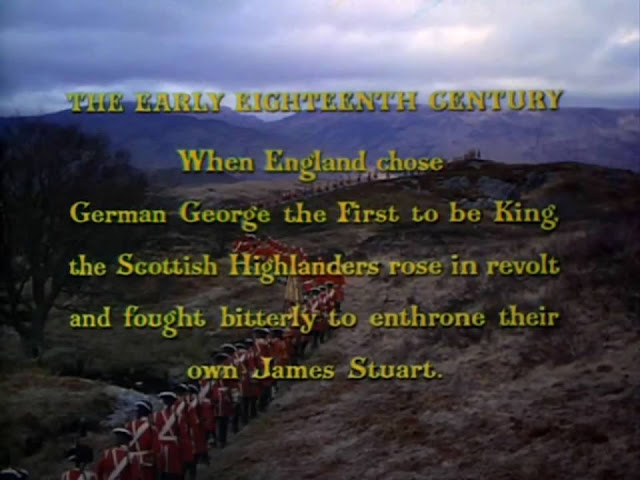
For the 8th Annual Royal Film Performance, a live-action Walt Disney picture was chosen. You can't go wrong with Walt Disney, right? Well... you can if the movie portrays the British suppressing the Scottish Highlanders and forcing them to obey unjust laws and pay double taxes with the intent of taking away their land in the future and stripping the name away of the clan MacGregor. And that's exactly what happens in Disney's Rob Roy the Highland Rogue, starring Richard Todd in the title role.
The only sympathetic figure on the side of the British is a Highlander himself, the Duke of Argyll (James Robertson Justice), a kinsman of Rob Roy's mother from the Campbell clan. and the King, George I, is not even English but German, needing an interpreter. Not to mention he looks like this...
Reading about the Highland Rogue's latest exploits.
In the last moments of the film however, the King pardons Rob Roy - after he comes to the London court to give himself up and prevent further fighting - leading Rob Roy to praise the King as a great ruler.
Rob Roy (Richard Todd) and his wife, Helen Mary (Glynis Johns)
The Royal Film Performance took place at the Leicester Square Odean Theatre on Oct. 26, 1953 (less than a month later, the newly crowned Queen Elizabeth II and Prince Philip would leave on a six-month tour of the Commonwealth, not returning to England until May 1954). There were 19 stars in attendance, among them several from the cast of the film, including Richard Todd, Glynis Johns, James Robertson Justice, and Finlay Currie (Justice and Currie both in kilts); other British stars such as Jack Hawkins, Kay Kendell, Kenneth More, Alec Guiness, and Moira Shearer; and eight from Hollywood, including Gary Cooper (who was spending time abroad for tax reasons), Jeanne Crain, Dennis O'Keefe, Richard Basehart, and studio head Adolph Zukor.
From Girl Next Door: The Life and Career of Jeanne Crain by Rupert Alistair:
The Hollywood delegation was rendered relatively speechless during the elegant, formal event. "Gosh, darn it," Cooper told reporters afterward. "I was reduced to my usual 'yep' and 'nope' just when I wanted to be eloquent." Jeanne reflected a similar experience. "I was too excited to answer, she said, "But I was proud I remembered to say 'your majesty'" (129).
The queen and Princess Margaret arriving. Caption reads: "Her Majesty wor a tiered, crinoline-type evening dress of lavender organza, tied with a big bow in the back. She wore a diamond tiara, a diamond and emerald necklace, and a diamond bracelet. Princess Margaret also wore a tiered dress and a diamond necklace."
More on Margarets' gown: "Dressed in a shimmering white cascade frock, Princess Margaret was outstanding among the brilliantly dressed women who attended last week's Royal performance."
An article about the history of the Royal Film Performance, using a sketch of an image from the 1953 event, appeared in an issue of The Girls Annual (images from Etsy and Ebay).
It's too much to type up. It basically differentiates between the Royal Film Performance and a Royal Premiere (the difference being the RFP is for the Cinematograph Trade Benevolent Fund) and talks about some other films seen by the Royal family as well as their interest in filming the places they visit.
Walt Disney has always been a leader in the animation world. From the first flickering images of his Laugh-o-Grams in the early 1920s to the creation of Micky Mouse in 1928 to the first full length animated film Snow White and the Seven Dwarfs (1937), Disney has been a pioneer in this unique form of entertainment (Visit this site to read a fascinating article on "The Building of the Disney Studio" from a 1939 publication of Valley Progress).
Hurter working on Pinocchio
The first Concept Artist hired by Disney was Albert Hurter. He joined the team in 1931, at the age of 48. His job was as Disney's first inspirational sketch artist, where he would design characters for the animators to then bring to life, since his talent lay in his "ability lay in humorous exaggeration and the humanizing of inanimate objects." He was the "spark that kept others inspired" (They Drew as They Pleased: The Hidden Art of Disney's Golden Age - The 1930s. Didier Ghez). Other "inspirational artists" were hired to work with Hurter, including Bill Peet who stayed on for several decades, but Hurter had the final say and was the one Walt Disney went to to draw and approve the concept art for Snow White and the Seven Dwarfs (1937). During his decade working at Disney, until his death in 1942, Hurter worked on many of the Silly Symphonies as well as the feature-length Pinocchio, Fantasia, Dumbo, and The Reluctant Dragon. Some of his sketches would be used many years later in Peter Pan and Lady and the Tramp. To learn more about Hurter, there is an excellent post here. The book mentioned above is also a great source (linked below).
Sketch by Hurter
Mary Blair joined Disney in 1940, along with her husband, Lee Blair. Born Mary Browne Robinson in Oklahoma on the twenty-first of October, 1911, Mary and her family moved to San Jose. As they were poor, Mary had to work very hard to realize her dream as an artist. She earned a scholarship to the Chouinard School of Art (later the California School of Watercolor). It was there she met and married Lee Blair.
After graduation in 1933, the Depression was in full swing, meaning that a job as a fine art watercolorist was out of the question. She worked for a time as a barmaid and later got a job at Ub Iwerks Studio as a cell painter.
1940 found her working as a concept artist at the famous Walt Disney Studios, working on such films as Saludos Amigos (1942) and The Three Caballeros (1944), both part of the U.S. "Good Neighbor" policy with South America (click here to see tons of photos from Disney's trip to South America with his artists, including Blair). It was on this trip that Blair's art took on it's distinctive look that had previously been lacking and launched her as an artist worth having at Walt Disney Studios. Before she went, Blair’s style had been "sturdy, fluid, and earthy"—lots of browns and blues and grays, but...
...the artwork that she produced on the trip–stunning, colorful, occasionally geometric, graphic, and modern–speaks for itself. She observed everyday South American life (a woman with a baby on her back, carrying a small basket of chickens; the way huts and homes made fascinating jagged patterns when aligned next to each other) and turned it into something dynamic and evocative. She didn’t emphasize the culture’s otherness or try to glamorize its exoticism. Instead, she found the inner beauty present in each passing moment. “She went inside herself to find how it felt, more than how it looked, and brilliantly communicated her emotions through imagery,” Canemaker notes. Even if you’ve never been to South America, you can look at Blair’s illustrations from the period and get a real sense of what it is like (source).
World War II was raging at the time and like all of the movie studios in Hollywood, Disney too did it's part, releasing an extremely diverse range of films that otherwise might never have been made. It was during this time that Blair was able to experiment and hone in on her unique style and flair for colors.
She was the first artist I knew to have different shades of red next to each other.
~ Frank Thomas
In 1950, Cinderella was released. Blair's concept drawings for the film are "jaw-dropping without being showy" and had a "delicate, almost greeting card fashion." And while the angular characters that appeared in her sketches didn't make it into the final film, the overall feel and colors remain.
Blair's style is definitely apparent in Alice in Wonderland (1951), Lewis Carroll's whimsical tale of a little girl that dreams up a "world of her own."
Blair’s brand of colorful whimsy, upside-down conceptualizations, and angular sense of geography was not only essential to the film’s lengthy pre-production phase but much of it (in a modified sense) actually wound up in the finished movie. In a way, it was a movie made up entirely of the abandoned dream sequences she had devised for Cinderella (source).
Peter Pan (1953), Blair's last feature-length film at Disney, also ended up looking different than the artists original sketches. However, her mark can still be seen:
... her style took on an almost collage-like aesthetic; bold, chunky, with deep shadows and high contrast. While less of her work made it into the finished film, it certainly informed the way the movie looked, particularly in its color schemes and use of lighting. Mermaid Lagoon, Skull Rock, the mischievous pixie that is Tinker Bell, these are all 100% Mary Blair (source).
In 1953, Blair left Disney Studios to pursue her own career. In the following years, she illustrated Golden Books as well as "scarves and dresses for Lord & Taylor, designs for Radio City Music Hall holiday spectaculars, paper sculptures for the Bonwit Teller strorefront windows on New York's 5th Avenue, television commercials for toothpaste and ice cream, illustrations for greeting cards, and advertisements for Nabisco, Johnson & Johnson and Maxwell House Coffee" (source).
Walt greatly missed Blair and made a promise to himself when it came to his next concept artist:
“For years I have been hiring artists like Mary Blair to design the styling of a feature, and by the time the picture is finished, there is hardly a trace of the original styling left,” Walt said. So he made a steadfast commitment: Sleeping Beauty, the studio’s first attempt at an animated fairy tale since Cinderella (this time utilizing 70mm film projection and an exaggerated widescreen frame), would really stick to Earle’s style. And it did.
Blair wasn't through at Disney though. In 1963, Walt called her back to have her design the famous It's a Small World display for the United Nations Children’s Fund pavilion, part of the 1964 World's Fair.
Sadly, after Walt's death in 1966, art opportunities for Blair also ended. She was told that her art, once cutting edge, was no longer modern enough. She died of a cerebral hemorrhage on July 26, 1978, at the age of 66.
My favorite Blair sketches: Cinderella & Peter Pan
Mary Blair may be gone, but her artwork lives on, in the films she helped design, in her books, and in her artistic contributions to Disneyland. I could spend hours looking at her sketches which, thanks to the internet, are available by just typing her name. There are also books celebrating her contribution to the animation world.
Yes, Disney is its own genre and an important part of Hollywood History! What would this world be like without their animated movies? Or their feel-good live action films? True, the Disney of today has its problems, but the Disney of Yore still retains it's magic after nearly 100 years.
Here are my top ten Classic Disney films, both animated and live-action:
1. Cinderella (1950)
2. Alice in Wonderland (1951)
3. Sleeping Beauty (1959)
4. One Hundred and One Dalmatians (1961)
5. The Parent Trap (1961) - Hayley Mills, Maureen O'Hara, Brian Keith
6. The Three Lives of Thomasina (1964) - Karen Dotrice, Matthew Garber
7. Mary Poppins (1964) - Julie Andrews & Dick Van Dyke
8. That Darn Cat! (1965) - Hayley Mills, Dean Jones
9. The Jungle Book (1967)
10. Robin Hood (1973)
Honorable Mentions: Peter Pan (1953), The Shaggy Dog (1959), The Absent-Minded Professor (1961), Son of Flubber (1963), The Ugly Dachshund (1966), & Blackbeard's Ghost (1968).
Are you a big Disney fan? What films are most magical to you? Do you know all the words to The Ballad of Davy Crockett? Lol ;) Here's a complete list to refresh your memory. (Btw, anyone have any thoughts on the upcoming Mary Poppins film? If it was anyone other than Emily Blunt I would be totally against it but I think she will make a fantastic Mary Poppins! If only the script is good...)
Today's post for the Movie Scientist Blogathon is a classic Disney film starring Fred MacMurray: The Absent-Minded Professor (1961).
If you are a fan of Disney and a fan of Classic Film you have probably seen this movie (and likely more than once). You have also then probably seen the sequal Son of Flubber (1963).
The Absent-Minded Professor is based on the short story "A Situation of Gravity" by Samuel W. Taylor. The film stars Fred MacMurray as Prof. Ned Brainard of Medfield College. He is a lovable but forgetful guy (he's forgotten to attend his wedding to his secretary Betsy Carlisle, played by Nancy Olsen, three times!) who has invented a gravity-defying formula for flying rubber, which he calls "Flubber."
Even his note doesn't help.
Fun Fact: Time Magazine published the formula for the mixture they used in the film. The recipe called for "To one pound of salt water taffy add one heaping tablespoon polyurethane foam, one cake crumbled yeast. Mix till smooth, allow to rise. Then pour into saucepan over one cup cracked rice with one cup water. Add topping of molasses. Boil till lid lifts and says 'Qurlp'."
The Prof. has applied this mixture to his old Model-T, enabling it to fly.
Scheming Alonzo Hawk (Keenyn Wynn) is out to close the school so Prof. Brainard tries to show his invention to the government in order to raise funds. Hawk and his son Biff (Tommy Kirk) do all they can to spoil the deal for him, making him look ridiculous in front of everyone so that no one will believe in his Flubber.
Fun Fact: Three generations of the Wynn family appear in the film: Ed Wynn (Mary Poppins, Alice in Wonderland) is the bumbling Fire Chief, his son Keenyn Wynn is the bad guy, Alonzo Hawk, and Keenyn's son Ned Wynn.
Tommy Kirk with Keenyn Wynn as Biff and Alonzo Hawk
The basketball scene is sure to have you rolling with laughter as the Medfield team soars above the heads of the other team (including the basketball goals!) with the help of a little Flubber on their shoes.
This film is hilarious and fun for the entire family. If you have never seen it then you are in for a treat.