Chances are, that if you mention the name "Sean Connery" everyone will know who you are talking about. And if they don't know him by his real name, they will most certainly know him by the name of his most famous character, "Bond, James Bond." Not only did Connery play the iconic character, he was also the FIRST to do so. However, he and the actors that played 007 after him, also appeared in many other films as different characters, both before and after they gained world fame. And THAT is the subject of today's Blogathon - You Knew My Name: The Bond Not Bond Blogathon hosted by Realweegiemidget Reviews and Pale Writer.
Be sure to check out all of the other contributions to see what
your favorite Bond was doing when he WASN’T being Bond.
It is extremely rare for an actor to become famous from his very first on-screen appearance. Sean Connery was no exception. When he made the film Another Time, Another Place (1958) he was given an "INTRODUCING" credit UNDER the title (despite having been in a few movies and television episodes over the course of four years) with Lana Turner, Glynis Johns, and Barry Sullivan listed ABOVE the title. Lana Turner is still well known, but Glynis Johns is (unfortunately) mainly remembered for her role as Mrs. Banks in Mary Poppins (1963) and Barry Sullivan only by Classic Movie fans. This film certainly didn't do anything for anyone's career, with OFF-screen events being far more exciting than anything that happened ON-screen. But we will get to that later.
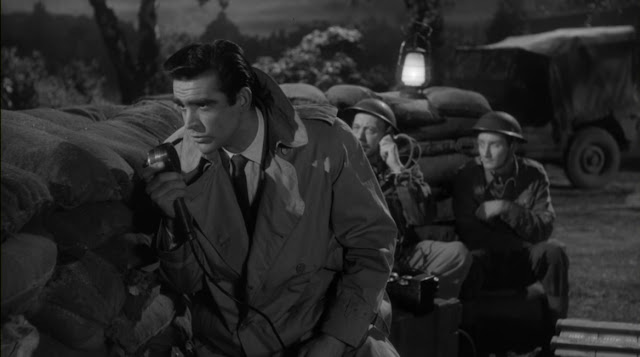
The film opens with the voice of Sean Connery - lacking the richness and accent we are accustomed to - describing the defusing a bomb that landed unexploded in WWII war-torn London. He is BBC reporter Mark Trevor. US Foreign Correspondent Sara Scott (Lana Turner) shows up. They seem to be professional rivals, until they hop in a car to escape the pouring rain for a few minutes and we discover they are lovers.
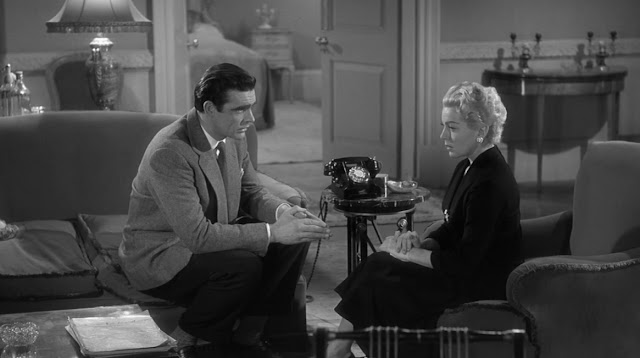
There's a lot of this in the brief 30 minutes that Connery is in the film.
The bomb is successfully defused and the couple make their way to Sara's apartment where there is more of this...
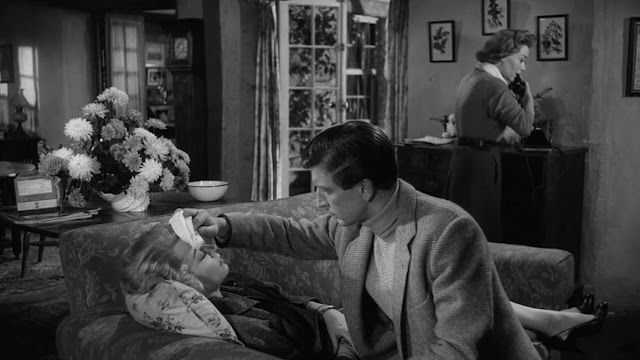
And some of this...
And then of course talks of marriage from her until Mark confesses... he's already married and has a son.
Sara is devastated and they break things off. Her newspaper publisher fiancé Carter Reynolds (Sullivan) shows up and, learning about what happened, offers to take her back to New York. She refuses, insisting she must straighten her life out first. Mark comes for her a few hours later before he flies to Paris to cover the surrender of the German army and they vow to somehow make things work.
The following morning, Reynolds informs Sara that Mark was killed in a plane crash.
After spending six weeks in an institution after the shock of Mark's sudden death, Sara is finally set to sail home to New York. However, enroute to the ship she decides to make a quick trip to Cornwall, where Mark had grown up and lived. We get some shots of Sara walking around the picturesque village and looking down at the crashing waves against the rocky shore before running into Mark's son Brian and wife Kay (Glynis Johns).
Kay Trevor
She feels faint at learning their identities and Kay, not knowing that Sara even knew Mark, invites her in. The women have tea and chat pleasantly. When Sara still appears unwell - after seeing Mark's study with folders containing copies of his broadcasts lying around - and the hotels being full up, Kay insists she stay the night and catch the morning train, which will allow her plenty of time for her ship departure.
Even though Connery is only in the first third of the movie, this photo
ensures that his presence is felt throughout the rest of the film.
During the night, Sara wanders around the house and, after accidently breaking the glass on a photo of Mark, runs wildly out into the night.
When Kay discovers her guest gone and the bed not slept in, she calls family friend Alan, but before he gets there, she spies some locals carrying Sara down the street. When Sara comes to, she recognizes Alan, but he makes a motion for her to hide the fact that she knows him.
Sara stays on with Kay until Alan warns her it is time to leave. Sara is not ready to go yet. Kay catches her listening to an old broadcast of Mark's and tells her that he had wanted to one day put them together into a book. Sara thinks aloud about how it could be formatted and Kay invites her to write it for him.
The two women get along well and both feel closer to Mark through the writing and reading of the book. Meanwhile, Reynolds finds out through Sara's doctor that she is still in England and flies over to fetch her. Kay invites him to join them for a dinner party, which becomes strained whenever Mark's name is mentioned. Later, Alan, who is in love with Kay, meets Reynolds at the pub and tells him Kay is becoming suspicious.
"There's a dead guy called Mark Trevor who's holding onto two women. That's a tough rope to cut."
That evening Kay goes to the movies with Alan. Afterwards she asks him about that last month when Mark hardly wrote to her and finds out that he had an affair. She still doesn't know who with.
Back at Kay's house, Sara has been packing. When Kay returns, she tells Sara what she learned. Sara decides to tell her that she was the other woman. Kay is naturally hurt and angry that Sara had dared come into her home. Sara then lies to Kay and tells her that Mark had ended their relationship and was planning on returning to his wife and son. Kay tells her to leave.
Later, as Reynolds and Sara are about to board the train, Kay appears with Alan to say goodbye and the film ends on a happy note, with each man getting the woman he loves.
Alan and Kay waving goodbye
Reviews for the film were pretty harsh. The New York Times was not at all impressed with the film, calling it a "turgid emotional melodrama" that was a "long way from making any contact with interests that might serve to entertain." Derek Monsey for the Sunday Express singled out "a newcomer to films, called Sean Connery," calling him "beetling-browed" and "unctuous-voiced," and concluding that he "will not, I guess, grow old in the industry." Anthony Carthew for the Daily Herald said the "Connery, in his first big part, gives the impression that he is reading his lines from a none-too-helpful prompt book."
Even Connery knew it was a dud. "The script was not entirely satisfactory; they were rewriting as they were shooting so they started with the end first, and I was dead at the end...so by the time they led up to me, I was only a picture on a piano. The film wasn't very good, it was beautifully lit but dreadfully directed."
While the events on-screen did little to capture anyone's interest - even today its only real interest is in seeing Connery-before-Bond - the events surrounding the making of the film are notorious in Hollywood history.
The stabbing of Lana Turner's lover, Johnny Stompanato, by her 14-year-old daughter Cheryl is one of the most well-known scandals of Hollywood history. What many people might NOT know is Sean Connery's part in it.
37-year-old Lana Turner had recently formed her own production company, Lanturn Films, as many big stars did in the fifties with the fall of the studio system. Another Time, Another Place was her first film. She had script and cast approval, and, for her love interest, she chose unknown British (Scottish) actor 27-year-old Sean Connery.
In the film, I was supposed to be married to Glynis, but I was also having an affair with Lana and I died halfway through the picture. It was only when I was asked what it was like to make love to an older woman did I ever become aware of a woman's age.
~ Sean Connery
Connery was not going to let an opportunity of working with a major Hollywood star to go by without trying his best. He meticulously researched his role, listening to tapes of famous WWII reporters and correspondents. He also got along well with Lana, despite often missing his marks and key lights. Lana, who had said goodbye to boyfriend Johnny Stompanato in New York - to her a final goodbye - had undeniably chemistry with her younger co-star and when Stompanato came to visit her in London he became convinced that they were having an affair. When he appeared on set one day, challenging Connery and threatening him with a gun, Connery, in true James Bond style, punched him in the nose (an article about the incident). Stompanato was banned from the set. Of the set, Johnny began to abuse Lana, nearly smothering her and damaging her larynx. He was quietly kicked out of the country.

After the picture wrapped, Lana went back to America and Connery began work on his next film, Disney's Darby O'Gill and the Little People. Being in a Disney film meant he needed a clean background and, after Cheryl Turner stabbed Johnny Stompanato with a kitchen knife as he was beating Lana was not something he wanted to be associated with. Letters in which Lana described being shown around London with Cheryl and Connery were published and Connery was warned to get out of town (he refused but laid low).
Lana is a lovely lady. We went around together during filming, and sometimes I'd pick her up on my motor scooter, and she'd be all dressed up for the evening, but she'd hop on anyway. A good sport.
~ Sean Connery
Cute Photo of Connery and Turner in Cornwall
Another Time, Another Place was released four months early and one month after Stompanato's death to capitalize on the interest in Lana Turner. However, even with all of the publicity, the film flopped, not being able to compare with real life. You can currently watch the film for free on Pluto TV (website and app).
Sources:
Parker, John. Sean Connery. Contemporary Books, Chicago. 1993.
Pfeiffer, Lee & Lisa, Philip. The Films of Sean Connery. Citadel Press. 1993.
Tanitch, Robert. Sean Connery. Chapmans, London. 1993.
Turner, Lana. Lana: The Lady, the Legend, the Truth. E.P. Dutton, Inc., New York. 1982.