Showing posts with label Costume Dramas. Show all posts

Monday, January 31, 2022

Recycled Costumes: Marie Antoinette (1938) - Part 1

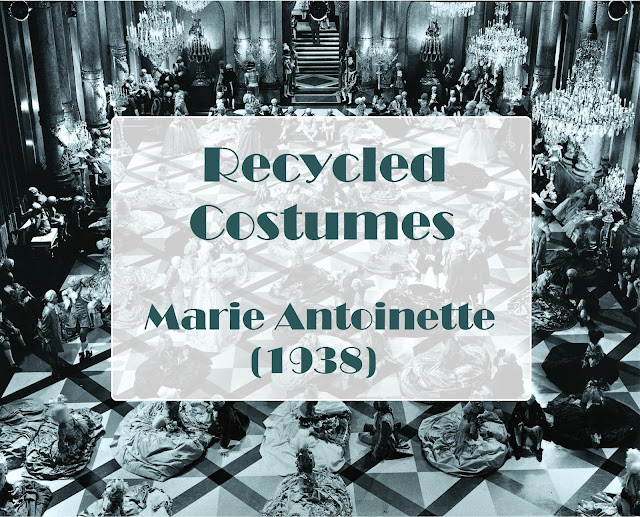
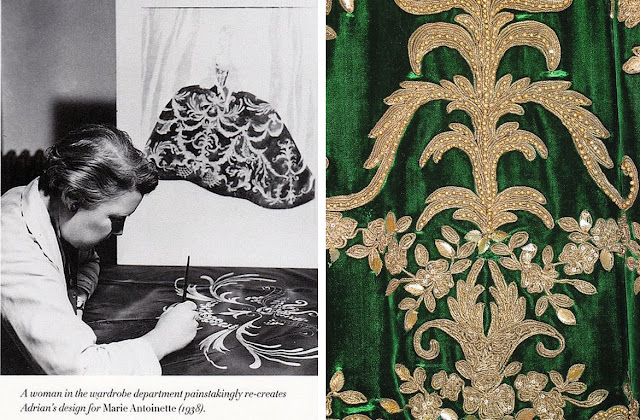
This series will look at the sumptuous costumes designed by Adrain for the epic Norma Shearer film Marie Antoinette (1938) and the films in which they were recycled. I thought about going "in order" but decided to just choose them at random. 

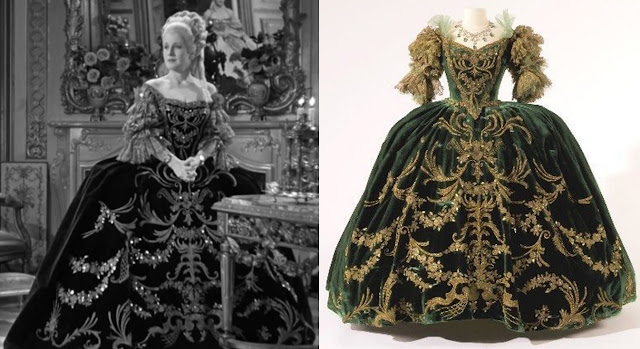
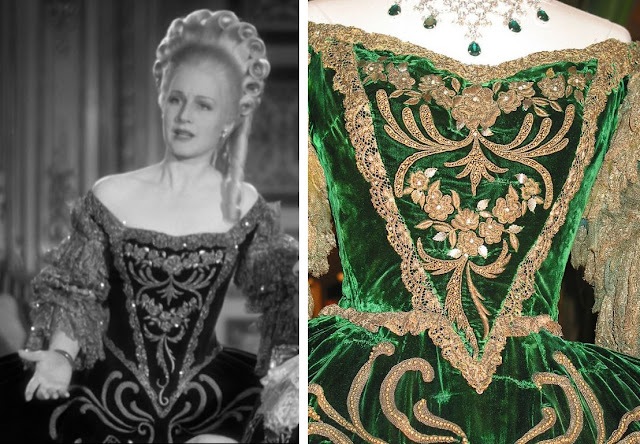
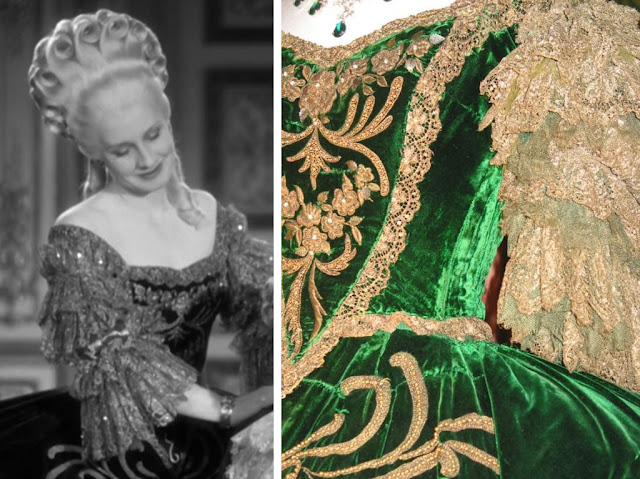
This month's costume is a green velvet and gold lace gown worn by Shearer in the scene where the mob storms the palace. 

The gown in full.

A closer look at the bodice.

Detail of the gold lace sleeves. Note the green tulle inserted between the layers.

Detail of the design on the skirt

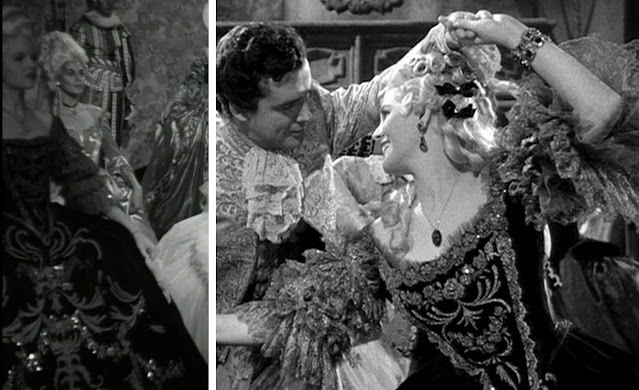
So far I have spotted the gown in two other films: on the left in Two Sisters From Boston (1946) and on the right in The Black Castle (1952).

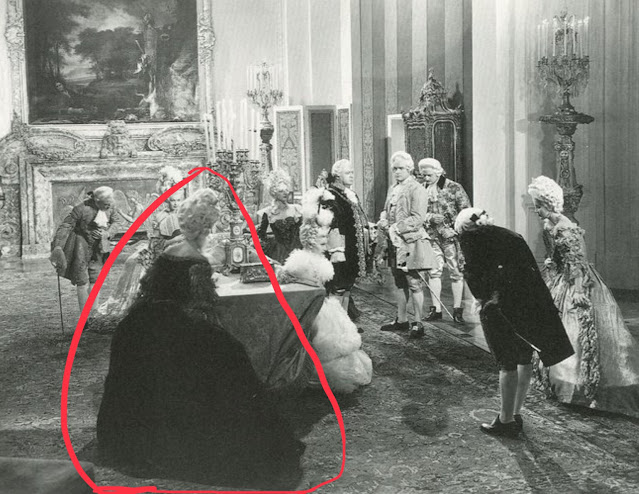
UPDATE: It looks like it also appears in Monsieur Beaucaire (1946) starring Bob Hope. I have not watched the movie yet but will update with screenshots when I get the chance to watch a clear copy. Sadly, it is also in black and white.

Photos of costume in color are from here. Post will be updated if I spot the gown in more films.

Saturday, January 22, 2022

Cinema Wedding Gowns: Rob Roy the Highland Rogue (1953)

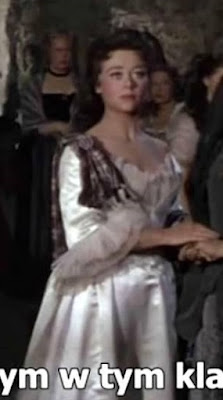
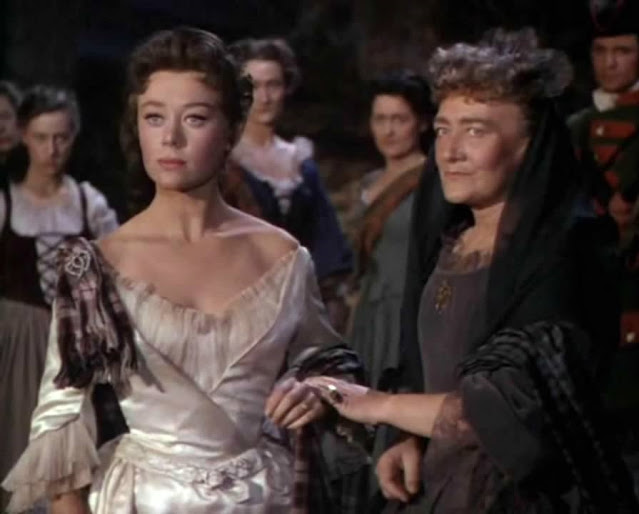
This month's Royal Film Performance post was on the Walt Disney film, Rob Roy the Highland Rogue (1953). In it, Glynis Johns wears a lovely wedding dress. I thought it would be fun to feature it today.

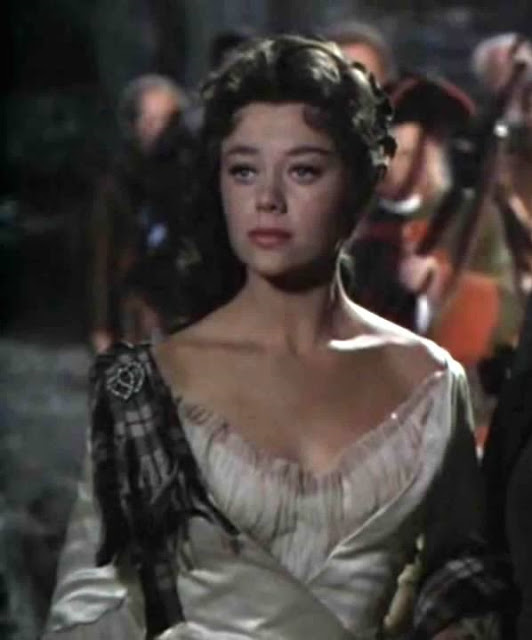
Set in 18th century Scotland, the dress features a silhouette similar to Colonial/Revolutionary War style gowns, with the 3/4 sleeves edged in ruffles and the low neckline. 

It is made of heavy ivory satin and ends just above the ankles.

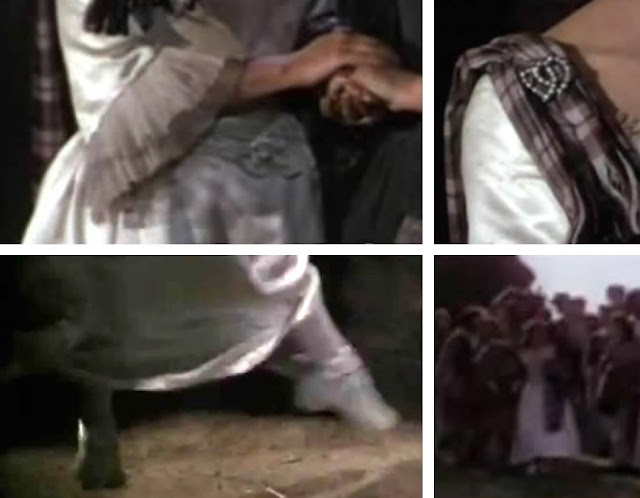
The skirt is flat in front and pleated on the sides and back.

The waist is tight and seems to have some sort of belt. Notice the way the ruffles on the sleeve are attached.

The neckline is just barely off the shoulders and features an interesting wrap-like design, withplisse fabric attached behind and covering the bust. It makes a soft "V" shaped neckline. A tartan (probably her family's clan, as it is different from the MacGregor tartan) is attached at the right shoulder with a brooch and falling behind her is then caught up over her left arm.

A closer look at the sleeves, double heart brooch, white shoes and stockings, and what looks like a veil. In a promotional photo she is wearing a wreath of ivy in her hair.

Sunday, November 5, 2017

Hollywood Auction Catalogs

 
This year I have discovered Auction Catalogs. Unfortunately - rather than being collected in one fabulous museum - costumes, jewelry, photos, and props from Classic Hollywood films are often owned by private collectors or consist of personal collections auctioned off by the actor or actress's family after their passing. Oftentimes the person who buys these items ends up selling them after a while and we end up with annual actions with catalogs featuring pages of fabulous items.

On Nov. 18, Julien's Auctions is having an auction consisting entirely of jewelry from the famous Joseff of Hollywood. The catalog, which you can view online, has over 400 pages of glittering jewels that once adorned the most beautiful of women and the most handsome of men. Here are a few of my favorite pages.


If you could own any of these pieces, or any of the other pieces in the catalog, which would you choose? Oh! To be fabulously wealthy at a time like this!
 
Update: Last night I started watching Rose-Marie (1936) and I noticed the bracelet Jeannette MacDonald wears on her left wrist appears to be the same one worn by Myrna Loy I shared above. As both films were made by MGM in 1936 and had their jewelry provided by Joseff of Hollywood I am almost certain it is the same piece.
 

Saturday, November 5, 2016

Cinema Wedding Gowns: The Old Maid (1939)


The Old Maid (1939) is an odd title for a post on wedding gowns, but throughout the course of the movie, starring famous rivals Miriam Hopkins and Bette Davis, there are three weddings and one almost-wedding, which is of course Bette Davis who then becomes the title's "old maid."

Hopkins and Davis are cousins living with their grandmother during the Civil War. On Hopkins' wedding day, her old beau, George Brent shows up. Even though she loves him, she goes through with her marriage to a man who is much wealthier. Davis, who has been secretly in love with Brent for years, takes this opportunity to be with him. But then he goes away to the war and gets shot, leaving her an unwed mother.


Davis starts a foundling home as a way to hide her child. On the day of her wedding to Hopkins' brother-in-law, she tells Hopkins that she has a child. Jealous that Davis had a child with the man she (Hopkins) loved, she stops the wedding.

The wedding gowns designed by Orry-Kelly and worn by Hopkins and Davis in the film are very elaborate and each very distinct. Hopkins gown is extremely busy. It features a silk corset-like bodice that is covered with a lace bolero. The long-sleeved bolero has a ruffled trim and small posies of flowers on each shoulder.

 
The skirt is hoop-skirted with a lace overskirt and a hem with ruffles, intricate pleating, and flowers.

 
The veil is made of tulle and has flowers surrounding the bride's forehead.

A look at the back of the dress as well as Davis' bridesmaid gown.

 
The dress worn by Davis seems designed to make her look like an old maid. She is not especially happy to be getting married as she is worried she will have to give up her foundling home and along with it her child. The gown is made of cream satin and features a high neckline, long sleeves, and bib pleating on the bodice and at the hips creating a symmetrical look.

 
The lace veil looks very much like a Spanish mantilla and is topped with a large headband of flowers. The bride's hair is held back from the face with a snood.
 
A close-up of the flowers. They look like mainly tiny roses.

Relaxing on the set
 
Out of the other two weddings in the film, that of Hopkin's daughter and Davis' daughter, one dress is only briefly seen and the other not at all.

Friday, October 28, 2016

Costume Dramas of Golden Hollywood

 
Costumes, like everything else involved in filmmaking, are extremely important to movies. Without them, viewers would have to try to imagine them (like imagining sets in a play). As you can see, it would be very difficult to envision the tone of a film without them. Therefore, Hollywood has long spent lavish amounts of money of costumes, whether they are fantastical or gritty and realistic, glamorous or ordinary.

Rhett is definitely not in costume!

Costumes are especially important in Period films. It would be very difficult to imagine an Elizabethan setting if the actors were dressed in jeans and t-shirts! Or think of Gone With the Wind without all of those hoop-skirted dresses! Costumes also help the actor to get into their character and therefore act more convincingly, especially in a time they are not familiar with. It can also be plain fun, as Greer Garson recalls:
I think all of us have often thought how interesting it would be to live in a different age and time. Imagination at best is a poor substitute for reality. My role as Miss Bennett (Pride and Prejudice, 1940) was one of the happiest I ever played. In the charming feminine costumes of the period. working on sets authentically re-creating Old English homes, schooled in the modes and manners for the period, and surrounded by the proper atmosphere - gallant gentlemen, candlelight, carriages and pianofortes - it was possible to believe that I was Elizabeth [Bennett] while the cameras turned, and each night after work it was like stepping out of one world into another. I always hated to take off the colorful costumes and put on slacks, feeling something like Cinderella after the ball.
Why Larry! How dare you suggest my costume isn't authentic!

Because movies are so popular, what we see in the movies is convincingly real and sometimes the line between fact and fiction becomes blurred. Especially with costumes, "Hollywood usually offers its audience an elaborate and excessive vision of the past, filtering history through rose-colored glasses... to create the effect of a different time."

That being said, Hollywood gets many aspects of period costumes correct, but oftentimes it is mixed in a little with modern trends to be more easily identifiable with the movie-going public. Fabrics, silhouettes, undergarments, make-up, and hair styles were frequently, and sometimes purposefully,  changed for a modern look with an authentic feel, making the viewer feel like they had just seen something of historical fact yet at the same time be able to relate completely with the characters. They could also incorporate the looks seen easily into their wardrobes, as these patterns from 1939 show (released by Hollywood of course):


With period films from the Classic Hollywood era, one can still always tell what decade the it was actually made in, even if you aren't familiar with the main actors. A 1930s period film looks like a 1930s period film, just like one from the 1960s looks like it was made in the 1960s.

The fabric is wrong. The makeup is wrong. But it feels right.

Some actors and actresses strove for authenticity however. Bette Davis famously shaved her hairline to play Queen Elizabeth I not once, but twice! Even then, she wasn't allowed to shave it back as far as she wanted for fear it would alienate the movie-going public.


Nowadays, Hollywood and other film-makers are much more careful with getting the details right. For example, the popular BBC television drama Downton Abbey had a historical advisor on the set at all times to make sure that every detail was as authentic as possible. Even such small items as a letter seen for only a split second were handwritten in the style of the period. The celebrated costumes were sometimes actual 1920s items or had pieces taken from a gown falling apart and refashioned into a wearable piece using only materials that would have been available at the time. Some dresses were so delicate that they fell apart soon after filming! The makeup was even authentic, with just a little powder to even out skin tones. Here is a short video about the costumes, hair and makeup on the show (Warning: gives away plotlines). Here's another really short one.


If you are interested in pursuing this topic further, Hollywood and History: Costume Design in Film by Edward Maeder is an excellent book. It was a companion piece to an exhibition hosted by the Los Angeles County Museum of Art. The chapters include Historical Dress in Films, Hair and Makeup, and their impact on fashion.


This post is for the Characters in Costume Blogfest hosted by Christina Wehner and Into the Writer Lea. Be sure to check out all of the other "form-fitting" posts ;)