Showing posts with label NoirSummer. Show all posts

Sunday, August 2, 2015

Summer Under the Stars Day 1: Laura (1944)


I'll never forget the weekend Laura died.

And I will never forget the first time I saw Laura. The film was breathtaking, suspenseful, haunting, captivating, and unlike any other movie I had seen up to that point. It was one of the few film noirs I had seen, and before I was really aware of what a 'film noir' was. The other 'noirish' films I had seen (but was too young to appreciate) were The Maltese Falcon and It's a Wonderful Life.

The Opening


"I'll never forget the weekend Laura died." This first line, spoken by Waldo Lydecker (Clifton Webb), immediately grabs the viewer and draws them into the story. Nino Frank wrote in his influential 1946 essay "A New Kind of Police Drama: the Criminal Adventure," that Laura was a "charming character study of the furnishings and faces, a complicated narrative, a perverse writer who is prosaic but amusing, and foremost a detective with an emotional life" (Daily Doses from the online Film Noir class Into the Darkness). When watching the opening scene after reading that observation, a whole new level of the film is revealed.


For example, in Some Visual Motifs of Film Noir, Janey Place and Lowell Peterson note that when detective Mark McPherson (Dana Andrews), peers through the glass case in Waldo Lydecker's apartment, the case becomes "at once constricting and symbolic of a percarious situation which threatens at any moment to shatter to the floor" (72). It was these qualities that made Laura unique and which have made the film the well-loved classic it is today.
Otto Preminger's 1944 Laura marks an important transition in film history. Visually it harks back to Hollywood's Golden Era, flooding with light elaborate sets and the glamorous stars they hold--but at crucial moments a noir vision bubbles up to artfully blemish this smooth façade. It is a classic love story--except that it hinges on forbidden fantasy and murder. It at once gives a coy nod to the parlor psychology of the "Thin Man" variety of mystery, and looks forward to the dark Hitchcockian psychological thriller. It is a Janus of a film, and it may be eternally debated whether its double vision signals an end or a beginning.


Laura, according to Gene Tierney, who plays the title character, has a "tricky plot: Laura, believed to be the victim of a murder, reappears to become a suspect" (Self Portrait, 113).


Laura/Gene Tierney


Gene Tierney described her most famous character as follows:
Laura dominated the story as a presence, felt but unseen, for half the movie. She was the victim of events she had not created and could not control. Laura was a woman of mystery and glamour, unattainable...
Laura is also the victim of male imaginings. Waldo Lydecker, who narrates the first half of the story, tells detective Mark McPherson (Dana Andrews) and the audience who this mysterious "Laura" is and how he came to know her. Hearing, and seeing, his story unfold, also reveals something about his character. To him Laura is his own creation, someone who would not and could not exist without him. He is obsessed with her to the point of madness.

McPherson, on the other hand, falls in love with Laura, not as a person, but as a portrait. She becomes his "feminine ideal." He too becomes obsessed with her. He sits in her apartment and stares at her portrait, goes through her personal belongings, reads her diary. When Laura becomes real, as well as a suspect, McPherson must try and put his feelings aside to get to the bottom of the mystery of who killed "Laura."


Gene Tierney was 24 years old at the time of filming. She had been in nearly a dozen movies, playing everything from "a frontier girl, an aristocrat, an Arabian, a Eurasian, a Polynesian, and a Chinese." This time she had a chance to play the title role, a leading lady. The part for Laura had already been turned down by both Jennifer Jones (who would get her own, less known "portrait" movie in 1948, Portrait of Jennie) and Hedy Lamarr and even Tierney was not impressed with the script at first. She was worried over the short amount of screen time her character had (it took Tierney only 18 days to shoot her scenes). Darryl Zanuck, the head of Fox Studios, encouraged her to take the rule, and Tierney agreed. "I was in no position to be picky," she wrote in her autobiograpy. "I had not made a picture in over a year. My husband was still in the army. The extent of our baby daughter's problems was not yet known. I needed to get back to work" (Self-Portrait, 114).

Tierney was also going through a difficult period in her life. She had been exposed to measles while pregnant and her baby daughter, Daria, was born with multiple problems: she was deaf, partially blind, and would never be able to speak properly. This crushed Tierney and led to mental problems later in her own life. Laura, however, launched her to stardom.


Waldo Lydecker/ Clifton Webb


The role of Waldo Lydecker was played by Clifton Webb, who was a gamble considering he had only been in a few silent pictures and was a stage player. However, the role seemed to be made for him. It was a challenging role, he had long stretchs of dialogue and has to become a tragic figure to the audience. Tieney writes, "There was a wonderfully brittle edge to Clifton, his manner, his speech, the way he moved. Part of what came across on the screen, the impression of a man very tightly strung, was true in person. After we finished filming he checked himself into a sanitarium in New England. He came out rested and restored" (Self-Portrait, 115). Film Noir FAQ describes the character of Lydecker as "arch and affected" and "consistent." He is "almost entirely self-created; you get the sense that, growing up, he never was who or what he wished to be, and that he's spent his adult life cultivating something - somebody - better (3).

Mark McPherson/Dana Andrews


Mark McPherson is a different kind of detective than the pre-noir detectives (Philo Vance) and the hard-boiled figures of early noir (Sam Spade, Philip Marlowe). He starts out so confident and sure of himself and then falls in love with a painting and seems to lose focus of the job at hand. When Laura comes to life, he suddenly has to suspect this vision of murder instead. He has to be cruel to this beautiful creature and then protect her like he wanted to do all along.


This was also a big role for Dana Andrews. He was not quite yet a leading man, though he had recently been noticed for his role in The Ox-Bow Incident (1943). Laura was his third film with Tierney.

The Portrait

The hauntingly beautiful portrait of Laura is the focus of the film at the beginning. It has its own life as it enchants those who look at it and causes people to forget the real Laura and see her as the Laura in the portrait. It became a "potent, poignant symbol of loss – one that would inspire an urgent, irrepressible desire to bring her back from the dead" (source).


The real portrait used in the film was actually a photograph, taken by Frank Polony the studio photographer, that was then blown up and lightly brushed with paint to give it the ethereal look Preminger wanted. A painting was done by Azadia Mamoilian (also known as Azadia Newman) but Preminger was disatisfied with it. He was disastified with several things. Nearly everything went Preminger's way in the end.

The Music

The music of Laura is the second thing for which the film is most remembered. Preminger originally wanted to use "Sophisticated Lady" by Duke Ellington.


However, the musical director of the film, Davie Raksin, wrote the melody that will forever be associated with the portrait - they go together, are meant for one another.


Later, Johnny Mercer wrote lyrics to go with it and it too became a classic.

 
. . . Laura is the face in the misty light,
footsteps that you hear down the hall;
The laugh that floats on a summer night
that you can never quite recall,
And you see Laura on the train
that is passing through.
 
Those eyes, how familiar they seem.
She gave her very first kiss to you.
That was Laura . . . but she's only a dream.

The Allure of Laura

What makes Laura so alluring? Why has it continued to capture audiences years later? We become just as fascinated with the portrait of Laura as the characters in the movies. Is it the beauty? The mystery? All of the elements of the film, its chemistry, its haunting title song, and its unique plot, all light the fire of our imaginiations and draw us into the plight of this girl who we have come to know through others memories of her. She becomes a memory for us also and we are just as surprised as McPherson when she suddenly walks in the room, alive and whole. We too think at first that we are seeing a ghost.


This post is part of the month-long 2015 TCM Summer Under the Stars Blogathon hosted by Journeys in Classic Film. Check out all of the other great posts throughout the month here!

All images found via Pinterest

Sources:

Self-Portrait. Gene Tierney with Mickey Herskowitz. 1978.
Film Noir FAQ. David J. Hogan. 2013.

Additional Readings (from tcm.com):

Overview
The Essentials
Behind the Scenes
The Big Idea Behind Laura
Trivia
Pop Culture
Critics' Corner

Also, several extremely interesting articles about the characters and deleted scenes. The different posts on Laura are listed on the right side. Here's another great post.

Thursday, June 18, 2015

Summer of Darkness Week 2 - The Maltese Falcon (1941)

The second week of TCM's Film Noir class focuses on the definition of film noir - is it a genre? A style? A movement? A combination of the three? It also talks about film noirs as a "heist." The Maltese Falcon (1941) is one of the earliest films that comes under the heading of Film Noir and a film that really launched the genre. When someone says "Film Noir," this is usually the first film that comes to mind. It is said to have "hid in plain sight for years—with a nary a word about it being a seminal work of a new and exciting mode of filmmaking. Like a well-orchestrated heist where the loot is already in the getaway car before a single alarm bell is tripped, films noir were being made in the Hollywood system for at least five years before movie critics began to label these films as something other, something different, from run-of-the-mill thrillers" (from Lecture 1, week 2).


The first article of TCM's Film Noir class states: "Pay attention to the first few minutes of a film. Right after the studio logo is prominently displayed, a filmmaker has a job to do: namely, to establish the film's story world and get you in a certain frame of mind. While many opening sequences might seem perfunctory, they are your entrance into the narrative and evince a visual style that fits the tale to be told" (Into the Darkness: Entering Noir Country). The Maltese Falcon is no exception. Let's take a look at some of the noir aspects found in the film.

*Contains spoilers

 
The very first frame shows the famous Black Bird. You can tell by the way it's lit that this is a noir film.


In the second frame, the title of the film appears on the screen - in smoke no less. It's off to a very good start.
 
 
We are the given an introduction; the "backstory" of the Falcon. It's exotic ad mysterious tone also helps to set the mood. You are instantly intrigued.

 
Now that you know it's a noir film, the place is established. San Francisco is the location of several noir films: Dark Passage, Nora Prentiss, Born to Kill (all 1947), and Woman on the Run (1950).


The opening shot of the film, and the first in which we see its central "live" character (I say live because the Falcon is really the central character), Sam Spade. At first, it doesn't look much like a noir film. It's daytime and Spade is performing the mundane task of rolling a cigarette.


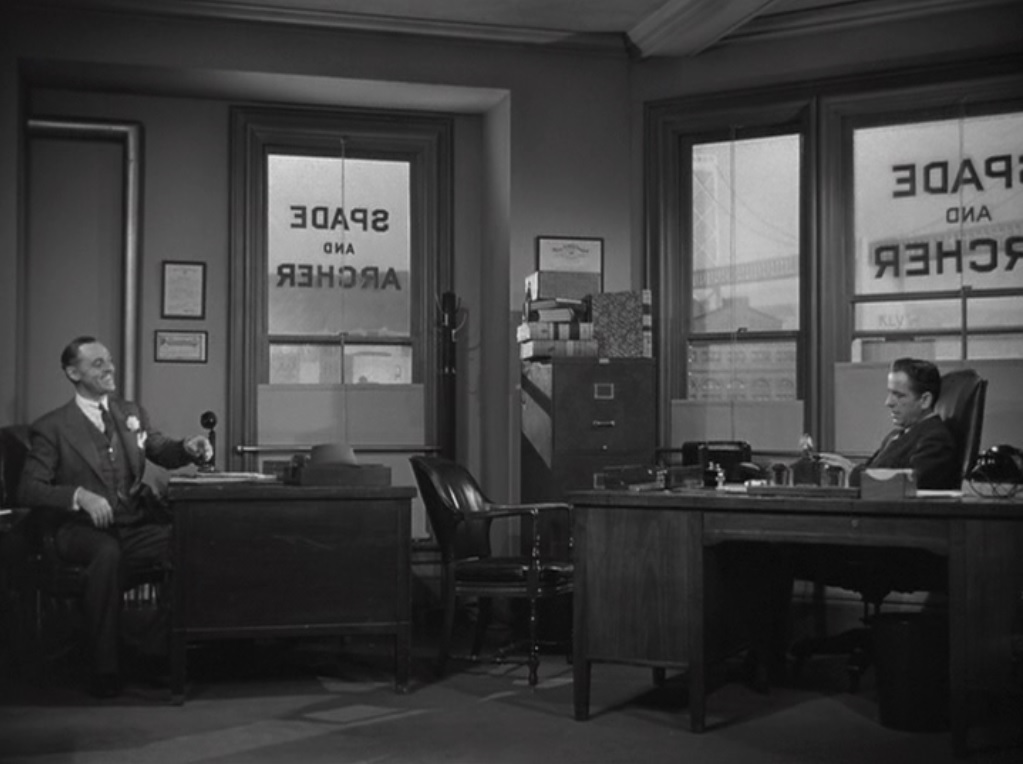
His office that he shares with his partner, Miles Archer, certainly doesn't look threatening. In fact, it looks pretty nice: lots of windows with sweeping views of the city; lots of space to walk around in, high ceilings, leather swivel chairs. Not bad!


Then the camera pans down to the floor for this shot. It seems a little ominous.

 
Six minutes into the film, Spade's partner is murdered while on the job. Spade is awakened by the phone call. During the short conversation, the camera stays pointed towards the window so that all we hear is Spade's voice. It's a fantastic noir shot.
 
 
Next, Spade visits the scene of the crime. He is shown looking down on the spot where Archer's body rolled. Angled shots like these became the norm in noir films. They are not used too frequently in The Maltese Falcon and when they are, they are more subtle than the some of the later noir films so as not to call attention to themselves but rather to enhance the atmosphere of the film without the viewer noticing it.
 
 
Here's a shot that's used twice: first when Spade is questioned by the police and later at another confrontation between Brigid O'Shaughnessy (an early representative of the femme fatale) and Joel Cairo (played by Peter Lorre). This is almost a point-of-view shot (POV) and includes the viewing audience in the circle.
 
 
 Newspaper clippings help move the story along quickly.
 
Let's take a look now at the main characters along with some analysis from the book Film Noir FAQ (2013) by David J. Hogan:
 
Humphrey Bogart as Sam Spade
 
"Huston and Bogart's interpretation of Spade became a template that's still used today: the private dick as tough, concise, strangely principled, and unafraid to take a beating" (84).
 
"Bogart set the tone for the era when he played Sam Spade in Huston's 1941 film version of Dashiell Hammett's 1929 novel The Maltese Falcon. He was neither hero nor villain, just a cynical detective navigating a corrupt world. Morally, Spade was on the fence. Not above having an affair with his partner's wife, but generally trying to do the right thing—when it suited his purposes. Plenty of imitations followed, characters with a savvy attitude and a smart mouth modeled on Bogart/Spade—and when they tumbled off the fence to the dark side, you had a truly noir protagonist" (Low Company, High Style: The Eternal Allure of Film Noir. Eddie Muller).
 
Everybody has something to conceal.
 
Mary Astor as Brigid O'Shaughnessy
 
You won't need much of anybody's help. You're good. It's chiefly your eyes, I think, and that throb you get in your voice when you say things like
"Be generous, Mr. Spade."
 
"Astor's Brigid O'Shaughnessy immediately defined the duplicitous beauty that every subsequent PI, in books and on the screen, has had to deal with ever since. In this, Huston's film has become archetypal and folkloric. We've come to know these characters" (84).
 
Sydney Greenstreet as Kaspar Gutman, also known as "The Fat Man"
 
There's never any telling what you'll say
or do next, except that it's bound to be
something astonishing.
 
Peter Lorre as Joel Cairo
 
You have always, I must say, a smooth
explanation ready.
 
I won't continue with a scene by scene description. I just wanted to look at some of the aspects of the film that make it a Noir film. They do finally recover the Falcon. But is it the real one?
 
 
Now, after seventeen years...

 
In the end, somebody has to take the blame for all the murders. Sam Spade, even though he loves Brigid, turns her in to the police. He is NOT going to take the blame for any of the previous events. This particular shot of Brigid being taken away, is symbolic in two ways. The shadows that the bars of the elevator cast across her face signify the bars of a jail cell. The shadow they make - a black bird, the cause of her downfall.
 

The film is based on the 1930 novel of the same name by Dashiell Hammett. You can read a review of the book here. It has been made into a film three times: the first time in 1931, in 1936 as Satan is a Lady starring Bette Davis, and the most famous version written and directed by John Huston.
 
The dialogue in the film is amazing. Huston's full screenplay can be downloaded in pdf form here.
 
 
The film has a propulsive quality that denies the viewer the time needed to process all the plot points - but then, plot hardly matters because The Maltese Falcon is a morality play and character study (83).
 
Huston's picture definitively established what a private-eye movie should be (84).
 
 
Week 2 of TCM's class also features an optional podcast on The Maltese Falcon. You can listen to it here. Click on the thing that says POD before the title. It will open in your media player. There are lots of other noir podcasts on this site from previous classes.
 
Here is an interesting article on Film Noir and the Hard-Boiled Detective that talks about the character of Sam Spade in The Maltese Falcon.
 
Be sure and read host Eddie Muller's Film Noir Overview of TCM's Summer of Darkness site (he wrote one of the noir books I mentioned in my first Summer of Darkness post). It's very interesting and was part of the required reading for the 2nd week of the class (if you're wanting to get a certificate). It's still not to late to join the class! You would just have to catch up!
 

Monday, June 8, 2015

Summer of Darkness Week 1


On June 1, the TCM Film Noir class started (there's still time to join!). Already I have learned some new things about Film Noir. I learned the definitions of these words (source):

Still of Orson Welles in The Third Man (1949) - an example of chiaroscuro

chiaroscuro Literally, the combination of the two Italian words for "clear/bright" and "dark"; refers to a notable, contrasting use of light and shade in scenes; often achieved by using a spotlight; also referred to as low-key lighting or high-contrast lighting (more examples).

Deep focus shot in Citizen Kane (1941)

deep focus
A use of the camera lens and lighting that keeps both the close and distant objects being photographed in sharp focus.

Example of diegesis - the beginning of M (1931) uses natural sounds
such as children's voices to set the creepy mood

diegesis, diegetic
The “world” of the story and all the elements that belong to it: the sight and sounds of the action (e.g., footsteps, explosions), including off-screen action and objects (e.g., birdsong, church bells). The most common non-diegetic sound is music, which would only be diegetic if the musicians or source of music were part of the action (great article).

Example of the Dutch Angle with low-key lighting in The Third Man

Dutch angle
A tilted camera angle that shows images obliquely slanted to the frame's vertical axis; also called oblique or canted angle.

Establishing shot of San Francisco in The Maltese Falcon (1941)

establishing shot
A shot that shows the environment in which the action will take place, usually early in the sequence.

Example of German Expressionism in M (1931)

expressionism and German Expressionism
A style of filmmaking that distorts physical reality in some way in order to "express" strong feelings about it. Typical expressionistic techniques include the use of distorting lenses, extreme camera angles, bizarre lighting and sound effects, and fragmented editing. The personality of the director is always paramount and obvious in this type of film (more on German Expressionism).

forelengthening The linear distortion caused by a wide-angle lens; the perception of depth is exaggerated.

high-angle lighting
Lighting coming from above a person or object, usually in order to outline the upper areas of the figure or to separate it more clearly from the background; also called top lighting.

Example of mise-en-scène from Laura (1944). Note the portrait of Laura in the background.

mise-en-scène French term from the theatre that literally means “what's put in the scene.” In the cinema it refers to the elements of a shot—the set, the props, the actors, the use of color and light—and the way these elements are composed or choreographed.

♦  ♦  ♦  ♦  ♦  ♦

I also checked out these books from my library:


Noir's preferred landscape is the night, that playground of our conscious fears and subconscious desires, the period of time when we're simultaneously at our most apprehensive and reckless (xvi).

Also the author of Dark City: The Lost World of Film Noir

The book traces the lives and careers of six actresses: Jane Greer, Audrey Totter, Marie Windsor, Evelyn Keyes, and Coleen Gray, focusing of course on their contribution to Film Noir.

A femme fatale was...a figure of enticing eroticism and ambiguous motivation, a woman possessing far more urgency and power than the men who tried to possess her (from the introduction).

♦  ♦  ♦  ♦  ♦  ♦
 
One of the recommendations for this class is, of course, to watch as many of the films as possible. Here are the ones I have selected to watch that aired June 5th:


Since in Week 2 there is a podcast on The Maltese Falcon, I will include my thoughts on the film in my next Summer of Darkness post. You can find it and other podcasts on noir films here.