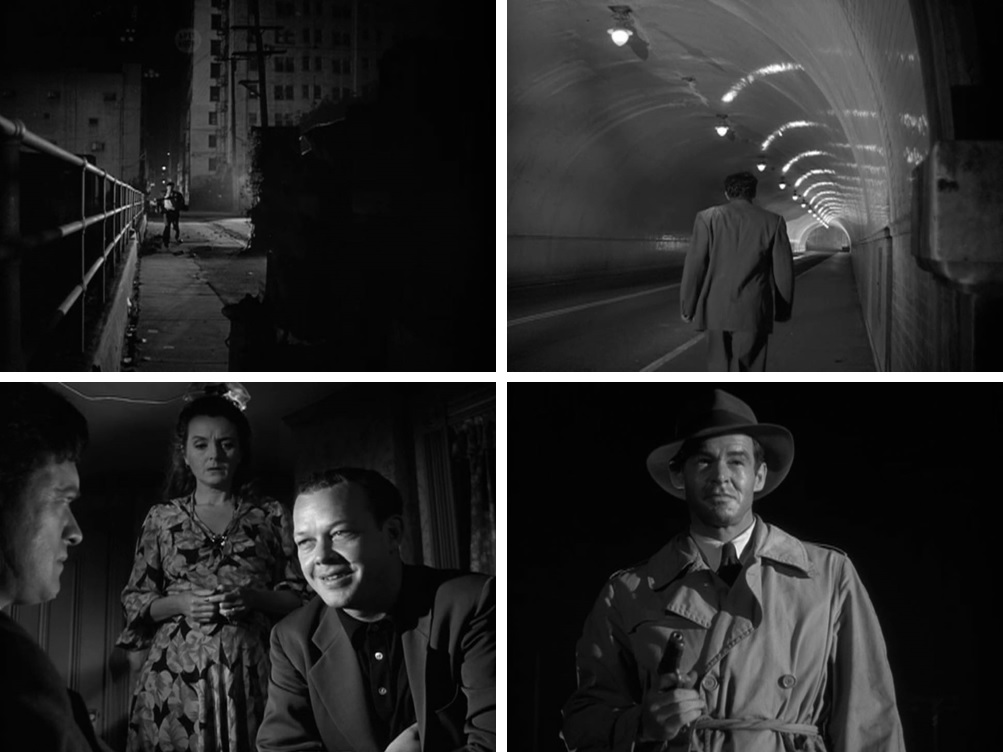
Not long after the very first National Classic Movie Day Blogathon, I wrote a post on my top 5 Film Noirs. A month later I lengthened it to ten (#6 and 8 would no longer have any chance of being on that list). However, at the time, I had hardly seen any, as it wasn't particularly my favorite genre - some of them were a little too violent or dark for my taste. As I got older though I discovered that they were actually really good. Like, REALLY GOOD. Becoming a Robert Ryan fan also helped ;) Anyway, without further ado, here are four of my favorite Noirs.
(1948)
I loved Act of Violence (1948) so much I rewatched it again a month later and took over 300 screenshots (you can see them here on my blog Facebook page - don't go all the way to the end if you haven't seen the movie). On the surface, war hero Frank Enley (Van Heflin) has a great life. He has a beautiful young wife (Janet Leigh) an adorable baby, and is well respected by his community. But when a mysterious man with a limp begins to stalk him, Enley's life quickly unravels and his dark secret is exposed. He confesses to his wife that during his time in a POW camp he became an informer in exchange for food. The man who is following him (Robert Ryan), was his friend Joe, who suffered torture because of Heflin's actions. Joe is out for revenge, intent on killing Enley and punishing him for his actions. Enley tries to run from Joe and even hires a hit man, with the help of a woman he meets in a bar (Mary Astor). Of course, being a Noir, the viewer already knows that Enley is doomed to his fate.
The deft cinematography of David Surtees is a visual depiction of Enley's worsening nightmare. It "shimmers with sunlight" at the beginning of the film and gradual descends into something "straight out of a Freudian nightmare"(Film Noir FAQ, David J. Hogan, p. 343). This is also aided by on-location shooting. The director, Fred Zinnemann, had "learned the value of authentic locations, and this new picture gave him and Surtees a chance to photograph the real LA, where Enley flees and descends into the criminal underworld." This "sense of realism extended to the actors as well. 'No makeup of any kind was used on any member of the cast,' wrote Surtees. 'We tried to maintain on the screen a high standard of skin texture.' This technique heightened the hard set of Ryan's face, with its lined brow and sneering mouth" (The Lives of Robert Ryan, J.R. Jones, p.84-85).
(1956)
Nightfall (1956) is what I call a "snowy noir." There's something about black and white cinematography and snow that I just love. Also, this film stars Aldo Ray (anybody else think he has a sexy voice? lol). Vanning (Ray) is a commercial artist who has been wrongly accused of murdering his friend while on a hunting trip in Wyoming. Not only that, but he's also accused of robbing a bank. Following from town to town is an insurance investigator for the bank and the two real bad guys, the pistol whipping, trigger happy Red and John (Brian Keith), the brains of the outfit. Vanning meets a model, Marie Gardner (Anne Bancroft), at the bar one night and let's his guard down a little. As they exit he is intercepted by John and Red, who intimate that Marie was helping them. He manages to escape and heads to Marie's apartment to confront her but she assures him of her innocence. He tells her his story and then the two of them take the bus to Wyoming to try and find the money that can clear his name. The movie climaxes with an epic shootout/fight involving a snowplow. You can watch it on YouTube. It was directed by Jacques Tourneur(who directed another favorite of mine, Cat People) with cinematography by Burnett Guffey.
Love this shot of Brian Keith.
(1944)
In Phantom Lady (1944), a man is accused of murdering his wife. The only person who could provide him with an alibi is a "phantom lady" with an unusual hat. His secretary, Kansas (Ella Raines), sets out to clear his name. I was blown away when I first saw this movie and Raines became an instant favorite. Rather than me try and describe it, please just do yourself a favor and watch it.
My favorite shot from the film.
Elwood Bredell was selected as cinematographer. He was advised by director Robert Siodmak to "study Rembrandt's paintings as an example of how dark shadows could attract the eye of the viewer toward a certain portion of the composition." There is a "contrast between the bright, well-organized business world inhabited by Carol and her boss and the city's distorted, menacing underworld, as Carol slides even further down the rabbit hole," and a "nightmarish atmosphere through highly stylized moments, rich textures, and claustrophobic settings... Siodmak favored low-key lighting, which would lend itself to sharply contrasting shadows and large areas of black" (Phantom Lady: Hollywood Producer Joan Harrison, The Forgotten Woman Behind Hitchcock, Christina Lane, p. 147-148).
(1946)
Nobody Lives Forever (1946) stars one of my favorite actors, the ever-troubled John Garfield. It is unusual in that much of the film takes place in the sunlight instead of the typical Noir darkness and on the beach instead of the city streets. Even then, the dark scenes are shrouded in mist instead of bathed in garish neon lights.
I figured for Noirvember we needed a Noir wedding gown ;)
This lavish home wedding hides a secret - the groom (Lawrence Tierney) is in love with the wealthy bride's (Audrey Long) penniless sister (Claire Trevor).
The dominate feature of this gown is its half circles that appear to be thick piping. They are everywhere on the dress. Above you see a fully lined, fitted bodice with small buttons up the front and diaphanous sleeves with the padded shoulder so typical of the 1940s. The large rounded neckline is edges with the piping loops. A simple strand of pearls graces the throat. The veil, which looks a little like a nurse cap, is also trimmed that way, with the center loop being pointed.
In this shot we see how the tulle of the veil is attached to the headpiece. Note the loops adorning the wrist.
A giant sash is draped around the waist of the floor-length gown. Here you can see the sleeves are gathered and puffed to the elbow - with the loop trim inside - where they become fitted to the wrist. The veil appears to be at least floor-length.
The sash is completely trimmed with the loops. As you can see, the bow is extremely large and ends hang far down the back of the dress. You can see the loops in the sheer sleeves well in these shots.
Here is Clair Trevor as the bride's sister and Maid-of-Honor. Like the bridal gown, it too has a large rounded neckline, padded shoulders, and long sleeves, but here the similarities end. There is pleating at the neckline for a perfect fit. The bodice is decorated with sequins or beads. Her elbow-length veil sits atop a crown-shaped hat, also sparling.
The sleeves are looser at the top and fitted at the wrist. The full tulle skirt ends at the calf. A glittering necklace and large round earrings complete the look. I wonder what color it was?
"Criminal pathologists try to crack a case with nothing but the victim's bones to go on."
This was the brief synopsis on TCM for the 1950 film Mystery Street. It sounded interesting so I added it to my list. I was also intrigued because the lead was played by Mexican actor Ricardo Montalban, who I've watched recently in a couple Esther Williams films as well as the WWII film Battleground (1949) - in which he gave a wonderful performance.
As soon as I watched it, I knew I had to write about it. Showing the procedural side of police work, the film was groundbreaking in showing how policemen use the science of forensics to solve crimes, in this case a murder in which all that is left to go on is some bones buried in the sand on the beach.
The audience already know who the bones belong to and who committed the crime, so there is no mystery involved. The excitement comes from seeing the way in which the clues are gathered and how the murderer and his victim are identified by the police. There is of course some suspense/action near the end with the death of the victims' landlady who tried to use her knowledge for monetary gain.
Trailer
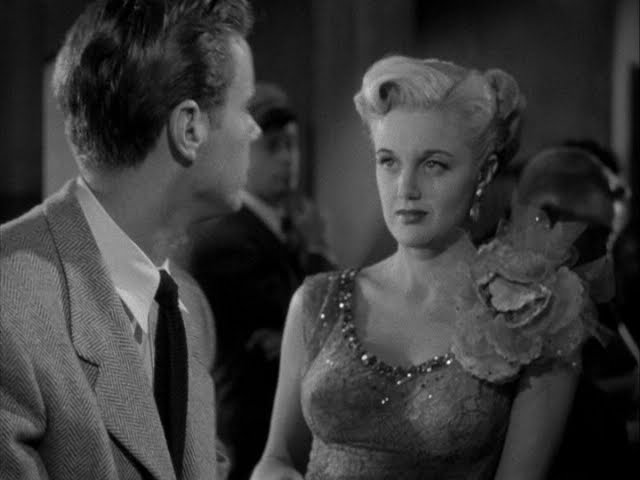
The film opens with the victim, Vivian Heldon (Jan Sterling) making a phone call to the married man she is having an affair with. She demands he meet her at the Grass Skirt cafe, her place of employment in Boston. While there she meets a young man, Henry Shanway (Marshall Thompson), who's wife has just lost their baby in childbirth. Vivian offers to take the inebriated Shanway home but instead takes over his car to meet her lover Hartley on Cape Cod. When he protested to ditches him on the side of the road a few miles from a diner. At the beach, Vivian demands Hartley give her money. Instead, he shoots her while she's still on the car, then buries her body among the sand dunes.
Three months later, her bones are discovered. They are all that remain of Vivian. The car belonging to Shanway, which was sunk by Hartley in a nearby pond, is also found. Police Lieutenant Peter Moralas (Montalban) is put on the case. They take the bones to Dr. McAdoo (Bruce Bennett), the forensics expert at the Department of Legal Medicine at Harvard University. McAdoo explains the process of gaining clues from bones. Once the skeleton is assembled, he is able to tell the sex, age, height, and build of the victim and when she died. The bones also reveal that she was pregnant. With that information, the police are then able to look through their missing persons file and narrow down the results. The most fascinating part (which you can watch here) is when they take photos of the possible candidates and match them with the skull (these scenes reminded me of the popular show Bones, which ended it's 12 season run last year).
Once they've ided the victim, Moralas sets out to figure out who murdered her. He visits her boarding house, run by Mrs. Smerrling (Elsa Lanchester) and is shown the victims belongings that were left behind and packed away by Mrs. Smerrling. When questioned by Moralas, she does not reveal all she knows. Calling a number that Vivian had scrawled on the wall next to the telephone, she tracks down the killer and pays him a visit in order to blackmail him. While he doesn't give her any money, she steals his gun - the murder weapon - from his desk and slips it in her purse.
Moralas meanwhile, also visits the Grass Skirt and learns that Vivien left with a young man. They track him down and are able to confirm that the car they found in the pond was his, which he had reported was stolen from in front of the hospital. Caught in his lie, he becomes their prime suspect and is arrested. However, the discovery of the bullet that killed Vivian lodged under the car raises doubts in Moralas' mind. He continues searching and is lead to Hartley by checking Vivien's phone bill. Hartley denies knowing Vivien and watches nervously as Moralas searches his office. When the gun is not discovered, Hartley pays a visit to Mrs. Smerrling, who again tries to blackmail him. She has hidden the gun at the baggage claim at the train station and put the claim ticked in a bird cage. Hartley, getting desperate, forces her to reveal the hiding place then, when there's a knock on the door, hits her on the head with a candlestick, killing her.
The visitor is Shanway's wife, trying to prove her husband's innocence. Moralas shows up a few minutes later - he was going to question Mrs. Smerring again - discovers the baggage claim ticket, and hurries to the train station. He arrives just moments after Hartley convinced the baggage claim attendant to give him the bag containing the gun despite not having a ticket. He and his partner chase Hartley down and arrest him for the murder of Vivian Heldon, clearing Shanway in the process.
The film, directed by John Sturges, was filmed in Boston and had a special thanks to Harvard in the credits. The screenplay was nominated for an Academy Award. Mystery Street is the Noir Alley pick for April 14/15 on TCM. Don't miss it!
When the name Robert Ryan is mentioned, the first image that comes to mind is a man with a hard glint in his eye and a menacing tone in his voice. But the man behind the oftentimes villainous character was a kind and quiet man at heart, content spending time with his wife and children and avoiding the Hollywood party scene.
My re-introduction to Robert Ryan was as a teacher at an all boys school in Her Twelve Men (the first film I saw with him in it was Flying Leathernecks but all I remembered about that movie is that his character and John Wayne's character did not get along. My second was Men in War which I watched for Aldo Ray...). I thought to myself, "Oh look, he plays a good guy in this movie." Even though I had hardly seen any of his films, I knew he was usually a bad guy.
I followed this film some months later with Tender Comrade (1943) in which he is the romantic lead in Ginger Roger's flashbacks. I fell in love with his character. And then Ryan. And then I started watching any film of his that showed up on TCM. And then I had to read his biography.
I was happy to learn that Ryan's personal life was quiet and scandal-free. Born Robert Bushnell Ryan on Nov. 11, 1909, Bob lived a happy childhood in Uptown, Illinois until the death of his younger brother at the age of six of lobar pneumonia. His life was lonely after that and he spent much of his time reading. His father signed him up for boxing lessons to help draw him out, which Bob loved. "Athletic prowess did a lot for my ego and my acceptance in school. The ability to defend yourself lessens the chance you'll ever have to use it."
Bob Ryan as a child
Bob also spent a lot of time at the movies - he never missed a Douglas Fairbanks picture. Aside from his fascination with how movies were made, it was also a way to get away from the smothering affections of his parents. "You cannot know the difficulties that attend an only child. Two big grown-ups are beaming in on him all the time - even when he isn't there. It is a feeling of being watched that lingers throughout life."
Bob as a football player for Loyola Academy
An Irish-Catholic, Bob attended Loyola Academy, during which time played football, becoming an All-City tackle his senior year. He also joined the literary society and wrote for the school's magazine The Prep.
Truly, I may say that a man's best friends are his books. Your companions may desert you, but your books will remain with you always and will never cease to be that source of enjoyment that they were when you first received them.
Bob's favorite book was Hamlet, which he memorized and which made him consider becoming a playwright instead of joining the family construction business.
After graduation, Bob spent the summer working on a dude ranch in Montana before heading to New Hampshire for his first year at Dartmouth. While there he won the school their first heavyweight title in boxing. During the first semester of his second year he suffered a football injury which caused his already average grades to drop. He left at the end of the semester and headed back home where he held odd jobs before returning to Dartmouth the following autumn. He defended the heavyweight title for two years, retiring from boxing in his senior year to focus more on literature
"Rum, Rebellion, and Ryan."
That was Bob's slogan when he ran for class marshal during Prohibition.
The stock market crash and some scandals with his families business made Bob even more determined not to join after graduation. He lived with a friend and tried out playwriting, did a little modeling to make extra cash, and worked a s a sandhog on the Hudson River. He even went in with friends on a gold mine, but pulled out when he realized it wasn't going anywhere.
In 1936 his father died and Bob returned home to take care of his mother. He tried to work at the family business but became frustrated with the way his life was going. It wasn't until a friend persuaded him to try acting that his life would change.
I never even thought of acting until I was twenty-eight. The first minute I got on the stage, I thought, 'Bing! This is it!'
Bob immediately signed up for acting classes and set his sights on Hollywood. He made the move to Los Angeles in 1938 and joined the Reinhardt School where he met his future wife, Jessica Cadwalader, a Quaker. The head of the school, Max Reinhardt, saw something in Bob and became his personal teacher as well as an important figure in his life, teaching him many things that he would carry with him for the rest of his career.
In 1939, Bob and Jessica wed. At the beginning things were rough, but after being noticed in the play Too Many Husbands, Bob secured a contract with Paramount where he was given several small parts. He was let go after six months, after which the Ryan's packed up and went to New York. The couple played in several theaters before Tallulah Bankhead saw him perform and picked him out to play a small role in Clash By Night with her (he would later play a bigger role in the 1952 film version with Barbara Stanwyck).
At the Robin Hood Theatre in Delaware, 1941.
The play made it's Broadway debut shortly after the Japanese bombed Pearl Harbor, causing the paly to close after forty-nine performances. Bob got good reviews from the critics and soon had a contract with RKO, where he held small roles in Patriotic pictures, most notably as a boxer in Behind the Rising Sun (1943). His break came when he was given a role in Tender Comrade (1943) as Ginger Rogers husband (see the opening scene in the video at the top of this post).
Bob's performance garnered him a spread in the April 1944 Photoplay.
I've never felt so at-home in a role in my life. Y'know, a lot of those scenes are retakes of things that have happened between Jessica and myself.
Ginger Rogers was skeptical when Bob was first suggested for the role, thinking his deeply lined face "too mean looking" as well as the major height difference - he was 6'4" to her 5'4". But after doing some scenes together she slipped a note to producer David Hempstead "I think this is the guy." Bob kept that note the rest of his life.
After completing one more picture, Marine Raiders (1943), Bob himself was finally called into service, with a promise that he would still have a job at RKO after the war. He joined the Marines and escaped the ragging that was typical of movie stars in the armed forces because, as a bunkmate said, "Most of these guys saw you beat that Jap in Behind the Rising Sun."
After completing basic training, Bob was frustrated to learn he would be recreation assistant and later a combat conditioner, teaching boxing, judo, and swimming. Jessica, who had quit acting and was writing for magazines at the time, was relieved. She moved near the San Diego base where Bob was stationed and started work on her first mystery, The Man Who Asked Why. In 1945, shortly before the end of the war, she found out she was pregnant.
Bob was honorably discharged on October 30, 1945 and was immediately put into his next picture, The Woman on the Beach (1947), directed by Jean Renoir. Bob played Scott, a Coast Guard suffering from shell-shock whose job is to patrol the foggy Pacific coast. He meets a woman (Joan Bennett) who is married to a blind artist (Charles Bickford) and they start an affair. Scott becomes convinced that Bickford is just pretending to be blind and takes him for a walk near the cliffs. Bickford falls off the cliff but escapes with only minor injuries. Scott then realizes what he's doing is wrong and breaks things off. In the end, Bennett goes back to her husband. Unfortunately the picture was cut and re-edited and so the final product did not do well at the box-office and it is evident that, while the film starts off strongly, it could have been a masterpiece.
Working with him [Renoir] opened my eyes to aspects of character that were subtler than those I was accustomed to.
On April 13, 1946, Jessica gave birth to Timothy. Bob was in between pictures and spent many happy days with his little son and wife. The couple preferred to stay away from the Hollywood scene and when they did entertain it was family and close friends only.
Bob with his son Timothy.
While in the Marines, Bob had read a book titled The Brick Foxhole that featured a racist, homophobic character who, as a cop, enjoyed beating up and killing blacks and Jews. As a man who would later fight for equal rights and the end of prejudice, he was interested in the book as a film and met with the author, Richard Brooks, to tell him that if it was ever made into a movie, he wanted to play that character. In 1946, RKO purchased the rights and Bob begged for the part. The film, Crossfire, would also star Robert Young as the policeman investigating the murder of a Jewish man and Robert Mitchum as a fellow soldier who is brought in by the police to help find the murderer.
Mr. Dmytryk has handled most excellently a superlative cast which plays the drama. Robert Ryan is frighteningly real as the hard, sinewy, loud-mouthed, intolerant and vicious murderer (NY Times).
I like how Ryan plays the bad guy yet he's the only one smiling in this cast picture.
Crossfire is a frank spotlight on anti-Semitism. Producer Dore Schary, in association with Adrian Scott, has pulled no punches. There is no skirting such relative fol-de-rol as intermarriage or clubs that exclude Jews. Here is a hard-hitting film whose whodunit aspects are fundamentally incidental to the overall thesis of bigotry and race prejudice (Variety).
The role could have meant the end of Bob's career, yet while he was in Berlin shooting his next picture, Berlin Express (1948) with Merle Oberon, the film had broken box-office records (it beat Gentleman's Agreement, another film that addressed anti-Semitism, to release by a few months). Bob was nominated for an Best Supporting Actor Oscar but lost to Edmund Gwenn for his role as Kris Kringle in Miracle on 34th Street (1947). Despite not winning, the role was just what his career needed.
Bob's next big role, and maybe my favorite film of his, was as an embittered ex-soldier in Act of Violence (1948) co-starring Van Heflin, Janet Leigh, Mary Astor, and Phyllis Thaxter. I watched it twice in the span of a couple of months and it was just as captivating the second time as it was the first. Frank Enley (Heflin) is known as a war hero in his town and to his wife, Edith (Leigh). But he's hiding a dark secret that only Joe Parkson (Ryan) knows: he ratted out his friends while being held prisoners in a Nazi POW camp in exchange for food, leading to the death of all but Joe. Now Joe is out for revenge, following Frank across the country with the plan to kill him. You can read about the making of the film here.
TCM Tribute to Robert Ryan
Well, this post is turning out a lot longer than I anticipated so I am going to divide it into two parts. Look out for the next part in two weeks on the 17th!
Also to look forward to: keep an eye out for my post on On Dangerous Ground for The Good Cop, Bad Cop Blogathon at the end of the month and "The Westerns of Robert Ryan" on April 14 for The Great Western Blogathon (I'm pretty much using any excuse I can to write about Ryan). You can also read my post on Her Twelve Men (1954).
Robert Ryan movies airing on TCM:
March 7 - Return of the Bad Men (1948) & Trail Street (1947)
March 9 - The Dirty Dozen (1967
March 17 - Crossfire (1947)
There are also a handful of his films on YouTube that can be found by searching "Robert Ryan Full Movies."
Source:
The Lives of Robert Ryan. Jones, J.R. Wesleyan University Press, Middleton, CT. 2015.