I recently discovered British actor Kenneth More in The Admirable Crichton (1956) and, by searching Tubi to see what other films of his were available, that he had starred in a 1959 remake of Alfred Hitchcock's The 39 Steps (1935), which is a great favorite of mine. This led me to also discover that there was a 1979 remake of The Lady Vanishes starring Cybill Shepherd, Elliott Gould, and Angela Lansbury. I ended up watching them back-to-back and decided to jot down a quick post with my thoughts.
While enjoyable, The 39 Steps, directed by Ralph Thomas, had none of the suspense of the original. More acted as if he were simply on holiday and there was never any real feeling that his life was in danger. The women in the film - the lady who was murdered in his flat, the wife at the house he took refuge in, and finally Miss Fisher (Madeline Carroll's role) - weren't quite right either. The first was too matter of fact, the second a "fortune teller," and Miss Fisher not nearly annoyed enough. All of the tenseness of the original scenes simply wasn't present. The impromptu political speech Hannay gives in the original is replaced with a botany lecture at a girl's school that isn't nearly as tense or funny and the final scene fell a little flat. It's still worth a watch and the color scenery was lovely, though not as harsh and dramatic as in black and white. It helped lend to the more "holiday" feeling.
The Lady Vanishes, directed by Anthony Page, faired better. I've only seen the original once (as opposed to I think four times for The 39 Steps plus the book by John Buchan). Cybill Shepherd plays the heroine differently than Margaret Lockwood (I do wish Sheperd didn't talk so loud the entire time) but it was a fun film. Again, not as tense as the original but that film also had more of Hitchcock's humor. I would say the remake had a slight screwball element to it as well with Sheperd's portrayal as a seemingly flighty heiress with multiple marriages and on her way to another. It was set in 1939 and had a stronger N*zi presence - our introduction to Shepherd's character is her doing a H*tler impression. There was on-location shooting in Austria, so this film had lovely scenery as well.
Have you seen any remakes of Hitchcock films (aside from the one's he remade himself)? What did you think of them? Did you like them better than the original?
Nominate one or more people to review the film or films of your choice. Or you can request they review something from a certain year, genre, or star. Everyone can review the same thing, or you can request each person cover something different. As long as it’s something they haven’t written about yet, you’re good.
Nominees are allowed to request a different pick for whatever reason no more than five times. Stuff happens. We all know it.
Nominees must thank the person who nominated them and provide a link their blog.
Nominees may nominate others to keep the tag going. Picking the person who nominated them is allowed, or they can nominate someone else. Maybe both.
All participants need to include these rules in their post, whether they’re nominees or picking nominees.
All participants should use the “Pick My Movie” banner or something similar in their posts.
Have fun!
At first I thought I wouldn’t be able to come up with that number, but I looked through the films I’ve seen and five was the exact number. Now, I still have several films I haven’t seen. I started Under Capricorn once but it wasn’t grabbing me, and I have no desire to watch his final films, Family Plot and Frenzy. And of course I haven’t seen most of his British films (that includes a The Lady Vanishes - I know). However, here is what I was able to come up with (SPOILERS are marked):
1958
Ok, before you start, I only watched this once probably over a decade ago. I need to rewatch it. At the time though, I really wasn't a fan of Jimmy Stewart, especially when he gets those crazy eyes. I have a thing about close-ups of eyes in movies. I also thought he was too old for Kim Novak (same goes for Grace Kelly in Rear Window). The whole psychedelic sequence was not to my liking either. Being younger, I probably missed a lot of underlying meanings and signs that I would get nowadays. Anyway, this is the first film that pops into my head when asked about my least favorite Hitchcock film.
1944
SPOILERS: It really disturbed me when Walter Slezak (I think it was him?) let Canada Lee fall overboard while everyone was sleeping just because he was black. And William Bendix losing his leg also bothered me.
1948
I watched about 15 minutes but did not like it so I stopped. I will probably never watch it all the way through. It was just too morbid.
1936
I couldn't get on board with Sylvia Sidney being married to Oscar Homolka. And SPOILER, her brother getting blown up at the end was pretty gruesome, even though they didn't show it.
1939
I don't really remember anything about this movie except that it was boring and I didn't like it. Was probably just creeped out by Charles Laughton.
What can I say? Those are my choices and I'm sticking to them!
Thanks to Emily for tagging me! And now I tag Hamlette's Soliloquy to write about her Favorite Movie that was FILMED in Europe!
For the first time in several years, the choice of film - To Catch a Thief (1955) - for the 10th Annual Royal Film Performance was, aside from being an American film, non-controversial and a welcome change for the Royals. An unsigned memo about the event read, "Lieutenant Colonel Charteris, an Assistant Private Secretary to the Queen said that Her Majesty had enjoyed the film (as I did myself) and was happy with the revised arrangement . . . She had particularly welcomed the elimination of the stage show and the fact that, for her, the whole occasion had lasted for no more than 2 hours 40 minutes" (source). If you recall, the previous year's choice of Beau Brummell had so disgusted everyone that the Queen reportedly threatened to cancel the Royal Film Performance altogether.
The Canberra Times, 9/21/55
Even though it was an American film, To Catch a Thief was not without ties to England. Both its director (Alfred Hitchcock) and leading man (Cary Grant) had been born in England. The leading lady was Grace Kelly, who would marry into the Monagasque Royal Family the following year. However, only Hitchcock attended the royal event on October 31, 1955.
This 48 second video shows Norman Hartnell in attendance, who designed many gowns for the Queen, including her wedding and coronation gowns.
Another video of the stars. You can see Katy Jurado at 0:41, but her name is not mentioned. At 1:42 you see Rossano Brazzi bowing to the Queen.
Held at the Odeon Theatre, stars in attendance included Ava Gardner, Rossano Brazzi, Diana Dors, Gina Lollobrigida, Katy Jurado, Anna Neagle, and Jack Hawkins. Some of the star's attire were deemed inappropriate to be worn in front of the Royals.
You would imagine that such and occasion would get a fair amount of press. However, a more shocking royal event overshadowed everything.
If you know anything about Princess Margaret, it is that she fell in love with her father's equerry, Peter Townsend. They wanted to marry but, as he was divorced, this would cause a big problem, as the Queen was the head of the church which did not recognize divorce. Margaret was told to wait until she was of age that she didn't need the Queen's permission to marry but, when the time came, Margaret gave him up rather than lose her royal status. She released a statement on Oct. 31, the same day as the Royal Variety Performance, that read:
I would like it to be known that I have decided not to marry Group Captain Peter Townsend. I have been aware that, subject to my renouncing my rights of succession, it might have been possible for me to contract a civil marriage. But mindful of the Church’s teaching that Christian marriage is indissoluble, and conscious of my duty to the Commonwealth, I have resolved to put these considerations before any others.
This of course became the Big Royal Story. Several articles commented on the fact that Margaret, understandably, did not attend the performance that evening. The Queen Mother was also absent.
The Canberra Times, 11/2/55
Looking at the Queen, you'd never know that this event took place on the same day.
The caption reads: "Film stars from five countries were presented to the Queen at the
Royal Command film show last week. But the Queen, magnificently gowned, stole the show."
Last week I realized that the new Netflix adaptation of Daphne Du Maurier's Rebecca was about to drop so I finally pulled out my copy of the original novel to read first. Now, my introduction to the story was with Alfred Hitchcock's 1940 classic starring Laurence Olivier and Joan Fontaine as Mr. and Mrs. De Winter and Judith Anderson as the creepy Mrs. Danvers. It's such an amazing movie, as I'm sure many of you will agree. The book was equally amazing. Only a few chapters in I was already dreading getting to the end. It is exquisitely written, with descriptions that would have made it come alive even if I had not already had seen the visual masterpiece that came about with the Hitchcock/Selznick adaptation.
Florence Bates IS Mrs. Van Hopper
One of the things that immediately struck me was how faithful the movie was to the novel. We have David O. Selznick to thank for that. Another was that Florence Bates WAS Mrs. Van Hopper. She is probably the most perfectly cast character in the 1940 film. Yes, even over Mrs. Danvers, as brilliantly portrayed by Judith Anderson. As I read, I never fully imagined Olivier and Fontaine in the roles. Most of the characters are described slightly different in the novel than the stellar actors that portrayed them in the film. The cast is ridiculously talented. I mean, George Sanders, Reginald Denny, Gladys Cooper, C. Aubrey Smith... I could go on. The most notable character differences were with the Favell character, played in the film by Sanders, and the old servant Frith. Frith seemed a tad more sinister in the novel. In the film he definitely seems more kindly. Jack Favell is described vastly different from the suave George Sanders. Here is the introduction to his character:
He was a big, hefty fellow, good-looking in a rather flashy, sunburnt way. He had the hot, blue eyes usually associated with heavy drinking and loose living. His hair was reddish like his skin. In a few years he would run to fat, his neck bulging over the back of his collar. His mouth gave him away, it was two soft, too pink. I could smell his breath from where I stood. He began to smile. The sort of smile he would give to every woman.
One has trouble seeing Rebecca even associating with him!
I wish I had a gif of this moment. Sanders even jumps through the window gracefully!
The character of Frank
Crawley, played by Reginald Denny, seems less sophisticated and rather socially
awkward in the novel but always a gentleman and very tactful. It's hard to
imagine Denny being awkward. He plays Crawley quiet and dependable.
The other big change from the novel seems to be Manderley itself. Throughout the book it mentions its "perfect symmetry. In the film, while Manderley is extremely impressive (it was a large model built on a table) it is rather rambling, with nothing being repeated in its outward design. The interior however is very symmetrical, with its central staircase in the great hall with rooms and passages leading to the east and west wings.
I revisited the film after reading the book and was surprised that the novel was almost entirely there (only chapter 15 where Mrs. De Winter meets Maxim's grandmother was left out ). Sometimes a different character said a certain line or the action took place in a different room, but it was virtually all there exactly as it was in the book. However, after reading the slow-pace novel with its many descriptions of Manderley and the grounds and Mrs. De Winter's thoughts, the film seemed to rush a little, with sometimes several chapters condensed into fifteen minutes. And the film is over two hours long!
Warning! If you have not read the novel or watched the
1940 film yet you may want to skip the next two paragraphs.
Spoilers!
There are two major departures from the novel in the film, one of them a direct result of the Hays Code. In the novel, Maxim actually kills Rebecca - he shoots her after she tells him she is going to have a child, which is of course a lie. In the film, Rebecca's death becomes and accident, as a character cannot go unpunished in a film if he commits a crime according to the Hays Code.
The second difference is the fate of Mrs. Danvers. Who can forget that terrifying scene when she sets Manderley on fire and stands there in Rebecca's room surrounded by flames with that creepy smile on her face? In the book she still sets fire to the De Winter ancestral home, but she doesn't stay and die. One knows this immediately upon reading the novel as Mrs. De Winter wonders where she is in the first chapter.
End of Spoilers
The 2020 Film
I almost didn't want to watch this version, despite my initial excitement when I first learned of it (I like both Armie Hammer and Lily James), as the novel was SO GOOD! But I decided to watch it anyway and... stopped after 30 minutes. It was underwhelming, crude, and in general not very well made. The early interior shots of Manderley looked like they were trying to go for a horror movie look but minus the horror? I don't know. They DID get the symmetry of the exterior correct.
Menabilly, Du Mauriers home that she based Manderley on.
Manderley 2020
I thought Mrs. Danvers would be the character I would be most critical of, but her portrayal by Kristin Scott Thomas seems fine. I HATED Mrs. Van Hopper.
I didn't get this far of course, but the creative choice of changing the dress pitured below from white to red is baffling to me. The irony of Rebecca wearing the white dress is that, while she may have fooled everyone around her but her husband, she was definitely not innocent and sweet and virginal like the white gown suggests, whereas it IS perfect for the second Mrs. De Winter (Fontaine). Changing it to a more seductive red dress takes that underlying meaning away and the viewer is easily able to imagine Rebecca flaunting herself in it.
I may still finish this film one day. If it had been an original story I probably would have watched it and liked it, loved it even. If you look at the films I watch every month you've most likely noticed I rarely watch anything from this century, and if I do it's usually a rewatch (or it stars a current crush). As movies rely more and more on sex, crude humor, and excessive violence to entertain their audience, I find myself staying away from them more and more. There are many times when I see a movie trailer that looks really good but then I discover it has nudity or lots of violence so I decide not to watch it. And if I DO end up watching it I'm quick to use the skip/fast-forward button.
Rebecca
Who do you imagine Rebecca to be when you watch the film or read the novel? Who would you cast as Rebecca if a prequel had been made? I have always subconsciously imagined a combination of Gale Sondergaard and Gail Patrick and, suddenly realized recently, Wallis Simpson! A friend of mine imagines Vivian Leigh in the role (she tested for the lead role of the second Mrs. De Winter but was all wrong for the part). I could also easily see Joan Crawford playing Rebecca if Hollywood had made a prequal in the early 40s. Many of her characters in the 30s were likable yet, as we see in The Woman (1939) she could also play the "There's a name for you ladies, but it isn't used in high society... outside of a kennel" type.
In which adaptation is her presence most strongly felt? Which version is your favorite (there is also a 1997 TV movie which I have not seen). Did you watch the 2020 version?
This month I was busy participating in the 50 Years of Hitchcock class (offered by TCM and Ball State University on Canvas) and binge watching Suits to catch up for season 7. There was a smaller than usual amount of films I wanted to see on TCM this month, which is good because I was able to clear off the dvr for Summer Under the Stars. Below are the films I watched (* means I've seen it before).
Anthony Adverse (1936) - Fredric March & Olivia de Havilland, Claude Rains
Andy Harry's Private Secretary (1941) - Mickey Rooney, Lewis Stone
Tortilla Flat (1942) - Spencer Tracey, John Garfield, Hedy Lamarr, Frank Morgan
Hail the Conquering Hero (1944) - Eddie Bracken, Ella Raines, William Demerest
The Dude Goes West (1948) - Eddie Albert, James Gleason
*The Lady Takes a Sailor (1949) - Jane Wyman & Dennis Morgan, Eve Arden
Clash by Night (1952) - Barbara Stanwyck, Paul Douglas, Robert Ryan, Marilyn Monroe
The Moon is Blue (1953) - William Holden, Maggie, David Niven
The Gun That Won the West (1955) - Dennis Morgan
Our Miss Brooks (1956) - Eve Arden
Teacher's Pet (1957) - Clark Gable & Doris Day, Gig Young
Gigi (1958) - Leslie Caron & Louis Jourdan
The Courtship of Eddie's Father (1963) - Glenn Ford & Shirley Jones, Ron Howard, Jerry Van Dyke
*Rocky (1976) - Sylvester Stallone & Talia Shire, Burgess Meredith (one of my top ten favorite movies)
*Down Periscope (1996) - Kelsey Grammar, Bruce Dern
*Star Trek Beyond (2016) - Chris Pine, Zachary Quinto, Zoe Saldana, Simon Pegg, John Cho
La La Land (2016) - Emma Stone & Ryan Gosling
Despicable Me 3 (2017) - Steve Carell, Kristen Wiig, Julie Andrews (I saw it at a drive-in theater, my first!)
Least Favorite: Anthony Adverse (really long and boring) and The Courtship of Eddie's Father (depressing and a little too frank about sex).
Favorite Film of the Month: Our Miss Brooks and Teacher's Pet, both about teachers!
Just a quick post to let everyone know I have decided to take a short break for the month of July to focus on the Hitchcock class I'm taking and to get a head start on August blogathon posts. I may still do my Cinema Wedding Gown series and I'm hoping to announce a blogathon near the end of the month.
A few weeks ago, Quiggy from The Midnite Drive-In graciously asked me if I would like to co-host a blogathon with him on Favorite Directors. As is apparent by all the blogathon banners running down the right side of my blog, I love blogathons, so of course I said yes.
As everyone knows, directors are essential to a successful film. A film director "controls a film's artistic and dramatic aspects, and visualizes the script while guiding the technical crew and actors in the fulfillment of that vision. The director has a key role in choosing the cast members, production design, and the creative aspects of filmmaking." Without a good director, a film may die before it's finished or never achieve the success it might have.
There are many directors from the Golden Age of Hollywood who have become iconic and whose faces are instantly recognizable. Then there are the directors who's films are loved by many but who are only known by name. And lastly there are the ones who are never given the acclaim they deserve. That is what this blogathon is for, to honor all directors.
Here are a few simple rules:
1. Directors from the early days of film up until 1990 are fine. You can choose a single film that particularly showcases the style of that director or cover an entire career. When you've made your choice, please let me or Quiggy know in the comments below. Be sure to include the link to your blog so I can add it easily to the roster.
2. No duplicates of movies. However, if someone has chosen Alfred Hitchcock's Psycho you can still pick another film he directed or his career as a whole.
3. Since this blogathon is taking place over Memorial Day weekend, early admissions will be accepted. If you will be out of town simply publish your post ahead of time and leave the link to it in the comments below. It will be added at the appropriate time.
4. Take one of the banners below and share it on your blog to spread the word!
5. And lastly, have fun!!
Roster:
Phyllis Loves Classic Movies: The film collaborations of Frank Capra and Robert Risken
1. What was the first Hitchcock film you ever watched? I don't remember but it was probably Rear Window that I watched first in one sitting.
2. What’s your favorite Hitchcock film? There's several that are up there: Rebecca, Mr. and Mrs. Smith, Shadow of a Doubt, Notorious and The Trouble with Harry but it was Strangers on a Train that started my interest in Hitchcock. I had only seen his more famous films before (Rear Window, To Catch a Thief, Vertigo, North By Northwest) none of which I particularly like. Psycho and The Birds are favorites too but not really ones I would want to watch a lot.
3. What’s your least favorite Hitchcock film? Vertigo. I've never been a huge fan of James Stewart, though I like several of his movies, and I don't really like Kim Novak.
4. What’s your favorite Hitchcock cameo? Either Lifeboat or Strangers on a Train.
All of Hitchcock's cameos
5. Who’s your favorite Hitchcock villain? Joseph Cotten in Shadow of a Doubt.
6. Hero? Rod Taylor in The Birds.
7. Heroine? Ingrid Bergman in Notorious.
8. What’s your favorite Hitchcock quote? Edmund Gwenn in The Trouble with Harry [after Dr. Greenbow trips over the body]: Couldn't have had more people here if I'd sold tickets.
9. And, finally, how many Hitchcock films have you watched? 21
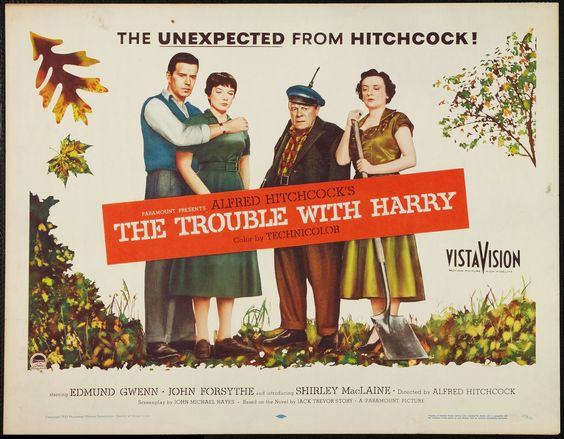
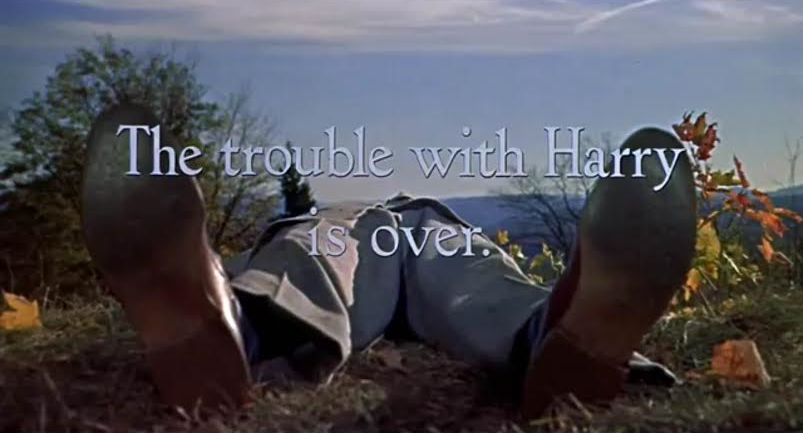
After wanting to watch The Trouble with Harry (1955) for quite some time, I was finally able to get my hands on a copy last month. It did not disappoint.
This isn't your typical Hitchcock film, and the viewer shouldn't go into it expecting one. Just watch the trailer and you will see what I mean.
That being said, here are five reasons you should watch The Trouble with Harry:
1. It's Hitchcock's only comedy. Yes, he also directed Mr. and Mrs. Smith (1941) but that was at the request of Carole Lombard and doesn't really have his "stamp" on it. Hitch's droll humor is unmistakable in this one.
2. Edmund Gwenn and Mildred Natwick. They are the REAL leading couple of the film. Without them, it would not be the delightful and unique film that it is! And who said falling in love over a corpse is only for young people?
3. Shirley MacLaine. It's her film debut and she nails it. It's not easy to play in a black comedy but her performance feels like that of a veteran.
4. Little Jerry Mathers of Leave it to Beaver fame. Only 6 years old, Mathers sprouts some of the most memorable lines and because he's so little they are all the more humorous.
This is a two-muffin rabbit.
5. The scenery. The fact that it was filmed in Vermont during a glorious autumn is more than enough reason to watch this movie. Okay, so some of the scenes ended up being shot in California with fall colored leaved glued on the trees, I couldn't tell the difference!