Last year Virginie of
The Wonderful World of Cinema hosted the 1st Wonderful Grace Kelly Blogathon in honor of her Serene Highness's birthday. This year she is back with the
2nd Wonderful Grace Kelly Blogathon. For last years event I wrote about the fashion marriage of Grace Kelly with the renowned costume designer Edith Head. This year I am writing about
The Swan (1956), Grace Kelly's last film to be made (
High Society was her final film to be released).
CAST:
Grace Kelly.....................Princess Alexandra
Alec Guinness..........................Prince Albert
Louis Jourdan......................Dr. Nicholas Agi
Jessie Royce Landis...............Princess Beatrix
Agnes Moorehead.........Queen Maria Dominika
Brian Aherne.................Father Carl Hyacinth
Estelle Winwood.........................Symphorosa
The film tells the story of Princess Alexandra (Kelly) meeting her distant cousin, Crown Prince Albert (Guinness), that she, and her mother, are hoping will propose marriage so that they can regain the throne that was taken from them by Napoleon Bonaparte. When the Prince (Guinness) appears to show no interest in Alexandra, she tries to make him jealous by pretending to be love with her brother's tutor, Nicholas (Jourdan). Nicholas has been secretly in love with Alexandra which, like the constellation mentioned several times, creates a love triangle.
The star Vega that Nicholas points out to Alexandra, is part of the Summer Triangle, a constellation made from three other constellations: Aquila (the Eagle), Lyra (the Harp), and Cygnus (the Swan).
The three constellations have another metaphor (aside from one of them being names "The Swan"). According to Kelly's biography by Donald Spoto, "Beatrice and her household represent an old and now inadequate way of life. Albert and his mother stand for a kind of royalty that can still be relevant in a modern world - a working family mindful of the need for a new social order. And Nicholas and Alexandra (a noteworthy choice of names in light of the couple still reining in Russia) represent the unlikely lover."
Spoto goes on to say:
The film sparkles with delicate humor that leavens the gravity with which it explores the nature of romantic love in a rapidly changing world dominated by class struggles. In this regard, Alexandra is not simple a foolish, inexperienced young woman. She is a sympathetic soul who, in the course of the story, moves through the stages of moral education, comporting herself at first with charming awkwardness, then relying on her idea of what it is to be a love-struck maiden, and finally accepting that her ambitions and her vocation require sacrifices she has not yet considered.
Under the pretense of being a romantic film, it is actually "high comedy, puncturing social pretenses and exaggerated expectations of life gently and without bombast or cruelty.
The Swan is also a remarkably earnest depiction of the shallow, fading monarchical pretensions of minor European royalty."
Symphorosa
Princess Beatrix (Landis) feigning illness so that she doesn't have to deal with Queen Maria.
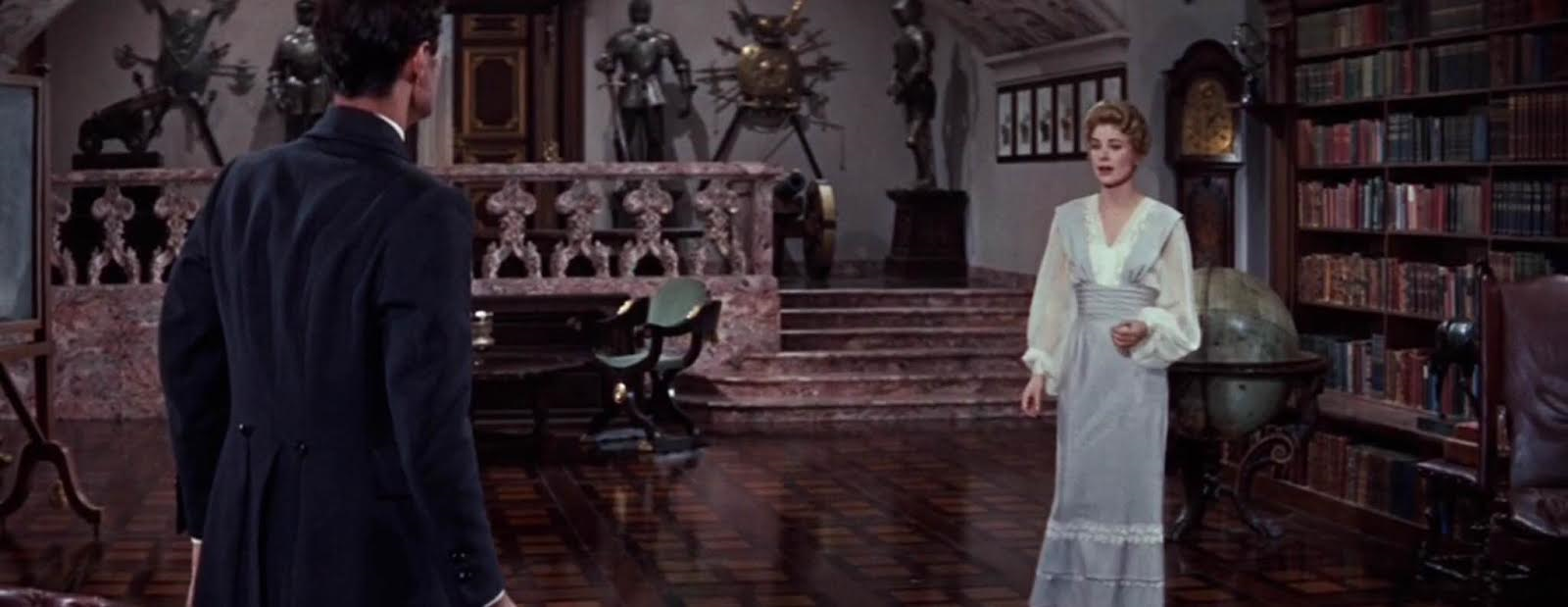
One of the things I noticed about this film was the use of Cinemascope to emphasize emotional distance. There are several shots where Alexandra and Nicholas or Alexandra and Prince Albert are on opposite sides of the screen. There are also shots when the Prince is shown literally standing between Alexandra and Nicholas, as he is the one preventing their love to be realized.
Spoto on Kelly and Jourdan:
Louis Jourdan, as the lovesick, mistreated academic, knew how to play a young man at the mercy of his emotions. His love scenes with Grace in the carriage by moonlight and on the terrace are lessons in the fine art of making such moments both credible and affecting.
For much of her time onscreen, Grace remains silent, or speaks but a few words. But we see her listening, we watch her subtle reactions and confusions, and her muted passion in the cyclorama against which everyone must play. The performance is like a pantomime in a silent movie: she communicates every emotion with only the slightest changes in facial expression.
One scene worth mentioning is when Alexandra comes to invite Nicholas to the ball. We just see her feet as she walks into the room, hesitates, turns to go, and then comes into full frame when Nicholas notices her. It's a brilliantly filmed scene:
Another thing that must be mentioned is the location. The exteriors were filmed at Biltmore House in the mountains of North Carolina. I especially liked the scenes where the house is being readied for the arrival of the Prince. I wonder if they used extras or just filmed the actual staff cleaning?
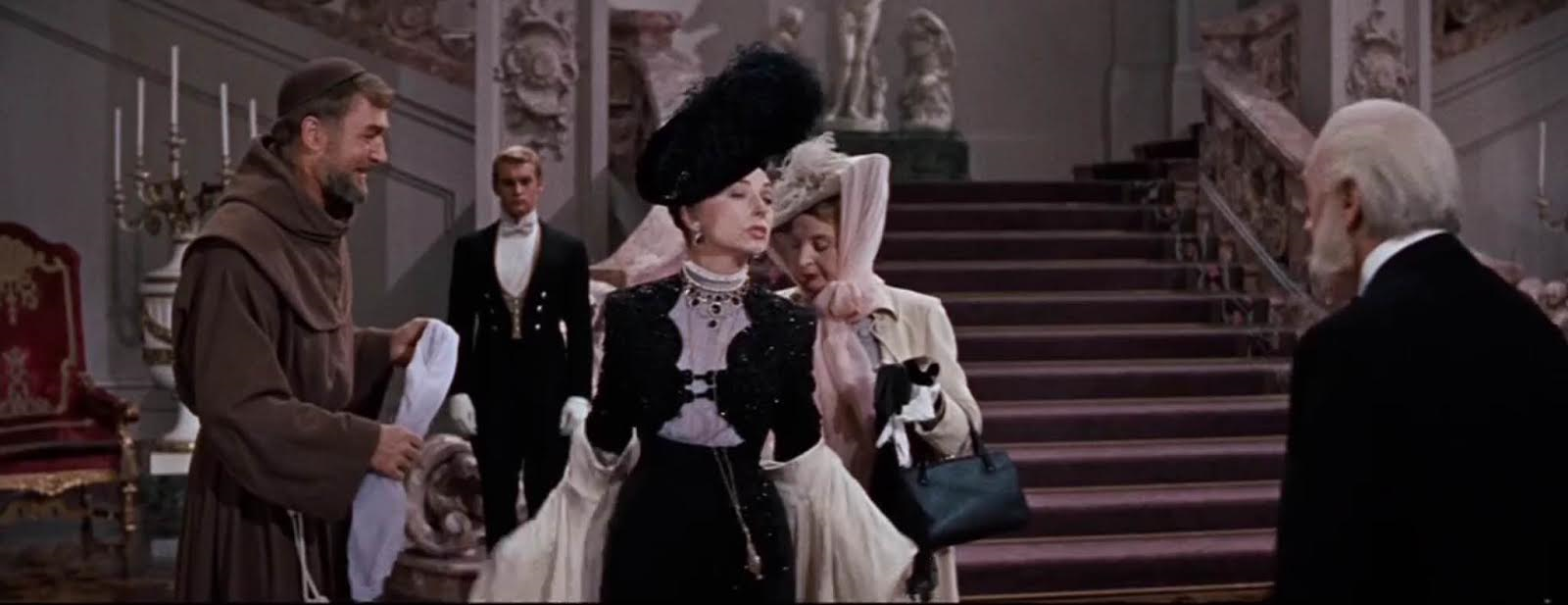
The interiors for the film are also spectacular, as seen in these shots:
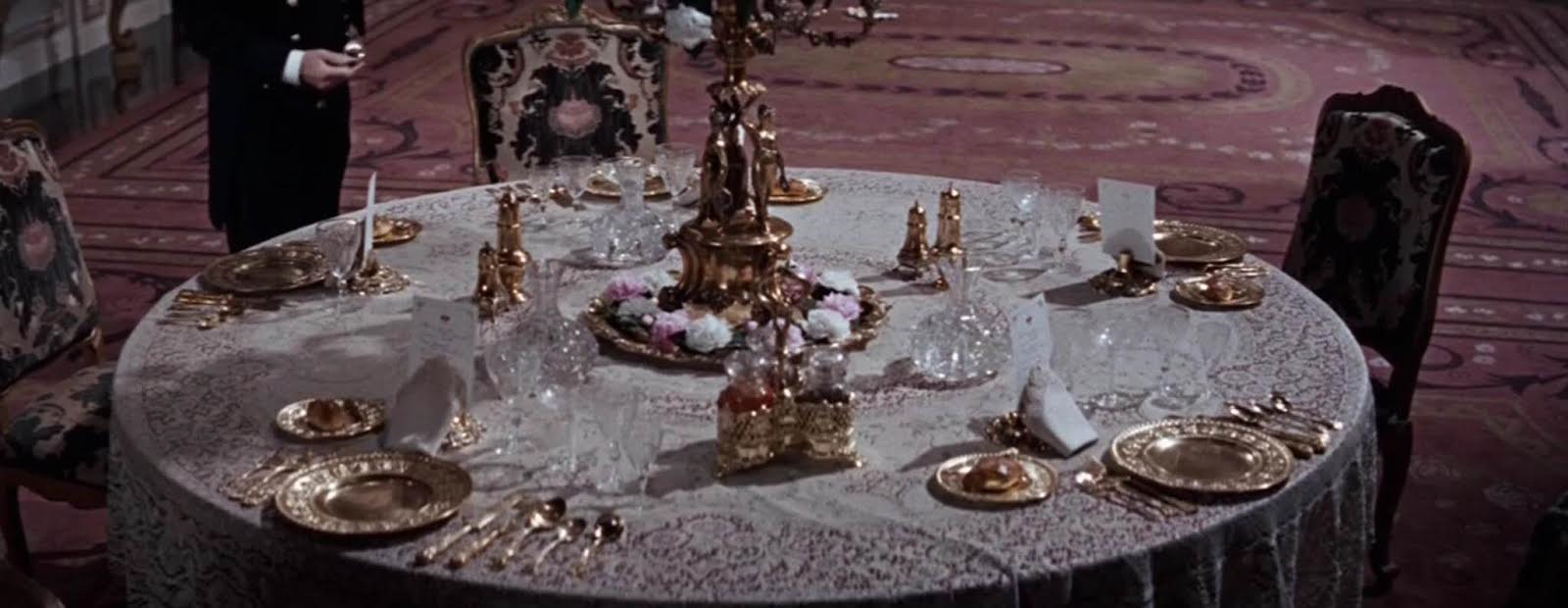
Great care was taken in the set dressing, as seen in this set table:
Also worth mentioning is the costumes in the film. Designed by Helen Rose, who also designed Kelly's wedding gown, the gowns designed for Princess Alexandra "were an enchanting look." Kelly "was trilled when [she] saw Helen's sketches and some of the exquisite fabrics she had selected."
Helen Rose said "I never saw a star as thrilled as Grace the day we fitted the white chiffon ball gown. She stood before the mirror, gently touching the embroidered camellias and saying, 'How simply marvelous, Helen - what talented people you have here at MGM!' For weeks, several skilled women had sat at embroidery frames, carefully working by hand each petal of every flower. The ball gown was indeed fit for a princess." You will notice that almost all of Kelly's gowns are white, another reference to the title of the movie.
Trivia:
The role of Prince Albert was offered first to
Rex Harrison and
Joseph Cotten. While I personally would have preferred either of them, Alexandra's sacrifice at the end wouldn't seem that bad (especially with Cotten).
One of the reasons this film is special is that, unknown to the public, Grace Kelly really was about to marry a prince, Prince Rainier of Monaco. Unlike the film, however, Grace was marrying for love.
The film premiered on
April 18, 1956 to coincide with Grace Kelly's wedding day.
Kelly named her son
Albert, which is the name of Guinness's character in the film.
Shots I didn't include above:
Favorite Shots:
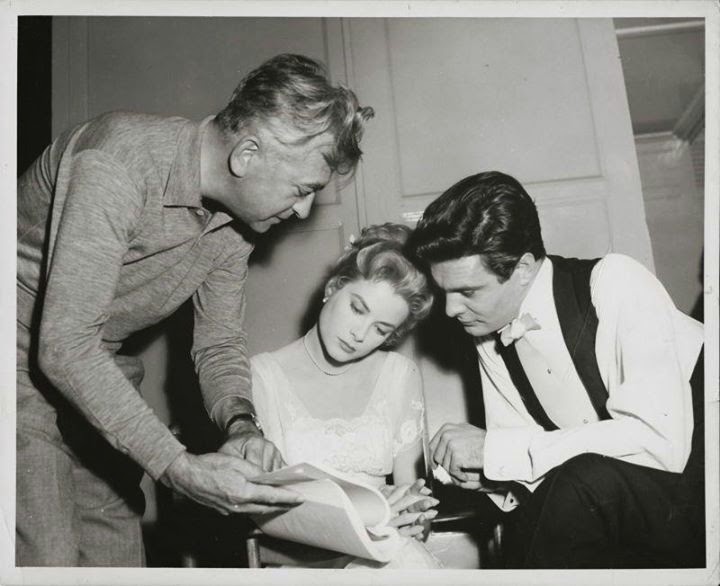
Behind-the-Scenes:
With costume designer Helen Rose
Kelly's birthday on the set
Sources:
High Society: The Life of Grace Kelly. Donald Spoto. Harmony Books. 2009