Showing posts with label Aldo Ray. Show all posts

Monday, May 16, 2022

National Classic Movie Day: Four Favorite Noirs Blogathon

UPDATE: This was my 500th blog post!

The National Classic Movie Day Blogathon hosted by the Classic Film & TV Cafe every year is one of the highlights of every blogger's calendar. This year the topic is Four Favorite Film Noirs

Not long after the very first National Classic Movie Day Blogathon, I wrote a post on my top 5 Film Noirs. A month later I lengthened it to ten (#6 and 8 would no longer have any chance of being on that list). However, at the time, I had hardly seen any, as it wasn't particularly my favorite genre - some of them were a little too violent or dark for my taste. As I got older though I discovered that they were actually really good. Like, REALLY GOOD. Becoming a Robert Ryan fan also helped ;) Anyway, without further ado, here are four of my favorite Noirs.

(1948)

I loved Act of Violence (1948) so much I rewatched it again a month later and took over 300 screenshots (you can see them here on my blog Facebook page - don't go all the way to the end if you haven't seen the movie). On the surface, war hero Frank Enley (Van Heflin) has a great life. He has a beautiful young wife (Janet Leigh) an adorable baby, and is well respected by his community. But when a mysterious man with a limp begins to stalk him, Enley's life quickly unravels and his dark secret is exposed. He confesses to his wife that during his time in a POW camp he became an informer in exchange for food. The man who is following him (Robert Ryan), was his friend Joe, who suffered torture because of Heflin's actions. Joe is out for revenge, intent on killing Enley and punishing him for his actions. Enley tries to run from Joe and even hires a hit man, with the help of a woman he meets in a bar (Mary Astor). Of course, being a Noir, the viewer already knows that Enley is doomed to his fate.
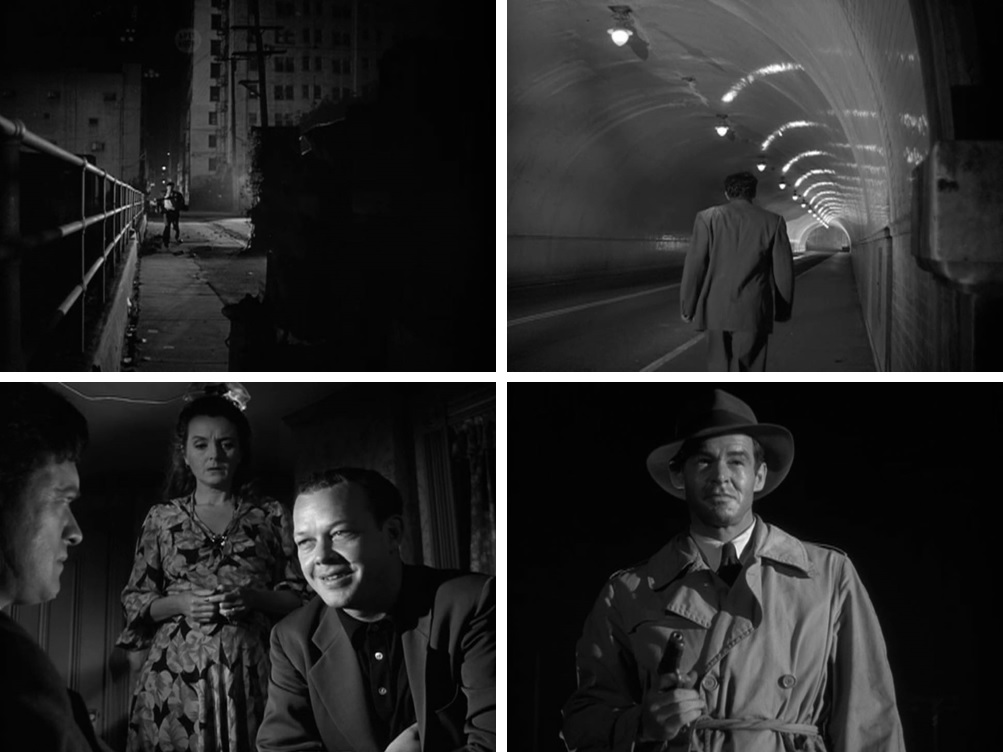
The deft cinematography of David Surtees is a visual depiction of Enley's worsening nightmare. It "shimmers with sunlight" at the beginning of the film and gradual descends into something "straight out of a Freudian nightmare"(Film Noir FAQ, David J. Hogan, p. 343). This is also aided by on-location shooting. The director, Fred Zinnemann, had "learned the value of authentic locations, and this new picture gave him and Surtees a chance to photograph the real LA, where Enley flees and descends into the criminal underworld." This "sense of realism extended to the actors as well. 'No makeup of any kind was used on any member of the cast,' wrote Surtees. 'We tried to maintain on the screen a high standard of skin texture.' This technique heightened the hard set of Ryan's face, with its lined brow and sneering mouth" (The Lives of Robert Ryan, J.R. Jones, p.84-85).

(1956)

Nightfall (1956) is what I call a "snowy noir." There's something about black and white cinematography and snow that I just love. Also, this film stars Aldo Ray (anybody else think he has a sexy voice? lol). Vanning (Ray) is a commercial artist who has been wrongly accused of murdering his friend while on a hunting trip in Wyoming. Not only that, but he's also accused of robbing a bank. Following from town to town is an insurance investigator for the bank and the two real bad guys, the pistol whipping, trigger happy Red and John (Brian Keith), the brains of the outfit. Vanning meets a model, Marie Gardner (Anne Bancroft), at the bar one night and let's his guard down a little. As they exit he is intercepted by John and Red, who intimate that Marie was helping them. He manages to  escape and heads to Marie's apartment to confront her but she assures him of her innocence. He tells her his story and then the two of them take the bus to Wyoming to try and find the money that can clear his name. The movie climaxes with an epic shootout/fight involving a snowplow. You can watch it on YouTube. It was directed by Jacques Tourneur(who directed another favorite of mine, Cat People) with cinematography by Burnett Guffey. 

Love this shot of Brian Keith.

(1944)

In Phantom Lady (1944), a man is accused of murdering his wife. The only person who could provide him with an alibi is a "phantom lady" with an unusual hat. His secretary, Kansas (Ella Raines), sets out to clear his name. I was blown away when I first saw this movie and Raines became an instant favorite. Rather than me try and describe it, please just do yourself a favor and watch it. 

My favorite shot from the film.

Elwood Bredell was selected as cinematographer. He was advised by director Robert Siodmak to "study Rembrandt's paintings as an example of how dark shadows could attract the eye of the viewer toward a certain portion of the composition." There is a "contrast between the bright, well-organized business world inhabited by Carol and her boss and the city's distorted, menacing underworld, as Carol slides even further down the rabbit hole," and a "nightmarish atmosphere through highly stylized moments, rich textures, and claustrophobic settings... Siodmak favored low-key lighting, which would lend itself to sharply contrasting shadows and large areas of black" (Phantom Lady: Hollywood Producer Joan Harrison, The Forgotten Woman Behind Hitchcock, Christina Lane, p. 147-148). 

(1946)

Nobody Lives Forever (1946) stars one of my favorite actors, the ever-troubled John Garfield. It is unusual in that much of the film takes place in the sunlight instead of the typical Noir darkness and on the beach instead of the city streets. Even then, the dark scenes are shrouded in mist instead of bathed in garish neon lights.

I'm going to cheat a little here and link up a post I wrote on the film several years ago. There are lots of great screenshots on the post.

Saturday, December 31, 2016

We're No Angels (1955)


Whenever a movie star dies during their prime in a tragedy, they immediately become immortalized in our culture. Jean Harlow, James Dean, Marilyn Monroe, Carole Lombard - these amazing talents stopped sparkling on earth but continued to sparkle in the heavens, brighter than they were before.

There are also the stars that died not long after their prime had passed, not yet old enough to retire, but not so young that it sent the world into shock. Many of these are still well-loved, but without the intensity of those who's life was snatched away from them.

Humphrey Bogart died in 1957, less than a month after his 57th birthday, after a year long fight against esophageal cancer. He had been married to Lauren Bacall for just a little under 12 years and had two children with her: Steve age 8 and Leslie age 4½. He had two Oscar nominations - Casablanca (1945) and The Caine Mutiny (1955) - and one win - The African Queen (1951) - out of his 85 credit career. The 5'8" star weighed a shocking 80 pounds when he left this earth in his sleep on January 14th.


After Bogart's death, a strange phenomenon took place. On college campuses everywhere Bogart was considered the epitome of cool, with students showing up to showings of Casablanca wearing trench coats and snap-brim hats, dangling cigarettes from their mouths, and reciting the dialogue (War on the Silver Screen). His name even became a slang word in the 70s meaning "to steal, take an unfair share" (Slang and Sociability). And it wasn't just the male students that liked Bogart. The female population had their own reasons for liking him:
In 1964 Time sent a reporter to the Brattle, where the Bogart festival was now a hallowed tradition. A Blue Parrot room, named for Sydney Greenstret's cafe in Casablanca, had been set up in the theater. Nearby a jukebox kept playing 'As Time Goes By.' 'When Bogart lights a cigarette on the screen,' the article stated, 'girls respond with big, sexy sighs.' Asked about the object of their affection, a Radcliffe student lamented the Age of Analysis: 'Bogie is everything we wish Harvard men were,' she said. 'Bogie's direct and honest. He gets involved with his women but he doesn't go through an identity crisis every five minutes' (source).

Bogart's film career can be divided into two phases. From 1930 to 1934 he played supporting roles, usually gangsters. Then, in 1936, he got the film part he originated on Broadway, that of Duke Mantee in The Petrified Forest. The role was good and Bogart took advantage of it. However, it still seemed that his film career was over as he was still stuck in the gangster roll.

In 1941 he again played a gangster, but this time it was one with a heart. The film was High Sierra and it set Bogart on the path to super-stardom. The films that followed were hits that are still popular to this day: The Maltese Falcon (1941), Casablanca (1942), and To Have and Have Not (1944) - the first of four films with Lauren Bacall, whom he married in 1945.


In 1955, Bogart was near the end of his career, though he didn't know it at the time. He made three films that year, one of them being We're No Angels, an unlikely Christmas comedy (he would make only one more film the following year). We're No Angels, though set at Christmas, 1895, was released on July 7, 1955. Directed by Michael Curtiz, the film has a stellar cast including Bogart, Peter Ustinov, Aldo Ray, Leo G. Carroll, Joan Bennett, Basil Rathbone, and Gloria Talbott. It follows three escaped criminals from Devil's Island who stop at a small shop with intentions of swindling the family, only to help the proprietor with his financial problems instead as well as spend the holidays with him, his wife and daughter.


Joseph (Bogart), Albert (Ray), and Jules (Ustinov) have managed to escape from nearby Devil's Island and plan on stealing some money and clothes so they can board a ship in the harbor heading for Paris. They steal a letter addressed to a Felix Ducotel (Carroll) and deliver it hoping for compensation. The kind-hearted man thinks they are convict laborers and even though his store barely makes any money - everyone seems to buy on credit - he hires them to repair the roof. While on the roof, the three men eavesdrop and, aside from noticing what a handsome wife Ducotel has, find out that Ducotel's store is not doing well and that he is under pressure from his cousin, Andre Trochard (Rathbone), to either do better or lose his job. They also learn that Ducotel's daughter Isabelle is in love with cousin Andre's nephew, Paul (John Baer).


The letter the three escapees delivered turns out to be from cousin Andre, who is stuck on the ship in quarantine. He wants Ducotel to come get him and Paul out. When Isabelle reads the letter (it also says that Paul is to be married to someone else) she faints, leading to my favorite part of the movie:


While Ducotel is trying to get his cousin off the boat, Joseph, who is good with finances - or rather moving numbers around, decides to help out Ducotel for fun. He starts out by selling a brush set to a bald man (you can watch that scene here), a small sized coat to a fat man, and getting a female customer to pay part of her bill. Touched by their help, Mrs. Ducotel (Bennett) invites the men to spend Christmas with them. Joseph, Albert, and Jules get into the spirit: stealing a turkey, getting flowers from the governor's garden, preparing the Christmas Eve meal and decorating the house - even finding a tree.


After a lovely dinner, and a cash gift from Ducotel, the men begin to reconsider their plan of robbing and killing the family (despite their crimes, one never suspects the three to actually do any harm to the family - it is a comedy after all). Just as Joseph has finished telling the other two they will go through with their plan, cousin Andre and Paul show up. They wake up the family, take the best rooms, and are a general pain.

We came here to rob them and that's what we're gonna do - beat their heads in,
gouge their eyes out, slash their throats. Soon as we wash the dishes.

In the end, the three "angels" help Isabelle see that Paul is not right for her and get rid of Ducotel's problems - with the help of a certain pet named Adolfe. They then decide that maybe they shouldn't try to escape after all and head back to prison.


We're No Angels was based on French play La Cuisine des Anges by Albert Husson. It was departure for Bogart, as well as director Curtiz, both who were known for more hardened pictures. It was also their fourth and final collaboration together.

Bennett and Bogart playing chess on the set.

As well as having comedic lines on-screen, Bogart also had fun off-screen, pulling such pranks as putting raw liver in his co-stars shoes and fake poop in Curtiz's trailer. And while they may not have appreciated those pranks, the camaraderie they had is apparent in the film, making it a delightful film to watch and one of my favorite films of Bogart. It is a performance any Bogart fan will not want to miss (or the occasional non-Bogart fan).

Foreign posters

This post is part of The Humphrey Bogart 117th Birthday Blogathon hosted by Sleepwalking in Hollywood and Musings of a Classic Film Addict.