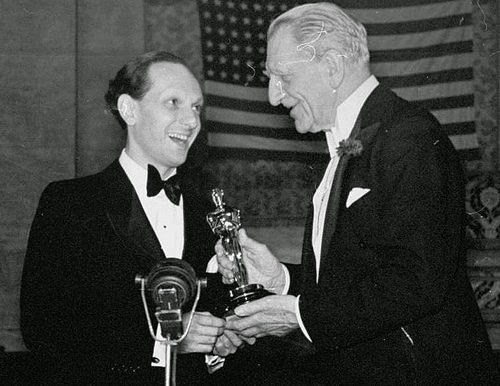
Saturday, February 21, 2015

Countdown to the Oscars: 1939


1939 has always been remembered as a big year for movies. Everyone has at least heard of the classics Gone With the Wind and The Wizard of Oz and if you are a classic movie fan you've probably also heard of Stagecoach and Mr. Smith Goes to Washington. Yes, 1939 certainly was a great year. The only problem was there wasn't enough awards to go around. All of them could not win Best Picture.


Gone With the Wind swept the awards like the fire swept Atlanta, setting a new record with 8 awards plus the Irving Thalberg award for producer David O. Selznick. It won Best Picture, Best Actress (Vivien Leigh), Best Supporting Actress (Hattie McDaniel), Best Director (Victor Fleming), Film Editing, Art Direction, Screenplay (the writer, Sidney Howard, had died during production and therefore became the first posthumous winner), and Color Cinematography (new classification). It was also nominated for Best Actor (Clark Gable), Best Supporting Actress (Olivia de Havilland), Sound Recording, and Special Effects.


The Wizard of Oz won Best Song (Over the Rainbow), Best Original Score, and a Juvenile Award for Judy Garland. It had a total of 5 nominations (including Best Picture, Art Direction, and Special Effects).

You can never listen to this song too many times

Stagecoach, best known as being John Wayne's breakout role, was nominated for Best Picture, Best Director (John Ford), Film Editing, Art Direction, and B&W Cinematography. It won for Best Supporting Actor (Thomas Mitchell) and Music-Scoring. Unfortunately Wayne was not nominated for his role as the Ringo Kid.


Mr. Smith Goes to Washington was nominated in nine categories for Best Picture, Best Actor (James Stewart), Best Supporting Actor (Harry Carey), Best Director (Frank Capra), Film Editing, Art Direction, Music-Scoring, Sound Recording, and Writing-Best Screenplay. It only won one of it's nominations: Writing-Best Original Story.


Other Best Picture nominees were Dark Victory starring Bette Davis, Goodbye Mr. Chips starring Robert Donat and Greer Garson (6 nominations, 1 award), Love Affair starring Irene Dunne (and Charles Boyer), Ninotchka starring Greta Garbo, Of Mice and Men (Lon Chaney Jr. and Burgess Meredith), and Wuthering Heights (starring Laurence Olivier and Merle Oberon - 7 nominations, 1 award) - names not in parenthesis also nominated for Best Actor or Actress.

><><><><><><><><><><><><><><><><><><
 
 
The ceremony was held on Feb. 29, 1940 at the now famous Cocoanut Grove of the Los Angeles Ambassador Hotel. Bob Hope was the Master of Ceremonies, his first of 19 times. The winners names were accidently printed in the 8:45pm edition of the Los Angeles Times, meaning there were no surprises. After this incident, the envelope reveal as we know it was instituted.


Here we see the stars arriving:


Best Picture: Gone With the Wind
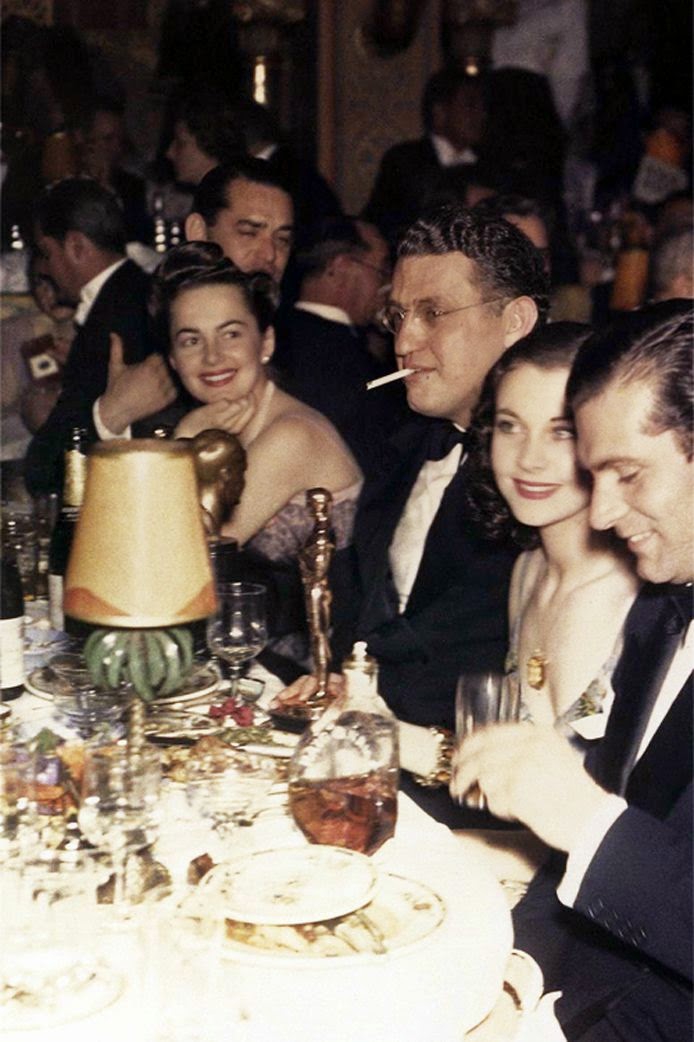
Olivia de Havilland, David O. Selanick, Vivian Leigh, and Laurence Olivier

Best Actor: Robert Donat in Goodbye Mr. Chips (Mickey Rooney was nominated for his first 'real' Oscar for his performance in Babes in Arms)

Spencer Tracy accepted for the absent Donat

Donat

Best Actress: Vivien Leigh in Gone With the Wind


Best Supporting Actor: Thomas Mitchell in Stagecoach (he was also in Gone With the Wind and Mr. Smith Goes to Washington as well as several other films that year - a very busy guy)


Best Supporting Actress: Hattie McDaniel in Gone With the Wind - here is a great article about McDaniel's career and win.

Being presented with her award by Fay Bainter

Best Director: Victor Fleming for Gone With the Wind


Special Awards:

To Douglas Fairbanks, "recognizing the unique and outstanding contribution of Douglas Fairbanks, first president of the Academy, to the international development of the motion picture." Fairbanks had died two months before. His son, Douglas Fairbanks Jr., accepted the award on his behalf.


To Judy Garland for her "outstanding performance as a screen juvenile during the past year."


To Technicolor Company for its "contributions in successfully bringing three-color feature production to the screen." (There is a dvd special feature on the three-strip Technicolor process on The Adventures of Robin Hood - 1938.)

Other notable films of 1939: The Women, Gunga Din, The Private Lives of Elizabeth and Essex, The Hunchback of Notre Dame, Bachelor Mother, Golden Boy (William Holden's breakout role), Intermezzo (Ingrid Bergman's American film debut), Beau Geste.

Take a look at this very complete timeline of movie history in 1939 for more movies from this year.

Watch this fantastic 17 minute presentation,
Cavalcade of the Academy Awards. 
It shows the stars arriving and accepting their awards. I love how Bob Hope is sitting in the background in between presentations.

Thursday, February 19, 2015

Countdown to the Oscars: 1935 - 1938


1935

It was around the mid thirty's that the Academy Award statue acquired the nickname of Oscar. It is not known exactly who came up with it, as several people claimed they named it. Robert Osborne, host of Turner Classic Movies, has recorded a little video recounting how the Oscar got its' name. Also in 1935, a new category was added for Dance Direction.

The eighth Academy Awards was held on March 5, 1936, at the Biltmore Hotel. Frank Capra was the host and D. W. Griffith presented the awards. It was also the second and last year write-ins were allowed. The only person to win a write-in was Hal Mohr for Cinematography for the film A Midsummer Night's Dream. Mohr was sitting at home when he got the call: "I shaved, threw on a tux, and with my wife jumped in a cab ad was there in an hour. I'm very proud of that award."

Irving Thalberg, Bette Davis and Frank Capra
 
The Academy Awards was boycotted that year by some of its members due to antagonism between several industry guilds over union matters. This led to the first declined Award by writer Dudley Nichols, who wrote the screenplay for The Informer. It would not be the last.

Best Picture: Mutiny on the Bounty (1935) starring Charles Laughton, Clark Gable, and Franchot Tone


Best Actor: Victor McLaglen in The Informer (1935) - Paul Muni came in second as a write-in over nominees Clark Gable, Franchot Tone, and Charles Laughton.

McLaglen, Davis, and D.W. Griffith

Best Actress: Bette Davis in Dangerous (1935) - likely awarded because of her overlooked performance in Of Human Bondage the year before


Best Director: John Ford for The Informer (1935)


Special Award: D. W. Griffith (David Wark) for his "creative achievements as director and producer and ... lasting contributions to the progress of the motion picture arts."

1936

The next year brought two more categories, Best Supporting Actor and Best Supporting Actress. They were awarded plaques rather than statues until 1943 (though in the following pictures they are all shown with statues - maybe they were handed a statue and then received their plaque afterwards).

 
Voting rules also changed. Nominations for awards were made by a special committee of fifty individuals appointed by Academy President Frank Capra, with equal representation from each of the Academy's branches, and the final decisions were made by a vote of all Academy members (85 Years of the Oscar).
 
 
The ceremony was held on March 4, 1937, at the Biltmore Hotel. The host and presenter was George Jessell.  
 
Jessell
 
Best Picture: The Great Ziegfeld (1936) starring William Powell and Luise Rainer. The award was accepted by Louis B. Mayer, as seen in the video below. This was also the first biopic to win an award.
 
 
Best Actor: Paul Muni in The Story of Louis Pasteur (1936) beating out William Powell in My Man Godfrey, Gary Cooper in Mr. Deeds Goes to Town, Walter Huston in Dodsworth, and Spencer Tracy in San Francisco.

Still sporting his beard

Best Actress: Luise Rainer in The Great Ziegfeld (1936) beating out Carole Lombard in one of her greatest performances in My Man Godfrey, Irene Dunne in Theodora Goes Wild, Norma Shearer in Romeo and Juliet, and Gladys George in Valiant is the Word for Carrie. Watch Rainer accepting her award (with multiple takes!) here.


Though I agree that Rainer's performance was excellent, I really wish that Lombard would have won, since her career was cut short by her death in 1942.
 
Best Supporting Actor: Walter Brennan in Come and Get It (1936)


Best Supporting Actress: Gale Sondergaard in Anthony Adverse (1936), which won 4 awards that year (including cinematography, music score, and film editing)


Best Director: Frank Capra for Mr. Deeds Goes to Town (1936) starring Gary Cooper and Jean Arthur

Muni, Rainer, and Capra (his 2nd Directing Award)
 
 
Academy Award Out-takes!

Special Award: W. Howard Greene and Harold Rosson for the color cinematography of The Garden of Allah (1936)

1937

The 10th Academy Awards was held on March 10, 1938 at the Biltmore Hotel. Even though it was delayed a week due to flooding of the LA area, there were more than 1300 guests in attendance. The host was comedian Bob Burns. All members of the Academy were allowed to vote to choose the nominees and winners.


Best Picture: The Life of Emile Zola (1937) starring Paul Muni


Best Actor: Spencer Tracy in Captains Courageous (1937) - Tracy's wife accepted the award for him as he was recovering from an operation. When his award was sent to be inscribed it came back engraved to "Dick Tracy" and had to be sent back to be corrected.

Best Actress: Luise Rainer for The Good Earth (1937) making her the first to win two consecutive awards


Rainer was not in attendance and had to be called to accept her award.
Her dress is actually a nightgown!
 
Best Supporting Actor: Joseph Schildkraut in The Life of Emile Zola (1937)

(on left)

Best Supporting Actress: Alice Brady in Old Chicago (1937) - Brady did not attend the ceremony due to a broken ankle. She was nominated the year before for her role of the mother in My Man Godfrey (1936)

Alice Brady and Charles Winninger - her award was stolen at the ceremony;
here she is getting a replacement.

Best Director: Leo McCarey for The Awful Truth (1937) starring Cary Grant and Irene Dunne


Special Award: To  the Museum of Modern Art Film Library for its "significant work in collecting films dating from 1895 to the present and for the first time making available to the public the means of studying the historical and aesthetic development of the motion picture as one of the major arts."

1937 Irving Thalberg Memorial Award Recipient: Darryl F. Zanuck

Zanuck and Douglas Fairbanks

~ Irving Thalberg, who was the legendary head of production at MGM and husband of actress Norma Shearer, had died the year before on Sept. 14th. This award, a bust of Thalberg, is given to producers whose "bodies of work reflect a consistently high quality of motion picture production." - source

1938

The 11th Academy Awards the biggest ceremony to date, even though the shadow of WWII had fallen over the world. The ceremony was held on Feb. 23, 1939 at the Biltmore for the fourth year in a row. There was no Emcee. Actors Cedric Hardwicke and Tyrone Power handed out the awards. The Music category added Best Original Score (which went to The Adventures of Robin Hood - 1938 - the DVD has a very interesting special feature on the music of the film).

Tyrone Power with Janet Gaynor
 
There was an unauthorized live radio broadcast that lasted about 12 minutes before it was shut down. You can hear a minute of it here (second sound clip down). You can also hear them talking about Spencer Tracy being photographed with his award (third sound clip down). 

Best Picture: You Can't Take It With You (1938) starring James Stewart, Jean Arthur, Lionel Barrymore, Edward Arnold, and Spring Byington. It beat The Adventures of Robin Hood (1938) starring Errol Flynn and Olivia de Havilland, which to this day is still the best loved version of the classic tale. It won three awards that night, including Art Direction and Film Editing.


Best Actor: Spencer Tracy in Boys Town (1938) - first actor to win two consecutive Oscars

Tracy and Davis

Best Actress: Bette Davis in Jezebel (1938)


Best Supporting Actor: Walter Brennan in Kentucky (1938) - his 2nd consecutive win in this category. I wish it would have gone to John Garfield in Four Daughters (1938)...what a performance! Once he is introduced in the film he dominates it.

Brennan and Bainter

Best Supporting Actress: Fay Bainter in Jezebel (1938) - she was also nominated for Best Actress for her role in White Banners (1938), making her the first to be nominated the same year for those two categories

Best Director: Frank Capra for You Can't Take It With You (1938)

Capra with his third award

Special Awards:

Juvenile Award to Mickey Rooney and Deanna Durbin for their "significant contribution in bringing to the screen the spirit and personification of youth, and...setting a high standard of ability and achievement."

Rooney, age 18

Deanna Durbin, age 17

To Walt Disney for Snow White and the Seven Dwarfs (1938), a "significant screen innovation which has charmed millions and pioneered a great new entertainment field for the motion picture cartoon."

 
The special Oscar statuette, an Oscar figure accompanied by seven 'dwarf' Oscar figures, was awarded to Walt Disney by Shirley Temple. Upon unveiling the award Shirley Temple exclaimed "Isn't it great Mr. Disney? Aren’t you proud of it Mr. Disney?" Disney replied “I’m so proud I think I’ll bust.”


To Harry M. Warner in "recognition of patriotic service in the production of historical short subjects presenting significant episodes in the early struggle of the American people for liberty."