Showing posts with label Gone With the Wind. Show all posts

Saturday, February 3, 2018

Three Times Clark Gable Proved He Could Act


Clark Gable was known for his macho image in the movies, an image he carefully cultivated and protected. In much the same way how John Wayne always plays John Wayne in his films, so Clark Gable is always Clark Gable. That devil-may-care smile, those mirthful eyes, a man who takes on life as it comes and enjoys every minute of it, all trademarks of the "King."


But the King of Hollywood had another side to him. And it was this side of himself that he was terrified to show. Behind the scenes and away from the prying eyes of the camera, he was a voracious reader and a lover of poetry. Whenever he was called upon to touch on this other side of himself, to show emotion, he worried that he would be laughed at or seen as unmanly. Yet it is these precise scenes which allow Gable's true talent as an actor to shine through. In these moments he's no longer Clark Gable but really becomes his character. Below are three scenes from the films Gone With the Wind (1939), Adventure (1945), and San Francisco (1936) in which Gable proved he could act:


{{THE FOLLOWING CONTAINS SPOILERS}}

The most famous example of this comes from the most famous movie in all of film history: Gone With the Wind. It's not a scene that's widely quoted, but it is one of the most, if not the THE most, emotional scenes in the film. Bonnie Blue Butler, the daughter of Rhett Butler and Scarlett O'Hara, has just been killed in a horse riding accident. Bonnie was the joy of Rhett's life. He spoiled her, comforted her when she was scared, and loved her more than anyone else in the world. Her death leaves him inconsolable. Melanie, played by Olivia de Havilland, goes into the room where is sitting alone, drinking, and tries to comfort him. In the scene, director Victor Fleming wanted Gable to cry, which Gable refused to do. He wanted to stand with his back turned to the camera in heavy sorrow. De Havilland talked him into at least trying the scene the way Fleming wanted it, and Fleming promised that if Gable didn't like it they would do it his way.

I remember talking to Clark about the scene when he is supposed to cry, after the death of his daughter. He was worried: you see, he had never cried on the screen before. He thought it was not masculine to cry.  He was so worried about it. ‘I’m just going to have to quit,’ he told me. I remember I said, ‘Tears denote strength of character, not weakness. Crying makes you intensely human.’ He agreed, rehearsed it, and it turned out to be one of the most memorable scenes in the movie (source).

After viewing the two different versions, Gable agreed that Fleming's way was more effective and one of the most heartbreaking and poignant scenes in cinema was born.


The ending scene of Adventure (1945) starring Gable and Greer Garson, contains another powerful scene in which their newly born child nearly dies. Gable, a sea captain who married Garson and then went back out to sea, comes home and learns that his wife is about to have a baby. When he arrives at the house the situation is grave. Garson is very weak and the baby is struggling to live. Gable goes into the room where the doctors are working on the baby. As he watches, they give up. The baby has stopped breathing. Gable goes over the table and looks down on this tiny baby and begins yelling at it, telling it to live so he can give him back to his mother. And at the last moment, the baby begins to breathe. It's a dramatic and emotional scene, heightened for me by the fact that Gable died before the birth of his son in real life, and only met his daughter with Loretta Young once.

The only picture of the scene I could find.
If it comes on TCM again I will record it and post it here.

In another ending scene, this time after the Academy Award winning earthquake scene in San Francisco (1936), Gable is walking through the streets, frantically searching for Jeannette MacDonald and horrified by all the death and destruction going on around him. This was the only scene I was able to find on YouTube (in three parts below).

Start at 3:50


Look at the expressions on his face in this scene, as he searches for the woman he realizes he can't live without. Gable masterfully conveys what his character is going through without speaking and the audience fears the worst with him. And when he finds her, the audience feels the overwhelming rush of relief and thanksgiving that Gable feels.


I hope you enjoyed this look at the Three Times Gable Proved He Could Act. If you've seen these films do you agree with me? Are there any other scenes you would have included? I watched Parnell (1936) last week and it too had a powerful closing scene and an overall restrained performance from Gable that, at the time of it's release, hurt the picture but now serves to show that "The King" was capable of so much more than the studio system, and himself, was willing to let him be.

This post is for the Dear Mr. Gable: A Celebration of the King of Hollywood Blogathon hosted by Love Letters to Old Hollywood in honor of Clark Gable's birthday. Be sure to check out the other great posts on this legendary actor!

Monday, June 22, 2015

David O. Selznick - 50 Years


You've all seen this image before. The sun-dappled sign. The big white house. It's the logo for Selznick International, the studio that produced such classics as Gone With the Wind (1939) and Rebecca (1940).


Today is the 50th anniversary of the death of David O. Selznick. What does the 'O' stand for? Well it doesn't stand for O'Malley. In fact, it doesn't stand for anything! Here's his explanation:
I have no middle name...I had an uncle, whom I greatly disliked, who was also named David Selznick, so in order to to avoid any growing confusion between the two of us, I decided to take a middle initial and went through the alphabet to find one that seemed to give me the best punctuation and decided on 'O'.
With his wife, Irene

Selznick was born May 10, 1902. In 1930 he married Irene Mayer, daughter of Louis B. Mayer, the head of MGM. Selznick worked for MGM until 1935, when he leased a section of the RKO Studios lot and opened his own production company, Selznick International (in 1957 it became Desilu). Production chief of MGM Irving Thalberg, who was married to Norma Shearer, helped finance the studio.
The trick in adapting novels is to give the 'illusion' of photographing the entire book. Tis is more difficult than creating an original [script].
Selznick International was committed to making pictures of the highest quality. Selznick ruled over his films with an iron fist (famously clashing with director Alfred Hitchcock, who was also used to complete control, on the pictures they made together). The studio produced between 2 and 3 pictures a year. Some of these pictures included: A Star is Born (1937), Nothing Sacred (1937), Made for Each Other (1939), Intermettzo (1939), Gone With the Wind (1939), Rebecca (1940), Since You Went Away (1944), I'll Be Seeing You (1945), and Spellbound (1945). The stars under contract there included Ingrid Bergman, Gregory Peck, Joan Fontaine, Shirley Temple, Joseph Cotton, and many others. You can see photos and drawings of the studio backlots here.
The difference between me and other producers is that I am interested in the thousands and thousands of details that go into the making of a film. It is the sum total of all these things that either makes a great picture or destroys it.
The studio closed in 1943, as Selznick could not afford to pay the enormous taxes. After that he formed Vanguard Films, Inc. and in 1946 it became the Selznick Releasing Organization.


In 1949, Selznick divorced Irene and married the actress Jennifer Jones (who had divorced Robert Walker in 1945). They remained married until Selznick's death on June 22, 1965.

Here's a really cool article with photos of their home.


Hollywood's like Egypt, full of crumbling pyramids. It'll just keep on crumbling until finally the wind blows the last studio prop across the sands.

One of the things Selznick was famous for was his exceptionally long memos. He even left a memo directing the handing of his funeral. Here's part of what he said (taken from Joseph Cotten's autobiography Vanity Will Get You Somewhere, 163):
I shall need a rabbi for, though I have not been a very good Jew, I am a Jew. But I would like a rabbi who doesn't know me too well; then he can't talk too long and bore my friends. I suppose a few words will have to be said; I would like them spoken by a good voice, so if Joseph Cotten is in the country I want him to say them. Also, he will be brief. 

Sources:
IMDb
Vanity Will Get You Somewhere by Joseph Cotten  
Wikipedia
Pinterest - images
 

Saturday, February 21, 2015

Countdown to the Oscars: 1939


1939 has always been remembered as a big year for movies. Everyone has at least heard of the classics Gone With the Wind and The Wizard of Oz and if you are a classic movie fan you've probably also heard of Stagecoach and Mr. Smith Goes to Washington. Yes, 1939 certainly was a great year. The only problem was there wasn't enough awards to go around. All of them could not win Best Picture.


Gone With the Wind swept the awards like the fire swept Atlanta, setting a new record with 8 awards plus the Irving Thalberg award for producer David O. Selznick. It won Best Picture, Best Actress (Vivien Leigh), Best Supporting Actress (Hattie McDaniel), Best Director (Victor Fleming), Film Editing, Art Direction, Screenplay (the writer, Sidney Howard, had died during production and therefore became the first posthumous winner), and Color Cinematography (new classification). It was also nominated for Best Actor (Clark Gable), Best Supporting Actress (Olivia de Havilland), Sound Recording, and Special Effects.


The Wizard of Oz won Best Song (Over the Rainbow), Best Original Score, and a Juvenile Award for Judy Garland. It had a total of 5 nominations (including Best Picture, Art Direction, and Special Effects).

You can never listen to this song too many times

Stagecoach, best known as being John Wayne's breakout role, was nominated for Best Picture, Best Director (John Ford), Film Editing, Art Direction, and B&W Cinematography. It won for Best Supporting Actor (Thomas Mitchell) and Music-Scoring. Unfortunately Wayne was not nominated for his role as the Ringo Kid.


Mr. Smith Goes to Washington was nominated in nine categories for Best Picture, Best Actor (James Stewart), Best Supporting Actor (Harry Carey), Best Director (Frank Capra), Film Editing, Art Direction, Music-Scoring, Sound Recording, and Writing-Best Screenplay. It only won one of it's nominations: Writing-Best Original Story.


Other Best Picture nominees were Dark Victory starring Bette Davis, Goodbye Mr. Chips starring Robert Donat and Greer Garson (6 nominations, 1 award), Love Affair starring Irene Dunne (and Charles Boyer), Ninotchka starring Greta Garbo, Of Mice and Men (Lon Chaney Jr. and Burgess Meredith), and Wuthering Heights (starring Laurence Olivier and Merle Oberon - 7 nominations, 1 award) - names not in parenthesis also nominated for Best Actor or Actress.

><><><><><><><><><><><><><><><><><><
 
 
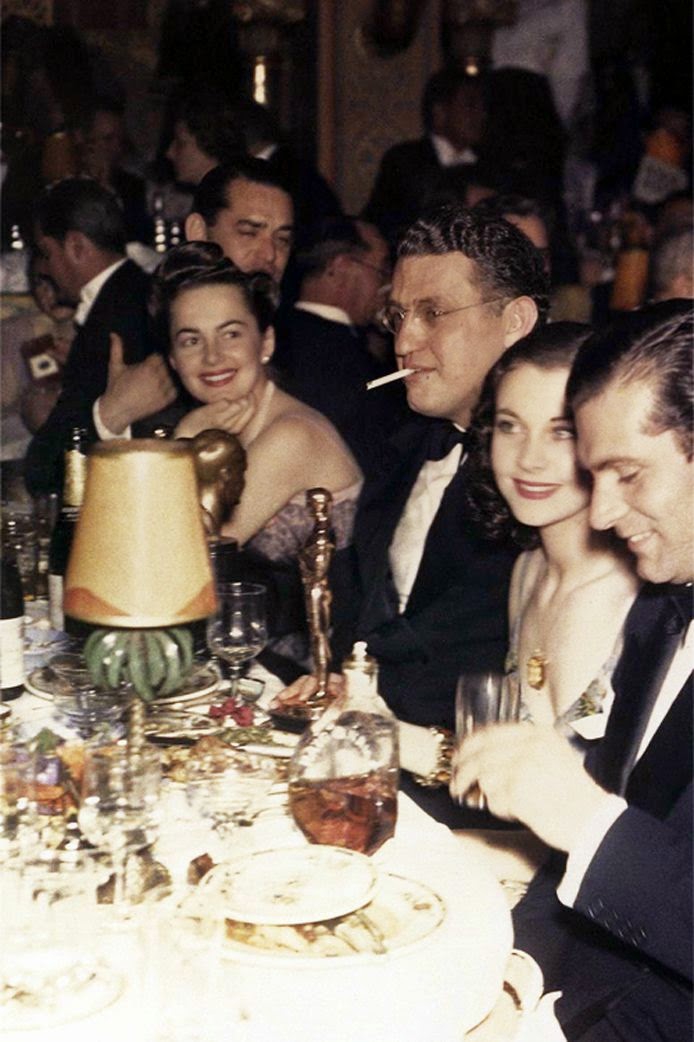
The ceremony was held on Feb. 29, 1940 at the now famous Cocoanut Grove of the Los Angeles Ambassador Hotel. Bob Hope was the Master of Ceremonies, his first of 19 times. The winners names were accidently printed in the 8:45pm edition of the Los Angeles Times, meaning there were no surprises. After this incident, the envelope reveal as we know it was instituted.


Here we see the stars arriving:


Best Picture: Gone With the Wind

Olivia de Havilland, David O. Selanick, Vivian Leigh, and Laurence Olivier

Best Actor: Robert Donat in Goodbye Mr. Chips (Mickey Rooney was nominated for his first 'real' Oscar for his performance in Babes in Arms)

Spencer Tracy accepted for the absent Donat

Donat

Best Actress: Vivien Leigh in Gone With the Wind


Best Supporting Actor: Thomas Mitchell in Stagecoach (he was also in Gone With the Wind and Mr. Smith Goes to Washington as well as several other films that year - a very busy guy)


Best Supporting Actress: Hattie McDaniel in Gone With the Wind - here is a great article about McDaniel's career and win.

Being presented with her award by Fay Bainter

Best Director: Victor Fleming for Gone With the Wind


Special Awards:

To Douglas Fairbanks, "recognizing the unique and outstanding contribution of Douglas Fairbanks, first president of the Academy, to the international development of the motion picture." Fairbanks had died two months before. His son, Douglas Fairbanks Jr., accepted the award on his behalf.


To Judy Garland for her "outstanding performance as a screen juvenile during the past year."


To Technicolor Company for its "contributions in successfully bringing three-color feature production to the screen." (There is a dvd special feature on the three-strip Technicolor process on The Adventures of Robin Hood - 1938.)

Other notable films of 1939: The Women, Gunga Din, The Private Lives of Elizabeth and Essex, The Hunchback of Notre Dame, Bachelor Mother, Golden Boy (William Holden's breakout role), Intermezzo (Ingrid Bergman's American film debut), Beau Geste.

Take a look at this very complete timeline of movie history in 1939 for more movies from this year.

Watch this fantastic 17 minute presentation,
Cavalcade of the Academy Awards. 
It shows the stars arriving and accepting their awards. I love how Bob Hope is sitting in the background in between presentations.

Monday, December 15, 2014

75th Anniversary of "Gone With the Wind"

Premiere button

75 years ago today, Gone With the Wind premiered at the  Loew's Grand Theater in Atlanta, Georgia. All the big stars attended...the white ones that is. Because it was located in the South, the black members of the cast were not allowed to attend, causing racial tensions. Clark Gable was going to boycott the event until Hattie McDaniel, who won the Academy Award for Best Supporting Actress for her role (and had to sit at a separate table for blacks at the Awards ceremony), insisted he attend. Check out the article and slideshow below for more about the most successful film of all time.

Remembering 'Gone With the Wind' Slideshow

TCM Blog Article: Behind the Scenes

Tara façade found in old barn - watch the video here

Hattie McDaniel winning her award

A page from the premiere program
 
Ticket stub - tickets to the premiere cost $10 because of the length of the film, the highest in cinema history!
 
Ad for the event
 
Evening coat worn by author, Margaret Mitchell at the Atlanta premiere.
 
I have yet to watch this movie. I have seen several parts before (as well as Carol Burnett's spoof, Went With the Wind, which you can watch below) but have never watched it in one (or two) sittings. I checked it out from the library recently but never got around to watch it. It is definitely on my list though. I also read the first few chapters of the book.