Showing posts with label Judy Garland. Show all posts

Wednesday, January 24, 2018

"Uncle Buzz" and Mickey and Judy

 
Busby Berkeley is a name well known to Classic Movie fans and especially fans of musicals. The choreographer/director was a trendsetter in the business with his staging concepts in such films as 42nd Street (1933) and Footlight Parade (1933). Berkeley, who had been working at Warner Brothers for six years, was brought to MGM in 1939. His first film there was Babes in Arms.


Babes in Arms was Berkeley's first time working with Mickey Rooney and Judy Garland, both child actors who had been working since they were toddlers and who already had impressive filmographies. Judy had just finished working on The Wizard of Oz, which would earn her a Juvenile Academy Award, and would arrive to recording sessions before filming of Babes in Arms began still in her costume and makeup as Dorothy Gale (Berkeley choreographed a routine for the Scarecrow that was cut from the final film).
Nobody ever topped Judy and Mickey. I don't know any two kids who could be better than those two were. Judy...called me 'Uncle Buzz' and always wanted me right there when the camera was photographing her. She would not do a scene unless I stood by the camera, and afterward she would ask me how she looked and if she had done all right.
Mickey Rooney remembered Berkeley as:
...a genius. He could be charming, with his flashing eyes and huge, expressive eyebrows and a smile that warmed everyone around him. But he had one small problem: he drank... [and] he had that alcoholic's perfectionism. He was tough on all of us. He was always screaming at Judy, 'Eyes! Eyes! Open them wide! I want to see your eyes!' To him her eyes were her greatest asset. 
The film, about the kids of vaudeville performers with dreams of staging a production of their own, featured impressive musical numbers. With Berkeley it was always BIG!


Here's a deleted scene with Rooney as President Roosevelt. The footage was removed and destroyed after FDR's death in 1945. Footage was found recently on foreign prints and someone put it on YouTube!


The entire film, which Rooney considered to be his best performance (he was nominated for an Academy Award) was shot in only eleven weeks and was a 'solid smash hit,' making it onto the Top Ten Box Office Hits list of 1939 - and we all know what a year THAT was!

Judy celebrating her 16th birthday on the set, with Rooney and Berkeley.

The film was quickly followed by another great success, Strike Up the Band (1940), with Rooney as a drummer who turns his high school band into modern dance orchestra with dreams of winning a nationwide band contest. Berkeley again directed, and left his unmistakable touch on the film's finale, "Do the La Conga," which he wanted to be "a huge number with about five minutes of Judy singing and every possible camera angle... AND he decided he wanted to do the entire song and dance number in one take." Everyone else in the production was dubious but after five days of rehearsals and careful laying out of every shot, Berkeley got what he wanted. Roger Edens, who wrote the song, remembered the atmosphere that enveloped everyone, saying it was "like the opening [night] of a Broadway show. There was the same great tension, because the number could only be shot once. When the morning came to shoot, the whole studio was down there. Everyone was very tense and keyed up-and the result was a real giving performance. The scene went beautifully, without a hitch. Even now it has an unforgettable something extra about it." You can watch it below.


Berkeley on the set of Strike Up the Band:


Why mess with success? The trio got together again for Babes on Broadway (1941), this time putting on a show for British war orphans to help realize their dreams of Broadway (I sang "Chin Up, Cheerio, Carry On" for our church's USO show a few years back - I was nowhere near as good as Judy though). 


Busby Berkeley directs this sort of thing about as well as anybody.
~ Variety


Berkeley was also to direct Girl Crazy (1943), the fourth musical with Rooney and Garland but he was removed from the film at Garland fell ill from overwork. Berkeley, who had been ill himself, wanted a big splashy number, clashing with Edens and causing a situation where only one of them could stay. As both Judy and Mickey could no longer handle his militant dictated, directing was taken over by Norman Taurog. Berkeley's only contribution to the film, the "I Got Rhythm" number, was left in the film. You can watch it (in two parts) below:


Source
Mickey and Judy 
The Metro-Goldwyn-Mayer Musicals of Mickey Rooney and Judy Garland
A History of the Four Garland/Rooney Musicals and a Guide to the Original Soundtrack Recordings
 
 
This post is part of The Busby Berkeley Blogathon hosted by Hometowns to Hollywood. Be sure to check out all of the other posts on this celebrated director and choreographer!

Saturday, April 8, 2017

"Are you a Good Witch or a Bad Witch": The Annual Classic Quotes Blogathon


Movie Quotes. For some of us, especially Classic Movie Bloggers, they are a part of everyday life. Those of us who are movie fans can often summon up the perfect quote for any occasion. Not everyone may realize that it's a movie quote and they may even give you an odd look until you explain that it's from a movie. But we same them anyway and always feel a little proud of ourselves for integrating our love of film into a normal conversation (or what was normal until you opened your mouth).

Sometimes a quote has become so much a part of the culture that people say it without realizing what it's from. And sometimes it's just so quotable that people say it whether it goes with the conversation or not. This is the premise behind The Flapper Dames Annual Classic Quotes Blogathon, to celebrate and share these beloved and famous quotes.

The Wizard of Oz (1939) is endlessly quotable. Pretty much every time a storm is coming someone in my family begins to shout out "Dorothy! Dorothy!" as they put things away so they won't get wet or blown away. "I'll get you my pretty, and your little dog too" is another one that sometimes makes it into the conversation, or "There's no place like home" (which is of course more effective if you actually own a pair of ruby slippers).

Another quote from the film, while not normally used in a conversation, is still worth mentioning for a reason I will explain to you:

Are you a Good Witch? Or a Bad Witch?

We all remember this scene. Glinda, played to perfection by the one and only Billie Burke, comes floating down to Munchkinland in her pink bubble and, upon seeing Dorothy, asks her this question. To Dorothy the question makes no sense, but to Glinda it is the only question to ask, as there are no humans in Munchkinland.


After Dorothy replies that she's actually a girl and says that witches are old and ugly, Glinda tells her with a smile:

Only bad witches are ugly.

Didn't you just ask Dorothy if she was a good witch or a BAD witch???

She basically just called Dorothy ugly...

 
Be sure to check out all of the other posts on the
iconic quotes we all love from Classic Movies!

Monday, December 19, 2016

The Clock (1945)


"The Clock was unique."

These were Vincente Minnelli's words when he was interviewed some thirty years later by Richard Schickel (The Men Who Made the Movies) on the films he had made in his thirty-three year career. It was only his fourth film, following Cabin in the Sky (1943), I Dood It (1943), and the Christmastime favorite Meet Me in St. Louis (1944) where he met the "little girl with the big voice," Judy Garland.

Minnelli was finishing up Ziegfeld Follies (1946) when Judy asked him to take over a movie she was making that was in danger of being scrapped. The film was The Clock, starring Judy and Robert Walker. Based on an unpublished short story by Paul and Paulline Gallico, and scripted by Robert Nathan who wrote the novels The Bishop's Wife and Portrait of Jennie, the film started under the direction of Jack Conway and then Fred Zinnemann, before being replaced with Minnelli.


Minnelli had to make some key changes to make the story - of a young soldier on leave and a girl who keep bumping into each other, go out on a date, fall in love, and marry, all in two days - work. The most important thing he did was to make New York a character: "Everything I could remember about New York went into it." He also made some cast changes, with Ruth Brady taking over Audrey Totter's role as Alice's (Garland) roommate, and James Gleason replacing Hume Cronyn as the milkman (Gleason's real-life wife played his wife in the movie as well).
This love story is really about the urgent mood of a city in war-time, etched with the same extraordinary precision of detail. By turns exuberant and claustrophobic, his [Minnelli] milling panoramas aren't merely a picturesque frame for a simple love story. New York's indifferent hubbub shapes everything that happens to The Clock's anonymous working girl and average GI on leave: edging them closer together for a touch of human warmth, abruptly dividing them in the chaos of the subway at rush hour ("Directed By Vincente Minnelli" by Stephen Harvey).

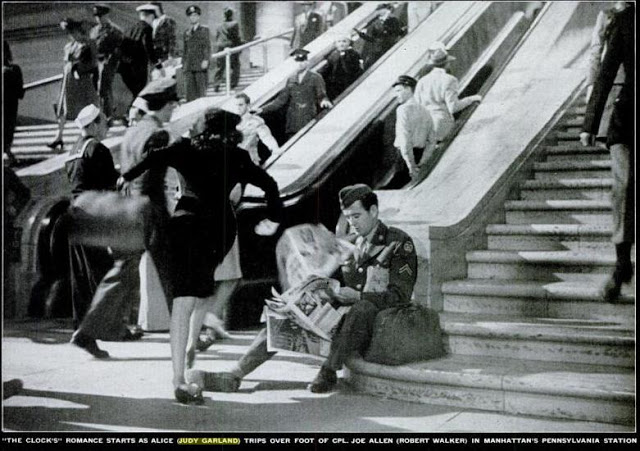
The film begins with the camera singling out a soldier from a crowded Pennsylvania Station. Then it picks out a young woman, following her until she runs into the soldier, who accidently trips her causing her heel to break.

Shoe appreciation alert.

They end up spending the day together - riding an open-air bus, going to the zoo, and touring the Metropolitan Museum. After they part, Joe (Walker) realizes he wants to see Alice again so he chases her bus and asks her to meet him that evening.
To convey the heroine's shy, contemplative quality, much of the time he [Minnelli] built her characterization on her hesitant gestures and the innate tenderness of those expressive eyes ("Directed By Vincente Minnelli" by Stephen Harvey).
Check out Judy's cute hat!

Back at her apartment, Alice's roommate discourages her from keeping her date, saying it's just another soldier's pick-up, but Alice goes anyway. They have dinner and then go walking in the park, where they have their first kiss.


Then, realizing they missed the last bus back into town, they catch a ride with a friendly milkman Al Henry (Gleason) on his milk truck. They stop at small diner where a drunk (Keenan Wynn) punches Al, leaving him unable to finish delivering the milk. Joe and Alice step in and finish for him, ending at the milkman's house where his wife makes them breakfast. Mrs. Henry sees that the young couple are in love and tells them they should get married, since she has been so happy married to Al.


Alice in Joe head to the subway to start wedding plans and get separated. Realizing they don't even know each others last names, they frantically search for each other, finally thinking to go to the spot where they met for their first date - the clock at the Astor Hotel. They head to city hall to get married where this humorous incident occurs:


They then find out just how difficult it is to get married quickly - blood tests, the marriage license with the standard waiting period - not to mention everything is in different buildings in different parts of town. When they do finally get married, it is in an office that is being cleaned and with the vacuum lady standing in as a witness. Afterwards the newly-weds go to a diner where Alice breaks down over their unromantic wedding. They head to a nearby church, where a couple has just been married, and whisper their wedding vows, again to one another in the light of the candles.


The following morning, a glowing bride fixes a simple breakfast for her husband and takes him to the station, where he heads out to rejoin his outfit to finish the war before he can come back to his little wife.

 
♥ ♥ ♥

 
I have to say a word on George Folstey's cinematography. Folsey had just photographed Garland exquisitely in the Technicolor musical Meet Me in St. Louis (1944) and was asked to do same in black and white. I have to admit it was difficult to not take a million screenshot's of Judy's beautifully lit face.


Trivia:

This film, Judgment at Nuremberg (1961) and A Child Is Waiting (1963) are Judy Garland's only non-singing movies.

When Alice meets Joe for their first date, they meet under the Beaux Arts clock in the lobby of the Astor Hotel in Times Square. This then-famous hotel was built in 1904, and demolished in 1967 to make way for the One Astor Plaza office tower.

The lady at the luncheonette counter is Moyna MacGill, Angela Lansbury's mother.

Minnelli and Judy, who had started dating during the filming of Meet Me in St. Louis, had actually been separated, with Judy resuming her relationship with Joseph Mankiewicz. However, during the filming of The Clock they got back together, marrying on June 15th, less than a month after the picture was released.


This post is part of The Vincente Minnelli Blogathon hosted by Love Letters to Old Hollywood. Please be sure to read all of the other posts celebrating this great director!

Monday, May 30, 2016

Ten Movies on an Island: Musicals


As promised, here is my first list of my top ten in each movie genre: musicals, westerns, dramas, comedies (screwball/romantic & regular comedies), comedy-drama, horror/ghost/sci-fi, suspense/mystery, biographical, and Disney.

This list will focus on musicals. First of all, what is a musical? According to the definition on Wikipedia, a musical is:
... a film genre in which songs sung by the characters are interwoven into the narrative, sometimes accompanied by dancing.
Throughout Hollywood History, the musical has evolved. A musical from the 1930s is not going to be the same as a musical from the 1950s. Over the decades, there have been Operetta's, Horse Operas (that's a Western that's also a musical), the Busby Berkley musicals, biopics about musicians and showmen, Historical costume epics, fantasies, musicals adapted from Broadway productions, rock & roll musicals, beach party musicals... the list goes on.

Now I'm not a huge musicals person (surprising since I love music, sing, and play both the piano and the ukulele).  But I've never been a huge fan of the musicals that typically come to mind when someone says the word "musicals,"  so you will not be finding such classics as Singing in the Rain and Oklahoma! on here.

In picking my films, I did decide on a certain criteria, aside from merely liking it. It had to be a movie that I enjoyed the songs as much as the storyline (aka I actually know most if not all of the songs by heart) and if I looked for it at the library I would find it in the musicals section. So with those two things in mind, here is my list:
1. The Great Ziegfeld (1936) - William Powell
2. The Wizard of Oz (1939) - Judy Garland
3. Ziegfeld Girl (1941) - Lana Turner, Judy Garland, Hedy Lamarr
4. Girl Crazy (1943) - Judy Garland & Mickey Rooney
5. Gentlemen Prefer Blondes (1953) - Marilyn Monroe, Jane Russell, Charles Coburn
6. White Christmas (1954) - Bing Crosby & Rosemary Clooney, Danny Kaye & Vera-Ellen
7. Daddy Long Legs (1955) - Fred Astaire & Leslie Caron
8. My Fair Lady (1964) - Audrey Hepburn & Rex Harrison
9. The Sound of Music (1965) - Julie Andrews & Christopher Plummer
10. Funny Girl (1968) - Barbra Streisand & Omar Shariff
Here is the list I consulted when choosing my Top Ten Musicals. What are your favorites?

Tomorrow, my top ten Westerns!

Tuesday, December 22, 2015

Movie Stars Singing Christmas Carols

Judy Garland singing "Have Yourself a Merry Little Christmas."
 
And "The Birthday of a King."
 
Cary Grant "singing" "Christmas Lullaby."
 
Rosemary Clooney singing "Suzy Snowflake"
 
Bing Crosby singing "Marshmallow World."
 
Dean Martin singing "Baby it's Cold Outside."
 
Frank Sinatra & Nat King Cole singing "The Christmas Song."
 
Nat King Cole & Danny Kaye singing "Jingle Bells" (White Christmas special features).

Monday, April 6, 2015

Mickey Rooney: 1 Year Later

Today is the first anniversary of the death of Mickey Rooney. A man such as him needs no introduction.

 
Mickey and the King (Clark Gable) on the set of Manhattan Melodrama (1934)
 
I always wished I could have met Mickey Rooney because of his close relationship with Judy Garland, who was my childhood idol. I mean, come on, she had an amazing voice AND a great pair of shoes!

 
I always felt that somehow Judy and him should have ended up together. He was the only one who truly knew what she went through, because he went through it with her. She always seemed so genuinely happy with him. And they both went through so many spouses it makes you wonder.

You can watch the entire program here on Youtube.
 
 This is my favorite picture of Mickey and Judy - Babes on Broadway (1941)

 
Betty White on the loss of Mickey Rooney

A few mind-blowing statistics from IMDb:
  • He was the only surviving screen actor (as of 2007) to appear in silent films and still continue to act in movies into the 21st century.
  • May have been the only actor in history to appear in at least one film in ten consecutive decades.
  • Ranked first in front of Barbara Stanwyck, Bette Davis, Jane Wyman, Eddie Albert, and Ernest Borgnine, in the number of movies; he appeared in over 100 films.
  • In Guinness book of world records for longest movie career of 86 years (1925-2011).
  • Began performing at the age of 17-months, as part of his parents' routine, wearing a specially tailored tuxedo.
  • Had two films released after his death: Night at the Museum: Secret of the Tomb (Dec. 2014) and Dr. Jekyll ad Mr. Hyde (2015) which comes on the 17th of this month.
All images found via Pinterest

Sunday, April 5, 2015

Happy Easter!

Just wanted to share with you this picture and song from the movie Easter Parade (1948) starring Fred Astaire, Judy Garland, and Ann Miller - Watch it on TCM tonight at 8pm ET! MarsMoonlight wrote a fantastic post on this film the other day on her blog, Back to Golden Days. Check it out!

Watch the movie to find out why Judy is making this face!
 
 
Happy Easter!

Thursday, January 1, 2015

Happy New Year!

♥Happy New Year from some of my favorite stars
 
 John Wayne and 3rd wife Pilar
 
 Judy Garland
 
 Carole Lombard in Made for Each Other (1939) - forgot it on my list
 
Lombard kissing Jimmy Stewart