Showing posts with label Irene Dunne. Show all posts

Saturday, October 9, 2021

Royal Film Performance Series: The Mudlark (1950)

Truth, Brisbane

The occasion of the fifth annual Royal Film Performance took place on Monday, the 30th of October, 1950 at the Empire Theatre in Leicester Square. The previous Friday had the coldest recorded temperature since April with the first snow of the year and the evening of the performance was cold and wet. The film chosen was The Mudlark (1950), about a young boy who sneaks into Windsor Castle to meet Queen Victoria, played by Irene Dunne. 

The caption reads: "This startling likeness to Queen Victoria as she was at 56 is achieved by Miss Irene Dunne in the film "The Mudlark," now being made in England. Two hours are needed every morning for make-up, the foundation of which is cosmetic latex (rubber). This enables the make-up to follow the muscles of the face. Grease-paint is laid over the latex" (Chronicle, Adelaide, SA).

There was much controversy about the choice of film, as Queen Victoria was the great-grandmother of the current King, George VI. According to one newspaper article, the committee "dithered delicately over the question whether some scenes were suitable for Royal eyes. For example, John Brown, Queen Victoria's gillie, refers to Her Majesty as 'she,' and criticizes a dress she is wearing. The 'Mudlark' himself, a tattered urchin who breaks into Windsor Castle, sits on the Throne in his rags. He says, ' Course I see'd the Queen. Sat on the bleedin' Throne, too, that's wot.' " In bold the article continues: "The word 'bleedin' ' was deleted and the committee was considering further cuts when word came from the King that he hoped to see the same version of the film as the public would see." It continued, "Queen Mary [mother of King George], who has never attended a post-war Royal film performance, is to have a copy of The Mudlark shown to her privately just before the performance on Monday week."

This wasn't the only controversy. An article by Dick Kisch for The Daily Telegraph (Sydney, NSW) claimed that, due to "the number of rows, temperamental displays, and rivalries" between British actors and "high-powered American glamour girls" over such things as seating arrangements and precedence when it comes to meeting "Their Majesties," this could be the very last "Royal Command Film Show ... staged in Britain." The organizers of the annual Royal Command VARIETY Show complained that the Film Show was "deliberately trying to steal their thunder." These things were obviously settled as the Royal Film Performance is still in existence today (the recent Bond premiere was NOT part of the RFP, which raises money for the Cinematograph Trades Benevolent Fund). 

The Advertiser (Adelaide, SA).

Over 8000 people braved the rain - some for over 8 hours - to catch a glimpse of the Royals' arrival. They were not disappointed. Marie Watson reported for The Courier-Mail: "Everyone arrived in their best, and if not owning a chauffeur-driven car, hired a Rolls or a Daimler to pull up in front of the theatre for a 'flashbulb' welcome. When everyone was in their seats, a newsreel man broadcast the arrival in the foyer of the Royal Family, and described their actions" (Watson). The Royal ladies "stole the fashion show" when they "arrived dressed in black frocks, making a dramatic foil to the pastel-hued model gowns and fine jewels chosen by women film stars. The contrast made the Royal trio look more strikingly impressive than they have ever looked before outside full Royal regalia." When they entered the foyer, "people gasped at the similarity of the Queen's and her two daughters' dresses." The Queen was reported as wearing black velvet crinoline, with Princess Elizabeth wearing black georgette and Princess Margaret wearing black net. The reason behind this rare occurrence of Royals wearing black had a simple reason - they were dressed in mourning after the recent death of King Gustav of Sweden. This didn't stop them however from adding some serious Royal jewels: "All three dresses were low cut to display a frosty sparkle of magnificent diamond necklaces. The two Princesses had smoothly coifed hair without ornaments, but the Queen wore a diamond tiara" (The Advertiser, Adelaide, SA). They kept warm with "rich white furs" (The Age, Melbourne). When they "entered the auditorium... a dozen trumpeters in the household dress heralded their arrival" (Watson). 

This article makes you feel like you are actually there. And click here to see the newsreel (no sound). Irene Dunne arrives at the five minute mark. The Royals arrive at seven minutes. This video shows the Royals chatting with the stars afterwards (also no sound). HM the King and James Stewart didn't seem to have much to talk about lol.

There were over fifty stars in attendance that evening, including Irene Dunne (Queen Victoria), Alec Guinness (Disraeli), Andrew Ray (the "Mudlark"), Michael Wilding, Margaret Lockwood, Glynis Johns, Richard Todd, Tyrone Power, Montgomery Clift, and - as several newspapers noted - several middle-aged stars, such as Marlene Dietrich (46), Gloria Swanson (52), Claudette Colbert (45), and for the gentlemen, Ray Milland, James Stewart (and family), and John Mills - "It was undoubtedly the evening of the over-40s."

"Marlene Dietrich was in a bouffant pink off-the-shoulder frock. Gloria Swanson wore a slinky black frock, trimmed with fox fur" (The Courier-Mail, Brisbane). "All looked wonderfully glamorous, even under the fierce glare of arc lamps. Dressed in a charming bouffant dress of russet-colored net, embroidered with gold beads, Claudette got almost the biggest hand of the evening when she made her bow on the stage" (The Newcastle Sun, NSW). You can see their gowns well in this video (no sound). 

To read the full article, click here.

Dick Kisch shared the Royals reactions to the film in his November 5th column: The Queen said "I wonder why people always look up to the Royal box to see whether we are laughing at the jokes, before laughing themselves?" Princess Margaret said "It is quite amusing to tour Windsor Castle in picture form." He notes that she did not comment on the scene where "Queen Victoria reads a young Lady in Waiting a moral lesson on  the behavior expected from young ladies in love." Kisch noticed that, although the King and Queen conversed with the artist performers after the show with their usual grace and geniality they refrained noticeably from open comment on the picture itself." 

Brisbane Telegraph

Irene Dunne (46) had actually met the King and Queen privately earlier in the year, during filming. The first American actress to have this opportunity, she was questioned about details of the Windsor Castle set and told "several small interesting details about Queen Victoria. The King also asked many questions about the film. He and the Queen seem very enthusiastic filmgoers. It was a most wonderful experience. The Queen made me feel more of a friend than a visiting actress" (The Sun, Sydney, NSW). After seeing the film, the "King and the Queen told me how much they enjoyed the film." Dunne shared that the "King was particularly interested in the latex cheek pads she wore as part of her make-up in the film" (The Age, Melbourne). Dunne wore pearl-studded lace frock, looking very different than from the film.

Here is a short article about how Dunne prepared for her role.

Andrew Ray, the "Mudlark," is seen below meeting Princess Margaret. When asked by her sister Elizabeth if he enjoyed making the film, he forgot to say "Your Highness." "It's very difficult to remember all these things, isn't it?" she replied with a smile when his father corrected him (The Herald, Melbourne, Vic.). Earlier in the evening, he and his father performed a variety act and he present orchids to the Queen (The Newcastle Sun, NSW).


Princess Margaret meeting Gloria Swanson (Terry Thomas and Richard Todd are in the background). Swanson erroneously remembered in her autobiography, Swanson on Swanson, that the film shown that evening was Sunset Boulevard, which is also repeated in Sam Stagg's comprehensive book about the making of that iconic film Close-Up on Sunset Boulevard.

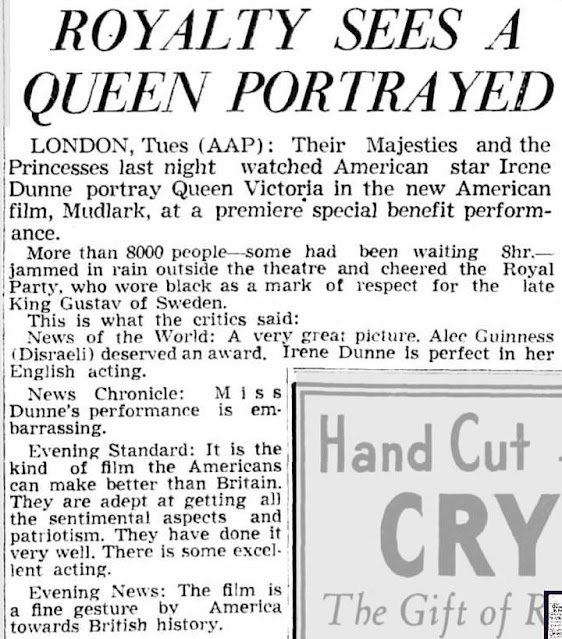
The reviews of the film were mixed, as seen below: 
The following article outlines the parts of the film that may have been uncomfortable to the Royal Family.

Some photos of the event in The Illustrated London News.

Caftan Woman has written a great post on the film. You can read it by clicking here

Dunne and Ray at a party before the premier (Chronicle, Adelaide, SE).

All newspaper articles pictured and quoted were found on Trove.

Sunday, October 11, 2015

My Favorite Wife (1940) & Move Over, Darling (1963)


Well, here is your blogathon host saving the best for last. Just kidding! All of the entries to the They Remade What?! Blogathon that I have had a chance to read so far have been amazing!!! I am constantly blown away by all of the talented writers I come across. I can't wait to read the rest of them!

For my films I chose My Favorite Wife (1940) starring Irene Dunne and Cary Grant and Move Over, Darling (1963) starring Doris Day and James Garner. Now usually when it comes to remakes one stands above the other in my opinion. In the case of these two films it's pretty close.

Pardon me, did you say they remade My Favorite Wife?

My Favorite Wife (1940) is the film that is better known because, let's face it, Cary Grant is in it, not to mention the extremely talented Irene Dunne. Now to big fans of Doris Day maybe it's the other way around, but for me the only version I knew for several years was the original. Recently I signed up for Netflix and discovered Move Over, Darling (1963). When I realized what it was a remake of, and as a fan of James Garner, I put it on my list.


Both films are essentially the same with My Favorite Wife having more scenes at the end (Cary Grant dressed up like Santa Claus anyone?).

 
The basic storyline is this: Ellen Arden (Dunne, Day) is lost at sea and after 7 years is officially claimed dead. This gives her husband, Nick Arder (Grant, Garner), the chance to finally remarry. The only problem is, the day he gets married, Ellen shows up - very much alive!


Nick is overjoyed to find out that his wife is still alive. The problem is, how does he explain it to his new bride, who is in a 'honeymoon' mood?
 
 
Ellen can't understand why Nick can't just tell her but she has problems of her own. She can't seem to tell the kids that she is their mother. She also happened to not mention that she wasn't alone all those years. She was with a man who she called 'Adam,' and who called her 'Eve.'


Ellen hires someone to pretend he's Adam, someone that Nick could never be jealous about, a timid, small man. Unknown to her, however, Nick has already tracked down Adam at the pool: big, strong, handsome, athletic, real good with the ladies - you get the picture.

 
Ellen eventually knows that Nick knows who the real Adam is and ... this is where the two pictures differ. In My Favorite Wife, Dunne and Grant string each other along a little longer. Dunne takes the children up to a cabin in the mountains so that she can tell them she is their mother. Grant makes an excuse so that he has to spend the night too. Dunne makes him sleep in the attic. After he keeps bothering her, she tells him that she will make her decision at Christmas. Enter Cary Grant as Santa Claus. The children have of course already figured out that Dunne is their mother and everything ends happily ever after, with Grant divorcing his second wife, Bianca, and having Dunne declared alive again.
 
 
In Move Over, Darling, Day and Garner go to court, have both marriages dissolved, and go their separate ways, so to speak. Garner goes home with Day following shortly after so she can pack her things. She goes around the back of the house to discover Garner and their kids in the pool. He has already told them who their mother is and they too have a happy ending.


I love both films but I have to say, the supporting cast is better in Move Over, Darling. We get Thelma Ritter as Garner's mother (she's always a plus) and Don Knotts (The Andy Griffith Show) as a nervous shoe salesmen that Day pays to pretend he's 'Adam.' Adam is played by Chuck Conners (The Rifleman). Polly Bergan takes on the role of Bianca. Other television stars, aside from James Garner (Maverick) and the two mentioned above, include Alvy Moore (Mr. Kimbell - Green Acres) as a room service waiter and John Astin (Gomez Addams - The Addams Family) as an insurance man.


In My Favorite Wife we get Randolph Scott as Adam and Gail Patrick as Grant's new wife, Bianca. We also get Asta the dog from The Thin Man series!

 
Even though the films are virtually identical, they each have their own comedic scenes that aren't in the other and as both have wonderful casts they are definitely both worth watching.

Trivia:

  • From IMDb: Move Over, Darling was a re-shot version of Something's Got to Give (1962), the never completed film Marilyn Monroe was working on when she died. It co-starred Dean Martin as Nick and Cyd Charisse as Bianca. It was supposed to begin filming on April 23, 1962, but the schedule was reorganized due to Monroe suffering a sinus infection. Production shot around her scenes using the rest of the cast. Soon enough, the shooting fell 10 days behind schedule. Monroe's last day on the set fell on her birthday, June 1, 1962. When Monroe called in sick again the following Monday, June 4, she was fired a few days later on June 8. Dean Martin refused to continue filming without Monroe, and the movie was left unfinished (most of the footage was unseen, until it was restored into a 37-minute short which aired on television on June 1, 2001. You can watch it here and the unedited footage here). The following year, it was recast with James Garner, Doris Day and Polly Bergen, retitled Move Over, Darling and released in December 1963. Many of the same sets were used.

  • In the scene where Garner pulls Day off of Bergan, he accidently broke several of her ribs. Day didn't tell him and finished the scene. The next day Garner discovered what had happened when he put his arms around and felt the bandages.

  • Leo McCarey was supposed to direct My Favorite Wife, but shortly before the filming began he was injured in an automobile accident, and had to hand over the direction to Garson Kanin. Actress Gail Patrick has stated that the severity of McCarey's injuries had an effect on the film company, and they found it very difficult to enter into the spirit of the comedy with the serious hospital bulletins they were hearing.
><><><><><><><><><><><><

My Favorite Wife airs on Turner Classic Movies November 27 at 10am and again on December 22 at 10pm.
Move Over, Darling is still on Netflix, at the time of this posting (As of April 1st, 2017, it has been taken down and then recently put back up).

Saturday, May 30, 2015

Theodora Goes Wild (1936)

 
Theodora Goes Wild is our third and last Romantic Comedy from the 1930s. This film is an absolute delight from start to finish. Irene Dunne and Melvyn Douglas give sparkling performances not to be missed.

Full Movie!!!


In the film, Dunne plays Theodora Lynn, a wholesome, small-town girl who lives with her two maiden aunts, Aunt Mary and Aunt Elsie, in Connecticut. Unbeknownst to them, Theodora writes risqué novels under the name of Caroline Adams. When one of her stories is printed in the town's local paper, the Lynnfield Bugle, it's citizens, including her aunts, protest and force the paper to stop running it. Theodora finds it amusing that her work has the town all in a frenzy.


Theodora goes to New York to visit her publisher (she tells her aunts she's visiting her uncle). He wants her to do some publicity for her book, which of course she can't do without revealing who she really is. During her meeting she meets the illustrator of her book cover, Michael Grant (played with zest by Melvyn Douglas). He finds it funny that the author of such a racy book is so unworldly. This of course makes Theodora mad and she sets off to prove him wrong. First she gets drunk and then she goes up to his apartment, where he scares her off - and proves his point - by his advances.


Next we find Theodora back in her hometown when who should show up by Grant. He gets himself hired as her aunt's gardener, under the name of Dubarry. Naturally the two end up falling in love, shocking Theodora's aunts in the process.


My favorite scene, and the scene that made me a Melvyn Douglas fan, is when Theodora visits him in his room in the back yard.
 
My favorite scene
 
When Grant realizes he is in love with Theodora, he goes back to New York. Theodora follows, only to run into his father and find out that Grant is already married! She also finds out that he can't divorce his wife as it would ruin his father's career. Theodora decides to do something about it. First, she moves into Grant's apartment, causing him to move out. Then she has her publisher reveal her identity as an authoress. This shocks her aunts and her entire hometown. What has become of their church-going, Sunday school teaching, organ playing Theodora?


Theodora's actions lead Grant's wife to file for divorce. Then she returns to Lynnfield - with a baby! Her aunts are shocked but ready to take her back in. In all the confusion, Grant shows up. He also thinks the baby is Theodora's!! She straightens them all out by telling them that the baby belongs to her friend, who had secretly married her sweetheart at Theodora's urging.
 
 
This film is a must to watch, especially if you are an Irene Dunne fan! Dunne almost turned down the role because she was afraid it might damage her good-girl image. I'm glad she didn't! She is perfect in this role (which incidentally was her first comedy) and received an Oscar nomination for it (she lost to Luise Rainer for The Great Ziegfeld). Douglas is the perfect leading man (he has been compared to William Powell but never achieved the star status that Powell did). Some people find his silliness in the film annoying but it was that aspect that made me love him in this part.
 
Dunne's Wardrobe by Bernard Newman


Behind-the-Scenes
 

Douglas and director Richard Boleslawski touching up Dunne's make-up
 
In Douglas's autobiography, he recounts a story about Dunne - she wasn't excited enough on one of her entrances. Boleslawski crept up behind her just as she was about to enter and fired a blank cartridge from a hand gun. If you watch the movie, you will "be rewarded with one of the most breathless, bewildered on-camera entrances ever recorded" (See You at the Movies: The Autobiography of Melvyn Douglas. Melvyn Douglas & Tom Arthur. 1986. 110).

Douglas and Dunne at the premiere
 
A car ad featuring Dunne as Theodora
 
Our next film also features Melvyn Douglas. To learn more about this underrated actor, read Robert Osborne's article on him here.

Sources:
TCM - Theodora Goes Wild
IMDb
All images found via Pinterest