Showing posts with label Epic. Show all posts

Monday, March 21, 2016

Netflix Monthly Movie: The Robe (1953)

 
The First Picture on the New Miracle Curved Screen !
 
The Greatest Story of Love, Faith, and Overwhelming Spectacle!


This months Netflix movie is The Robe (1953) starring Richard Burton, Victor Mature, and Jean Simmons. It tell the story of a Roman soldier Marcellus (Burton), whose job it was to crucify Jesus. He wins the robe worn by Christ by casting lots. But when he wears it, it puts a curse on him, or so he thinks. After the crucifixion, he is sent back to Rome, but he is haunted by what he has done. He goes back to Judea to find the Robe and destroy it, so as to destroy its hold on him. During his journey, he meets believers and followers of the dead Christ, Christians. One of these is his former Greek slave, Demetrious (Mature), who is now  follower of Peter. It is he who carries the robe of Christ.

You're afraid, but you really don't know the reason why. You think it's his robe that made you ill. But it's your own conscience, your own decent shame. Even when you crucified him you felt it.

Marcellus too becomes a Christian. Upon returning to Rome, Marcellus must now face Emperor Caligula.

Directed by Henry Koster (It Started with Eve, The Bishop's Wife, Harvey, The Singing Nun), this was the first movie filmed in Cinemascope and it is truly a spectacle. Complemented by glorious Technicolor and lavish sets of the powerful Roman Empire, it is a film well worth seeing. It is a long film - it runs 135 minutes - but it does not feel long. The sweeping and intense musical score by Alfred Newman complements the picture perfectly. This is a great film for the whole family to watch during this Holy Week.


Simon Peter (Michael Rennie) & Marcellus (Burton)

Trivia:

So sure was the studio of the films success, a sequel titled Demetrius and the Gladiators (1954) was immediately put into action. Victor Mature reprised his role as the Greek slave and follower of Simon Peter. The film takes place right at the end of The Robe, in the year 53 AD. A third film was made about Simon Peter, The Big Fisherman (1959), with Howard Keel in the title role.

Burton & Mature

It is the first motion picture in Cinemascope to be nominated for the Best Picture Academy Award.

Diagram of the curved screen.

The second movie to begin shooting in Cinemascope, but the first to be released (Sept. 16, 1953). The first film to go before Cinemascope lens-equipped cameras was How to Marry a Millionaire (1953) and was released Nov. 4, 1953.

Opening at Grauman's Chinese Theatre, September 24, 1953.

Acclaimed by many film historians as a triumph in the art of motion-picture music, Alfred Newman's reverent, intense film score failed to garner an Academy Award nomination for Best Score for a Dramatic Motion Picture (though Newman still took home an Oscar that night - for his adaptation of music for the Irving Berlin-Ethel Merman frolic, Call Me Madam (1953). Angered by the Academy voters' snub of Newman, distinguished film composer Franz Waxman, an Oscar winner for Sunset Blvd. (1950) and A Place in the Sun (1951), resigned from the Academy of Motion Picture Arts and Sciences.

The film won Oscars for Best Art Direction - Set Decoration in the color category and Best Costumes, also in the color category. In addition to Best Picture, it was also nominated for Best Actor (Burton) and Best Color Cinematography. It also won a Golden Globe for Best Picture - Drama.

At one point the producers considered making Marcellus older and casting Laurence Olivier.

Darryl F. Zanuck originally offered the role of Marcellus to Tyrone Power in a bid to get him to renew his contract with Fox. Power instead opted to star in the play "John Brown's Body" on Broadway.

Burt Lancaster was originally cast in the role played by Victor Mature.

Janet Leigh was considered for the role of Diana (Simmons).


Director Henry Koster chose Donald C. Klune - his 2nd assistant director - to play the role of Jesus in the film (his face is never seen). Klune would thus sign all the extras' vouchers and finish the paperwork while still in costume. He also had to eat lunch in his dressing room, as the studio thought it would be inappropriate for "Jesus" to eat in the commissary at Fox.

The opening shot after the title credits (and the background "red robe" curtain parts) is actually a scene lifted from this film's sequel, Demetrius and the Gladiators (1954).

The set of Cana, the village of Galilea where Marcellus Gallio meets Peter, was a redress of sets originally built for Algiers (1936), that had stood on the studio backlot for seventeen years. The sets were later used in Demetrius and the Gladiators (1954) - this film's sequel - as the Christian neighborhood in Rome where Demetrius lives in the beginning of the movie. The well with the old broken columns can be easily recognized.

Based on the book of the same title by Lloyd C. Douglas

Wednesday, April 1, 2015

Cecil B. DeMille's "The Ten Commandments"


It's that time of year when the epic by Cecil B. DeMille, The Ten Commandments (1956) is shown on television. There are so many stars in this film: Charlton Heston, Yul Brynner, Anne Baxter, Edward G. Robinson, Yvonne de Carlo, Debra Paget, Judith Anderson, Vincent Price...


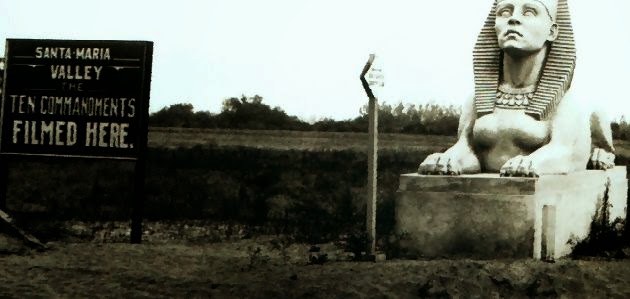
Since most everyone knows the story of Moses, which is the subject of the film, I will just share some trivia and behind-the-scenes photos of this Easter-time classic.

John Derek (Joshua) and Charlton Heston working out

The film has aired on television on ABC every year since 1973, except 1999. They received a lot of complaint calls that year as watching the film annually had become a tradition for many.

The Paramount mountain at the beginning of the film was a stylized version of the studio's logo. The mountain retained its conical shape but with a red granite tone and a more angular summit under a red clouded sky to suggest the appearance of Mount Sinai for this single motion picture. Its circle of stars faded in with the announcement: "Paramount Presents - A Cecil B. DeMille Production."


There were at least 14,000 extras and 15,000 animals used in this film.

The script contained 308 pages with 70 speaking parts and included over 1,200 storyboard sketches.


Charlton Heston's newborn son Fraser Clarke Heston appeared as the infant Moses. According to DVD commentary by Katherine Orrison, Cecil B. DeMille deliberately timed the filming of his scenes for when Fraser Heston was about three months old, the age of baby Moses when his mother put him in the basket on the Nile, according to the Old Testament.


The illusion of the Red Sea parting was achieved by large "dump tanks" that were flooded, then the film was shown in reverse. The two frothing walls of water were created by water dumped constantly into "catch basin areas" then the foaming, churning water was visually manipulated and used sideways for the walls of water. A gelatin substance was added to the water in the tanks to give it more of a sea water consistency. Although the dump tanks have long since been removed, the catch basin section of this tank still exists today on the Paramount lot, directly in front of the exterior sky backdrop, in the central portion of the studio. It can still be flooded for water scenes, but when not being used in a production, it is an extension of a parking lot.

Playing at the drive-in

To create the effect of the sandstorms, in the narrated desert sequence, as Moses left Egypt and headed to Midian, Cecil B. DeMille used the engine blast from tied-down Egyptian Air Force planes.

 The fiery "hailtones" that fell from the sky in the background were actually animation, as were the hailstones that destroyed Sodom and Gomorrah. The "hailstones" that fell onto the pavilion of Rameses' palace were actually pieces of popcorn that had been spray-painted white; their advantage was that they were light, wouldn't hurt actors they were hit by them, and could be swept up and used again if needed in other scenes.

Set model

The pillar of fire, which kept the Egyptians from getting closer to the Israelites just before they crossed the Red Sea, was not achieved through the use of actual flames, but was instead, an animated fire. Of all the special effects in the film, it is the one that looks the least realistic to modern audiences, and probably seemed just as unrealistic in 1956.

Special Effects Property Master William Sapp created the effects that turned the waters of the Nile red. Red dye was pumped into the water through a hose at the point where Aaron touched the river, with his staff. Sapp also created the vessel that was used by Rameses' priest in an attempt to restore the waters. The vessel had two chambers: one that was filled with clear water and which was located near the vessel's opening, while the other chamber was filled with red-dyed water was located near the bottom of the vessel. As the vessel was tipped to empty its contents, the clear water poured out first, and as the vessel was tipped further, this released the red-dyed water into the "river" on the sound stage. There were six of these vessels that were made for the film, but only two were used during production. The reverse shot showing the red water extending out into the sea was created through animation onto shots of the Red Sea that had been photographed in Egypt.

DeMille was persuaded to hire Charlton Heston for the role after being presented with a statuette of Michelangelo's statue of Moses in Rome, Italy by the Israeli government, and noting Heston's resemblance to the statuette.

       
Wardrobe tests


When Yul Brynner was told he would be playing Pharaoh Rameses II opposite of Charlton Heston's Moses and that he would be shirtless for a majority of the film, he began a rigorous weightlifting program because he did not want to be physically overshadowed by Heston. This would explain his buffer-than-normal physique during The King and I (1956), the film he made just after this one.


Gloria Swanson was originally cast as Memnet, but she was then having difficulties getting a backer for a musical stage version of Sunset Blvd. (1950) so she had to depart from the project (the musical was abandoned in the early 1960s, even after a cast album was recorded during out-of-town tryouts). Judith Anderson played the part instead.

Yvonne de Carlo on location

Audrey Hepburn was originally slated for the role of Nefretiri(!?!). DeMille reluctantly decided to pass on her after it was judged that she was too "slender" (flat-chested). Anne Baxter, who was eventually cast in the role, had originally been a contender for the role of Sephora (Moses' wife).

Baxter and DeMille


Costume sketches for Nefertiri

At the end of the movie, after Charlton Heston as Moses has turned over leadership of the Israelites to Joshua, he watches as the Israelites march into Caanan. At this point, Moses was supposed to have been enveloped in the fog coming down from the mountain, but the effect was never completed. As a result, Moses is shown to be standing there watching the Israelites go, and this is closer to what is related in the actual Bible than what Cecil B. DeMille originally intended.

DeMille, Heston, and crew

This was DeMille's final film, due to declining health. He turned 75 during production and suffered a heart attack. He died in 1959.

 
DeMille and the Heston family
 
The DVD has some interesting special features: DeMille introducing the film and footage from the premiere, showing the stars from the movie as well as other stars such as John Wayne.
Ladies and gentlemen, young and old, this may seem an unusual procedure, speaking to you before the film begins, but we have an unusual subject, the story of the birth of freedom, the story of Moses. As many of you know, the Holy Bible omits some 30 years of the life of Moses' life from when he was a three-months old baby, and was found in the bulrushes by, by Bithiah, the daughter of Pharaoh and adopted into the court of Egypt, until he learned that he was Hebrew and killed the Egyptian. To fill in those missing years, we turn to ancient historians, Philo and Josephus. Philo wrote at the time Jesus of Nazareth walked the earth and Josephus wrote some 50 years later and watched the destruction of Jerusalem by the Romans. These historians had access to had access to documents long since burnt, destroyed - or perhaps lost, like the Dead Sea Scrolls. The theme of this picture is whether man ought to be ruled by God's law, or whether by the whims of a dictator like Rameses. Are men the property of the state or are they free souls under God? This same battle continues throughout the world today. Our intention was not to create a story, but to be worthy of the divinely inspired story, created 3,000 years ago. The story takes three hours and thirty-nine minutes to unfold. There will be an intermission. Thank you for your attention.

All images found via Pinterest.
Source used: IMDb