Showing posts with label David Niven. Show all posts

Saturday, July 10, 2021

Royal Film Performance Series: The Bishop’s Wife (1947)

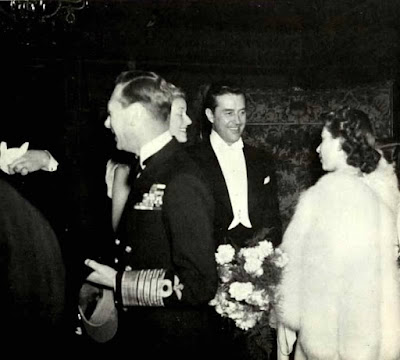
King George VI (blurry), Queen Elizabeth, King Michael of Rumania, and Princess Margaret.

The movie shown at the second Royal Film Performance, like the first, had a religious tone to it. It was the now Christmas classic, The Bishop's Wife (1947) starring Cary Grant, Loretta Young, and David Niven. It was held at the Odeon Theatre on November 25, 1947, just five days after the Royal wedding of Princess Elizabeth and Prince Philip, the Duke of Edinburgh. They understandably did not attend. 


While the newlyweds were not in attendance, the audience WAS treated to a 30 minute color film of the wedding. An Australian newspaper described the scene:

The King and Queen, with Princess Margaret, made a tortuous progress to the theatre while milling crowds choked the approaches and pressed against the steel crush barriers.

Mounted police had to force a route for cars bearing the Royal parties and film celebrities.

Several people fainted an had to be extricated by ambulance men. 

~ The Mercury, November 27, 1947

Another newspaper, The Daily News (November 26, 1947), shared this interesting tidbit:

The Film, The Bishop's Wife, is American. It comes under the new British tax and will not be generally distributed. 

Up to £A32/10/ were paid for seats near the Royal box. The show raised more than £A31,500 for the Cinematograph Trade Benevolent Fund. 

Click here to see the program (for sale on Ebay) 

CLICK HERE to watch a two minute British Pathe newsreel. 
I love how they describe the gowns.

And CLICK HERE for a six minute video of silent footage of stars and guests arriving.
British Pathe films have to be licensed, so I have removed them from my posts.

Loretta Young: An Extraordinary Life, by Joe Morella and Edward Z. Epstein, recounts the glamorous star's encounter with the royals:
Among their fellow passangers [on the Queen Mary] was Noel Coward, of whom an anxious Loretta asked, "When I curtsey to the queen how low shall I bow?" To which Coward replied, "To the floor, ducky"(260).

Loretta was not disappointed upon meeting the royal family. She later recalled, "As the big moment approached, I kept running around trying to find out whether I should wear my long white gloves. Everybody was so excited, and I was no exception. Although we had been well rehearsed for the event, we all just plain forgot. I was frantic, for suddenly the line began to move and my turn was coming. At the last minute I got a peek at the others and saw they had their gloves on. I never got gloves on so fast in my life"(261). 

David Niven, according to the authorized biography Niv by Graham Lord, reported to producer Sam Goldwyn, "The audience loved every second of it and the Queen and Princess Margaret told me afterwards and at great length how much they enjoyed it" (148). 

 CLICK HERE TO SEE PHOTO OF LORETTA YOUNG 


While a fantasy, there are no fantastic heavenly manifestations. There’s a humanness about the characters, even the angel, that beguiles full attention. Henry Koster’s sympathetic direction deftly gets over the warm humor supplied by the script, taken from Robert Nathan’s novel of the same title.

Cary Grant is the angel of the piece and has never appeared to greater advantage. Role, with the exception of a minor miracle or two, is potently pointed to indicate character could have been a flesh-and-blood person, a factor that embellishes sense of reality as the angel sets about answering the troubled prayers of Episcopalian bishop (David Niven).

 Plot, essentially, deals with Grant’s assignment to make people act like human beings. In great need of his help is Niven, a young bishop who has lost the common touch and marital happiness because of his dream of erecting a massive cathedral.

Loretta Young gives a moving performance as the wife whose life is touched by an angel without her knowledge of his heavenly origin. Niven’s cleric character is played straight but his anxieties and jealousy loosen much of the warm humor gracing the plot.

And the NEW YORK TIMES:

Emissaries from heaven are not conspicuously exceptional on the screen, the movies having coyly incarnated any number of these supernatural types, ordained by their fanciful creators to right the wrongs of this world (not to mention the bookkeeping errors that seem to occur up above). And certainly communion with angels is traditional at Christmastime, which is the season when most of us mortals need angelic reassurance anyhow. So there is nothing especially surprising about the miracle that occurs in Samuel Goldwyn's "The Bishop's Wife," which opened last night at the Astor—except that it is superb. And that is very surprising, in view of the realistic fact that it is a sentimental whimsy of the most delicate and dangerous sort. All of us know that angels don't walk the earth like natural men—and definitely not in the image of that debonair rascal, Gary Grant. And most of us have some dark misgivings about the tact of the makers of films when they barge into the private area of a man's communication with his God. But you need have no anxieties in the case of "The Bishop's Wife." It is as cheerful and respectful an invasion of the realm of conscience that we have seen. And it comes very close to being the most enchanting picture of the year — a judgment to which its many merits will shortly make a strong bid. That is because its incursion is on a comparatively simple and humble plane and its whimsy is sensitively syphoned from the more human and humorous frailties of the flesh. We are not going to make an analysis of the many subtle comments in this tale of a full-bodied guardian angel who answers a young bishop's prayer for guidance and spiritual comfort in the midst of a crisis in his life. We are not going to state any morals which this charmingly casual angel proves in drawing the bishop's wrought attention from a new cathedral to the richer services of life—and, particularly, to a fresh fulfillment of his family responsibilities. We are not going to mouth about these matters, because the picture itself refrains—and that is one of the most endearing of its many endearing young charms. In shaping this warm and winning fable from a Robert Nathan book, Robert Sherwood and Leonardo Bercovici have written with beautiful belief that a point clearly made in performance doesn't have to be hit a dozen times nor a moral quietly manifested put into a hundred solemn words. And so there is no heavy pounding of the lesson of humanity, of the futility of ostentation, of the special possessiveness of a man's love. Nor is there any such pounding in Henry Koster's directorial style. Smoothly and with artful invention he has induced Mr. Grant to give one of his most fluent and beguiling performances as the angel, "Dudley," who fixes things. And he has got out of David Niven a deliciously dexterous and droll characterization of a sorely pressed young bishop who can't quite cotton to this messenger from on high. Elsa Lanchester, too, is encouraged in an exquisitely faceted role of a twitterly little housemaid who flirts with this angelic gent, and Monty Woolley is actually human as an old dodo who is morally re-inspired. James Gleason, Sara Haden and Gladys Cooper are rich in smaller parts. Weakness is only evident in Loretta Young's unctuousness as the bishop's wife. She is the one artificial, inconsistent and discordant note.Of course, there are probably some people who are going to say that this film encourages a futile illusion with its hope of miraculous aid. But they—if they do—will be missing its most warmly inspiring point which is—but wait a minute That's for you to recognize and enjoy. We cannot recommend you to a more delightful and appropriate Christmas show.

Next up in the Royal Film Performance Series: Scott of the Antarctic (1948).

Previous Film: A Matter of Life and Death (1946).

Sources
Lord, Graham. Niv: The Authorised Biography of David Niven. St. Martin's Press. 2003. 
Morella, Joe & Epstein, Edward Z. Loretta Young: An Extraordinary Life. Landmark Books. 1986.

Saturday, June 5, 2021

Royal Film Performance Series: A Matter of Life and Death (1946)

On November 1, 1946 the Royal family attended the very first Royal Film Performance. The film chosen was A Matter of Life and Death (released in the US under the title Stairway to Heaven), directed by Michael Powell and Emeric Pressburger and starring David Niven (in his first film after being released from the Army), Kim Hunter, Roger Livesey, and Raymond Massey. The event, which was held in aid of the Cinematograph Trade Benevolent Fund, was held at the Empire Theatre in London. 

This poster has "The First British Royal Command Film" printed on it!

Below is an article from Picturegoer (which I found here - there are also scans of the program) which described how the event came about and how the film was chosen:

First Royal Film performance ever to take place will be on Friday, November 1, at the Empire, Leicester square, in the presence of the King and Queen and the Princesses. It will be in aid of the Cinematograph Trade Benevolent Fund.

This will be an historic event. For many years the stage and music hall have been honoured by Royal Command performances. Now the cinema receives equal recognition. As can be understood it was no easy task to choose a film for this occasion. A special viewing committee representing all sides of the industry saw all the films submitted by British and American producers. They were considered not only for their intrinsic merits but also in view of their suitability for this particular occasion.

Finally, the entrants were narrowed down to three.

These were Metro's The Green Years, which had very strong claims because of the nature of the story and its many British associations.

The Magic Bow, a story of Paganini with Stewart Granger and Phyllis Calvert in the leading parts, and Yehudi Menuhin responsible for the violin playing.

And A Matter of Life and Death, the Michael Powell - Emeric Pressburger picture starring David Niven, Raymond Massey, Roger Livesey, and Kim Hunter.

After much careful consideration, the Viewing Committee decided on "A Matter of Life and Death". This is an honour to British films of which we can be justly proud. We don't mean to suggest that we can beat the Big Drum and crow about scoring over Hollywood. Far from it. We can be modestly happy that we are producing pictures which are worthy of a Royal Command performance.

Not everyone was pleased with the choice, however. The Daily Graphic said:

There will be widespread indignation at the choice for the first Royal Performance last night of a picture which might have been made specifically to appeal to Isolationist and anti-British sentiment in the United States. ...Ancient charges against British imperialism, which for the most part never had any real substance, are paraded here and no defense is offered. ... It is a pity that the film should cross the Atlantic carrying the cachet which comes from its Royal showing (The Other Side of the Moon: A Biography of David Niven. Sheridan Morley. Pages 136-137). 

Embed from Getty Images

Kim Hunter recalled in a 2003 interview for the BBC:

Niv[en] had high hopes for the film, which took two months to shoot, was released in Britain amazingly quickly, in November, and was chosen to be the first Royal Command Film Performance, much to the fury of most of the British critics, who were almost unanimously condescending, though the Daily Telegraph said quite rightly that "David Niven has done nothing quite so good as his airman trembling on the brink of a nervous breakdown without lapsing into hysteria" (Niv: The Authorised Biography of David Niven. Graham Lord. Page 134).

Ray Milland, shown above meeting Princess Elizabeth with King George VI in the foreground, recalled the evening in his 1974 autobiography Wide-Eyed in Babylon

It was to be the first big gala after five years of war, and London was girding for it. My invitation, when it came, was most impressive, all covered with seals and ribbons. 

On the evening of the Command Performance itself, London put on the closest thing to a riot since the days of Titus Oates. In one interview I referred to it as the Battle of Leicester Square, and it was by that name that it was known for the rest of our stay (228).

The frenzied scene, as reported by this Australian Newspaper even included a quote by the King who remarked, "I thought at one time I was going to be a casualty myself. We arrived practically on two wheels."

I noticed you have to license films from the British Pathe and I'm not sure 
if I can display it to play IN my blog post, so I will be linking them only. 

In the video above, from the British Pathe, you can see King George VI and Queen Elizabeth (the Queen Mother), as well as Princess Elizabeth (Queen Elizabeth II) and Princess Margaret. Movie Stars in attendance were Ray Milland with Kim Hunter, Reginald Gardiner, a brunette Dorothy Malone (talking to the princesses), Hunter and Pat O'Brien meeting the Queen Mother, Sir Laurence Olivier and Vivian Leigh, John Mills, Malone walking with Stewart Granger, (I recognize the actress at 1:21 but don't know her name), Deborah Kerr meeting the Queen, Joan Bennett, Margaret Lockwood, and more.

Here is a Royal Command scroll signed by the stars who attended that sold on Bonhams
You can make out the signatures better on their site.

An excerpt from a review by VARIETY:

Returning from a bomber expedition, Squadron-Leader David Niven is shot up. Last of the crew, minus a parachute, and believing the end is inevitable, before bailing out talks poetry and love over the radio to Kim Hunter, American WAC on nearby air station. Miraculously Niven falls into the sea, is washed ashore apparently unhurt, and by strange coincidence meets Kim. They fall desperately in love.

Meanwhile in the Other World there’s much bother. Owing to delinquency of Heavenly Conductor Marius Goring, Niven has failed to check in, and Goring is despatched to this world to persuade Niven to take his rightful place and balance the heavenly books.

The rest of the review isn't very flattering, complaining that "the striving to appear intellectual is much too apparent. Less desire to exhibit alleged learning, and more humanity would have resulted in a more popular offering." 

There's a fantastic article about the film with some great behind-the-scenes photos on the Criterion website. I really liked the opening paragraph:

To love the films of Michael Powell and Emeric Pressburger, among the most mischievous and inventive of all cinema poets, is to accept that there’s more to life than you’d previously imagined: more color, more humor, more ardor, more blissful confusion. In those terms, A Matter of Life and Death is the quintessential Powell-Pressburger movie. It’s a fantasy love story, imaginative to the point of being hallucinatory, one of the most out-there pictures of the last century.

Further in the article they share Powell's reaction to the Royal Event:

The occasion was so exciting that the film passed practically unnoticed.

I wonder what Princess Elizabeth, then 20 years old, thought of the religious aspects of the film. It's certainly a film to make you think. Click here to see a photo of the Royal Family leaving. 


Next up in the Royal Film Performance Series: The Bishop's Wife (1947)

Sources
Lord, Graham. Niv: The Authorised Biography of David Niven. St. Martin's Press. 2003. 
Milland, Ray. Wide-Eyed in Babylon; An Autobiography. William Morrow & Company, Inc. 1974. 
Morley, Sheridan. The Other Side of the Moon: A Biography of David Niven. Magna Print Books. 1985.

Wednesday, April 27, 2016

Please Don't Eat the Daisies

If you think this is going to be a review of the 1960 movie with Doris Day and David Niven then you are only partially right.

            
Left - Movie cast; Right - Apparently there was a TV show too (1965-1967)

I watched Please Don't Eat the Daisies last December and when I discovered a couple weeks ago that my library had the book it was based on, I decided to check it out.

                       
The author and her book

Please Don't Eat the Daisies by Jean Kerr is HILARIOUS!!!! It's one of those books where you find yourself laughing out loud and end up reading in one sitting because you don't want to put it down. My favorite chapter was "How to decorate in one easy breakdown," where Kerr describes the process of redecorating one's home. I also greatly enjoyed the chapter "The Kerr-Hilton," which describes the house/monstrosity they bought. The only chapters that didn't seem to fit in were the ones titled "Don Brown's body" and "Toujours tristesse" - a play and short story respectively. However, it is always interesting to read fiction written by another person because it gives you a glimpse of another side of them that you may never have known existed.

Ok, now to the movie.

In writing the script for the movie starring Doris Day and David Niven, the writers took the four rambunctious boys, the crazy old house, the fact that everyone is writing a play, and that Mr. Kerr is a critic. However, the critics part is greatly built up, showing instead of telling, what it is like to be the wife of a drama critic. It also throws in a little marital discord in the form of an actress, played by Janis Paige. Reminiscent of Mr. Blandings Builds His Dream House, the movie paints a vivid picture of what it's like to buy a fixer-upper. Doris Day, however, is able to transform this creaky castle into what could easily be a chic New York flat. She also finds the time to play the lead in the local town play, in addition to attending plays with her husband. Only Doris Day could do all of that and still look fresh as a daisy (pun intended).

I hope you get a chance to both read the book and watch the movie. They are both delightful and shouldn't be missed!

Click here to see pictures of the movie version of the Kerr home and here to see pictures of the actual home! Each version gets more and more ridiculous. The movie house appears twice as big as the real house and the TV show house even bigger!

Jean Kerr wtote several other books. I'm having my library get The Snake Has All the Lines, How I Got to be Perfect, and Penny Candy.

A note about the TV version:

I just started watching the first episode. The children are entirely too well behaved and Mr. Nash (his name in the show) is suddenly a hypochondriac!