Sunday, June 21, 2015

Father's Day in Hollywood

Happy Father's Day!!!
 
  
Buster Keaton
 
Lou Costello
 
Dana Andrews
 
James Stewart with his twin daughters

Humphrey Bogart with daughter Leslie

I wonder if Bogie got in trouble for this picture...

Bogie with Steve, his first child
 
Gene Kelly
 
William Holden
 
With his two sons
 
Vincent Price with his 6-year old son

Robert Mitchum
 
Kirk Douglas

Kirk and Michael Douglas
 
Jack Lemmon
 
Dan Blocker (of Bonanza)

James Garner and daughter Gigi
 
Love this picture
 
Chevy Chase (not from "classic" Hollywood but a cute picture)
 
All images found via Pinterest

Saturday, June 20, 2015

Errol Flynn + Film Noir + Netflix = "Cry Wolf" and "The Big Boodle"

+
+
 
=


Since today is Errol Flynn's birthday, and it's all about Film Noir over here because of TCM's Summer of Darkness, and since I've only reviewed one Netflix movie on this blog (I've changed it from a weekly to a monthly feature), I thought I would talk about two films (one of which is on Netflix) that are as close to Film Noir as Flynn ever got.
 
The first film is Cry Wolf (1947), a horror mystery starring Flynn (his part was originally supposed to go to Dennis Morgan) and Barbara Stanwyck in their only screen pairing.
 
 
Here is the plot synopsis from TCMDb
After Sandra Marshall (Stanwyck) learns that James Demarest has died, she surprises his uncle, Mark Caldwell (Flynn), with the news that she and Jim were secretly married. Although Sandra shows Mark a marriage license, he refuses to believe her claim because Jim never mentioned it. Sandra reminds Mark of the conditions of Jim's mother's will: Jim's money was to be held in trust until he reached thirty or until he married. She had married Jim as a favor, in exchange for the money which she needed to finish her education. At the end of six months, she was to divorce him, but as only five months have passed since the marriage, Sandra now stands to inherit two million dollars. At dinner, Sandra meets Jim's younger sister Julie (Geraldine Brooks), who berates Mark for opening a letter addressed to her from Ronnie Manning, the boy she loves. Later, Sandra questions Julie and learns that Mark had interfered with Jim's engagement to another woman. Because Jim was buried in a closed casket, Sandra is surprised to learn that he died of pneumonia. She is also shocked by the restrictions Mark places on Julie, who is not allowed to leave the estate and is constantly watched by the servants. That night, an hysterical Julie runs into Sandra's room, frightened by the sound of agonized cries coming from Mark's laboratory. Sandra tries to calm her, then hears the cries herself. The next morning, following Sandra's directions, Julie tells Mark about the sounds, but omits mentioning her visit to Sandra's room. Mark attributes her experience to a vivid imagination. When Sandra later examines Jim's room, she notices that his pipes and sports clothes are missing, and Julie becomes agitated at the thought that her brother might still be alive. When Mark hears this, he locks Julie in her room and orders Sandra not to fill her head with fantasies. That night, Sandra enters the laboratory through the dumbwaiter. She eavesdrops on a conversation between Mark and Jackson Laidell, a servant, about the lodge at Three Hills, but her investigations are cut short by a woman's scream.
 
Want to find out what happened? Watch the movie or read the rest of the synopsis here (contains major spoilers).
Flynn: May I make a suggestion?
Stanwyck: What?
Flynn: Next time you hear some odd noise in the night, just follow the memorable custom of your sex and stick your head under the bedclothes.
                            

Some remarks from a TCM Article on Cry Wolf by Richard Harland Smith:
 
"Cry Wolf ... [was] complete with forbidden laboratories, dodgy servants, cries in the night, and a resourceful heroine in Stanwyck's unstoppable Sandra Marshall. Sold as a borderline horror film, Cry Wolf seemed to take inspiration from the Universal Studios school of fear-mongering, while its allocation of heroic deeds to a strong female lead seems influenced by the shockers produced by Val Lewton at RKO... The Gothic ambiance is furthered by Franz Waxman's stormy orchestrations...
 
"Cry Wolf endures sixty-odd years later as an entertaining experiment, one giving its principal players a taste of something completely different. Flynn clearly relished the opportunity to play a man of high breeding and erudition, yet one guided by hardwired propriety and hobbled by mounting guilt, while Stanwyck was an inspired midlife Nancy Drew, creeping through the shadows at zero-dark-thirty, folding herself into dumbwaiters and spidering across gabled rooftops to gain access into Flynn's forbidden attic laboratory."
 
 
This blog post talks about Flynn's unusual darker role and also compares Stanwyck to Nancy Drew.
This one talks about the noir aspects of the film. 
 
~ ~ ~ ~ ~ ~ ~ ~ ~ ~ ~  
 
The second film, The Big Boodle (1957), can be found on Netflix, and is one of the last films that can be classified as a Noir Film, "released on the tail-end of the American trend"(source). It stars an older Flynn and Rossana Rory
 
 
Here is the TCMDb entry:
After Ned Sherwood (Flynn), a blackjack dealer in a Havana casino, is passed some counterfeit peso bills, he challenges the woman who presented them, as under the casino's rules, a dealer is responsible for any phony currency he unwittingly accepts. The woman denies knowing that the bills were counterfeit, refuses to change them for others and leaves. That night, on his way home, two thugs attack Ned but run off when the police are summoned. Guillermo Mastegui, Chief of the Secret Section of the Cuban National Police, interrogates Ned about the attack and, because he still has some of the counterfeit bills, accuses him of being involved in a plan to flood Cuba with worthless currency. Mastegui refrains from arresting Ned, however, as he and a U.S. Treasury agent plan to have him followed in the hope that he will lead them to the head counterfeiter. Now jobless and forbidden to leave Cuba, Ned takes measures to clear his name. Ned meets with a young woman, Anita Ferrer, who believes that he has the bills, as well as the engraving plates they were made from, and offers to buy them. After a totally bewildered Ned denies any knowledge of the bills and plates, Anita takes him to meet her father, who is president of the Bank of Cuba. SeƱor Ferrer explains to Ned that Mastegui suspects that three million counterfeit pesos, manufactured in Chicago, are about to be laundered through the bank. Because this act would destroy confidence in the bank and in the government, Ferrer is anxious to discover who is behind the plot. Ned tells Ferrer that he knows nothing about the matter and is about to leave when Ferrer's other daughter, Josefina (Rory), returns home and Ned recognizes her as the woman who passed him the notes in the casino, but says nothing. When "Fina" agrees to a meeting with Ned, she again denies any involvement in the counterfeiting, but offers to be seen with him in the hope of having the ringleaders show their hand.
To read the rest of the synopsis, go here.


Here is an interesting article about the film. It discusses how it is like the earlier French version of noir. It also talks about the location shooting. Unfortunately the whole article is not available.
 
 
All images found via Pinterest

Thursday, June 18, 2015

Summer of Darkness Week 2 - The Maltese Falcon (1941)

The second week of TCM's Film Noir class focuses on the definition of film noir - is it a genre? A style? A movement? A combination of the three? It also talks about film noirs as a "heist." The Maltese Falcon (1941) is one of the earliest films that comes under the heading of Film Noir and a film that really launched the genre. When someone says "Film Noir," this is usually the first film that comes to mind. It is said to have "hid in plain sight for years—with a nary a word about it being a seminal work of a new and exciting mode of filmmaking. Like a well-orchestrated heist where the loot is already in the getaway car before a single alarm bell is tripped, films noir were being made in the Hollywood system for at least five years before movie critics began to label these films as something other, something different, from run-of-the-mill thrillers" (from Lecture 1, week 2).


The first article of TCM's Film Noir class states: "Pay attention to the first few minutes of a film. Right after the studio logo is prominently displayed, a filmmaker has a job to do: namely, to establish the film's story world and get you in a certain frame of mind. While many opening sequences might seem perfunctory, they are your entrance into the narrative and evince a visual style that fits the tale to be told" (Into the Darkness: Entering Noir Country). The Maltese Falcon is no exception. Let's take a look at some of the noir aspects found in the film.

*Contains spoilers

 
The very first frame shows the famous Black Bird. You can tell by the way it's lit that this is a noir film.


In the second frame, the title of the film appears on the screen - in smoke no less. It's off to a very good start.
 
 
We are the given an introduction; the "backstory" of the Falcon. It's exotic ad mysterious tone also helps to set the mood. You are instantly intrigued.

 
Now that you know it's a noir film, the place is established. San Francisco is the location of several noir films: Dark Passage, Nora Prentiss, Born to Kill (all 1947), and Woman on the Run (1950).


The opening shot of the film, and the first in which we see its central "live" character (I say live because the Falcon is really the central character), Sam Spade. At first, it doesn't look much like a noir film. It's daytime and Spade is performing the mundane task of rolling a cigarette.


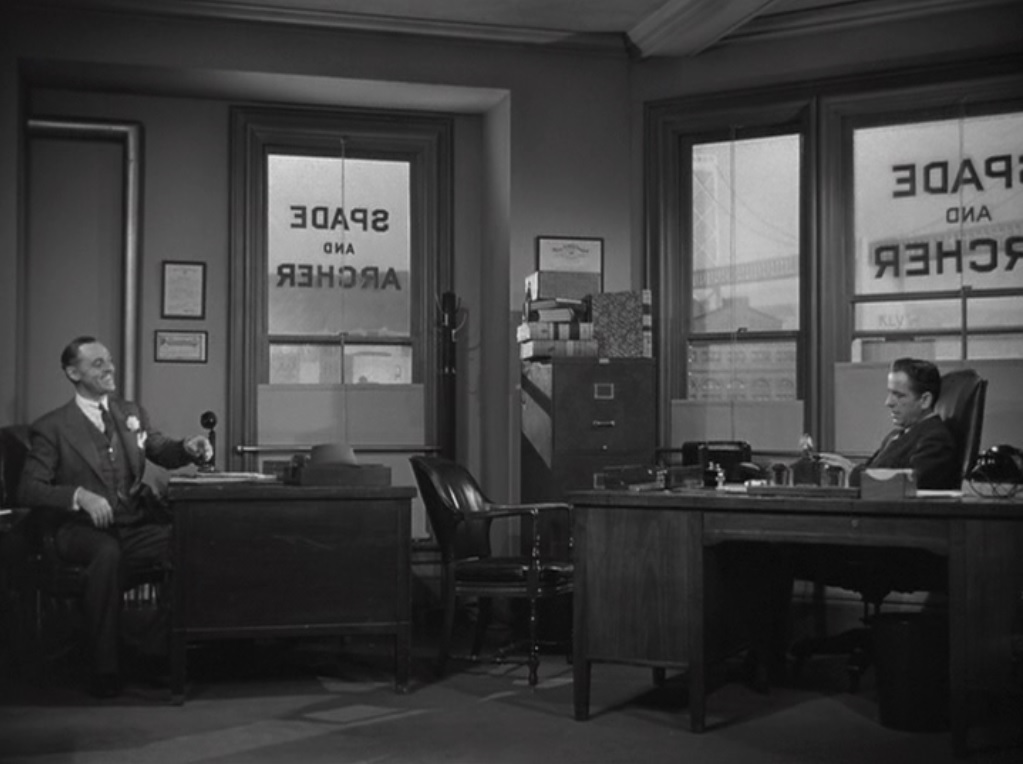
His office that he shares with his partner, Miles Archer, certainly doesn't look threatening. In fact, it looks pretty nice: lots of windows with sweeping views of the city; lots of space to walk around in, high ceilings, leather swivel chairs. Not bad!


Then the camera pans down to the floor for this shot. It seems a little ominous.

 
Six minutes into the film, Spade's partner is murdered while on the job. Spade is awakened by the phone call. During the short conversation, the camera stays pointed towards the window so that all we hear is Spade's voice. It's a fantastic noir shot.
 
 
Next, Spade visits the scene of the crime. He is shown looking down on the spot where Archer's body rolled. Angled shots like these became the norm in noir films. They are not used too frequently in The Maltese Falcon and when they are, they are more subtle than the some of the later noir films so as not to call attention to themselves but rather to enhance the atmosphere of the film without the viewer noticing it.
 
 
Here's a shot that's used twice: first when Spade is questioned by the police and later at another confrontation between Brigid O'Shaughnessy (an early representative of the femme fatale) and Joel Cairo (played by Peter Lorre). This is almost a point-of-view shot (POV) and includes the viewing audience in the circle.
 
 
 Newspaper clippings help move the story along quickly.
 
Let's take a look now at the main characters along with some analysis from the book Film Noir FAQ (2013) by David J. Hogan:
 
Humphrey Bogart as Sam Spade
 
"Huston and Bogart's interpretation of Spade became a template that's still used today: the private dick as tough, concise, strangely principled, and unafraid to take a beating" (84).
 
"Bogart set the tone for the era when he played Sam Spade in Huston's 1941 film version of Dashiell Hammett's 1929 novel The Maltese Falcon. He was neither hero nor villain, just a cynical detective navigating a corrupt world. Morally, Spade was on the fence. Not above having an affair with his partner's wife, but generally trying to do the right thing—when it suited his purposes. Plenty of imitations followed, characters with a savvy attitude and a smart mouth modeled on Bogart/Spade—and when they tumbled off the fence to the dark side, you had a truly noir protagonist" (Low Company, High Style: The Eternal Allure of Film Noir. Eddie Muller).
 
Everybody has something to conceal.
 
Mary Astor as Brigid O'Shaughnessy
 
You won't need much of anybody's help. You're good. It's chiefly your eyes, I think, and that throb you get in your voice when you say things like
"Be generous, Mr. Spade."
 
"Astor's Brigid O'Shaughnessy immediately defined the duplicitous beauty that every subsequent PI, in books and on the screen, has had to deal with ever since. In this, Huston's film has become archetypal and folkloric. We've come to know these characters" (84).
 
Sydney Greenstreet as Kaspar Gutman, also known as "The Fat Man"
 
There's never any telling what you'll say
or do next, except that it's bound to be
something astonishing.
 
Peter Lorre as Joel Cairo
 
You have always, I must say, a smooth
explanation ready.
 
I won't continue with a scene by scene description. I just wanted to look at some of the aspects of the film that make it a Noir film. They do finally recover the Falcon. But is it the real one?
 
 
Now, after seventeen years...

 
In the end, somebody has to take the blame for all the murders. Sam Spade, even though he loves Brigid, turns her in to the police. He is NOT going to take the blame for any of the previous events. This particular shot of Brigid being taken away, is symbolic in two ways. The shadows that the bars of the elevator cast across her face signify the bars of a jail cell. The shadow they make - a black bird, the cause of her downfall.
 

The film is based on the 1930 novel of the same name by Dashiell Hammett. You can read a review of the book here. It has been made into a film three times: the first time in 1931, in 1936 as Satan is a Lady starring Bette Davis, and the most famous version written and directed by John Huston.
 
The dialogue in the film is amazing. Huston's full screenplay can be downloaded in pdf form here.
 
 
The film has a propulsive quality that denies the viewer the time needed to process all the plot points - but then, plot hardly matters because The Maltese Falcon is a morality play and character study (83).
 
Huston's picture definitively established what a private-eye movie should be (84).
 
 
Week 2 of TCM's class also features an optional podcast on The Maltese Falcon. You can listen to it here. Click on the thing that says POD before the title. It will open in your media player. There are lots of other noir podcasts on this site from previous classes.
 
Here is an interesting article on Film Noir and the Hard-Boiled Detective that talks about the character of Sam Spade in The Maltese Falcon.
 
Be sure and read host Eddie Muller's Film Noir Overview of TCM's Summer of Darkness site (he wrote one of the noir books I mentioned in my first Summer of Darkness post). It's very interesting and was part of the required reading for the 2nd week of the class (if you're wanting to get a certificate). It's still not to late to join the class! You would just have to catch up!